Committee hears implementation issues with residential exemptions; assessors propose timing fixes
August 22, 2025 | Revenue, Joint & Standing, Committees, Legislative, Wyoming
This article was created by AI summarizing key points discussed. AI makes mistakes, so for full details and context, please refer to the video of the full meeting. Please report any errors so we can fix them. Report an error »
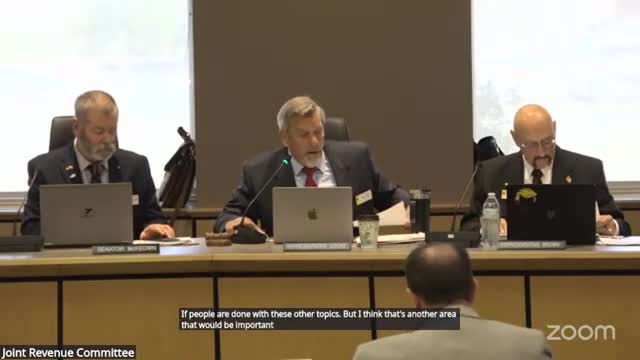
Members of the Joint Revenue Interim Committee reviewed implementation issues that arose after passage of recent residential property tax measures: the 4% cap on increases, the 25% homeowner exemption (senate file 69) and the 50% long‑term homeowner exemption. Department of Revenue staff and county assessors described operational challenges and proposed administrative fixes.
Department and assessor presenters summarized the program scale: county data showed more than 32,000 statewide applications for the long‑term homeowner exemption in 2025 and an estimated ~175,000 owner‑occupied homes in the state (census‑based estimate for context). The Department’s sheet showed a drop in total assessed (taxable) value from 2024 to 2025 of roughly $4,147,000,000 after applying the recent exemptions. Gill and assessors said the department initially delivered obsolescence and exemption materials in mixed formats; several committee members asked for spreadsheet (Excel/CSV) delivery for easier review.
The discussion identified recurring implementation issues: timing conflicts between the appraisal/abstract calendar and application deadlines; ambiguity about the eight‑month residency requirement for owner‑occupied status; situations where taxpayers applied for and were approved for exemptions and then sold the property before the tax year closed, producing proration disputes at closing; and examples of taxpayers who opted out of a 25% exemption because they qualified for homestead exemptions elsewhere.
County assessors asked the committee to consider moving some deadlines (for example, owner‑occupied certification) earlier in the cycle so assessors can process applications before taxing entities set levies. Dixie Huxtable, Converse County assessor, said assessors tried outreach (tax‑bill inserts, town halls) and that counties were willing to provide better documentation and to accept an affidavit process for renewals where appropriate. Laurie Herb Kite (Wyoming Realtors) explained a Park County sale in which a seller had applied and been approved for the long‑term homeowner exemption but sold the house in late May; the title closing did not credit the proration for the exemption because of timing and qualification questions, creating equity and process concerns.
Committee members asked the Department of Revenue and the assessors to examine whether the residency test should reference the prior tax year (to avoid the ‘‘I’ll live in it eight months later’’ ambiguity), whether deadlines (fourth Monday in May vs. March 1) should change, and whether a limited affidavit procedure could reduce administrative burden for renewals. The committee requested follow‑up data on how many transactions were impacted by the timing glitches and asked for evidence of administrative costs to counties where budgets were strained by additional processing demands. No formal statutory changes were made in this meeting; the department and assessors will return with recommended timing or rule clarifications for the committee’s next meeting.
Department and assessor presenters summarized the program scale: county data showed more than 32,000 statewide applications for the long‑term homeowner exemption in 2025 and an estimated ~175,000 owner‑occupied homes in the state (census‑based estimate for context). The Department’s sheet showed a drop in total assessed (taxable) value from 2024 to 2025 of roughly $4,147,000,000 after applying the recent exemptions. Gill and assessors said the department initially delivered obsolescence and exemption materials in mixed formats; several committee members asked for spreadsheet (Excel/CSV) delivery for easier review.
The discussion identified recurring implementation issues: timing conflicts between the appraisal/abstract calendar and application deadlines; ambiguity about the eight‑month residency requirement for owner‑occupied status; situations where taxpayers applied for and were approved for exemptions and then sold the property before the tax year closed, producing proration disputes at closing; and examples of taxpayers who opted out of a 25% exemption because they qualified for homestead exemptions elsewhere.
County assessors asked the committee to consider moving some deadlines (for example, owner‑occupied certification) earlier in the cycle so assessors can process applications before taxing entities set levies. Dixie Huxtable, Converse County assessor, said assessors tried outreach (tax‑bill inserts, town halls) and that counties were willing to provide better documentation and to accept an affidavit process for renewals where appropriate. Laurie Herb Kite (Wyoming Realtors) explained a Park County sale in which a seller had applied and been approved for the long‑term homeowner exemption but sold the house in late May; the title closing did not credit the proration for the exemption because of timing and qualification questions, creating equity and process concerns.
Committee members asked the Department of Revenue and the assessors to examine whether the residency test should reference the prior tax year (to avoid the ‘‘I’ll live in it eight months later’’ ambiguity), whether deadlines (fourth Monday in May vs. March 1) should change, and whether a limited affidavit procedure could reduce administrative burden for renewals. The committee requested follow‑up data on how many transactions were impacted by the timing glitches and asked for evidence of administrative costs to counties where budgets were strained by additional processing demands. No formal statutory changes were made in this meeting; the department and assessors will return with recommended timing or rule clarifications for the committee’s next meeting.
View the Full Meeting & All Its Details
This article offers just a summary. Unlock complete video, transcripts, and insights as a Founder Member.
✓
Watch full, unedited meeting videos
✓
Search every word spoken in unlimited transcripts
✓
AI summaries & real-time alerts (all government levels)
✓
Permanent access to expanding government content
30-day money-back guarantee
