Wyoming committee reviews state-property tax exemption after Supreme Court case and 2025 law change
August 22, 2025 | Revenue, Joint & Standing, Committees, Legislative, Wyoming
This article was created by AI summarizing key points discussed. AI makes mistakes, so for full details and context, please refer to the video of the full meeting. Please report any errors so we can fix them. Report an error »
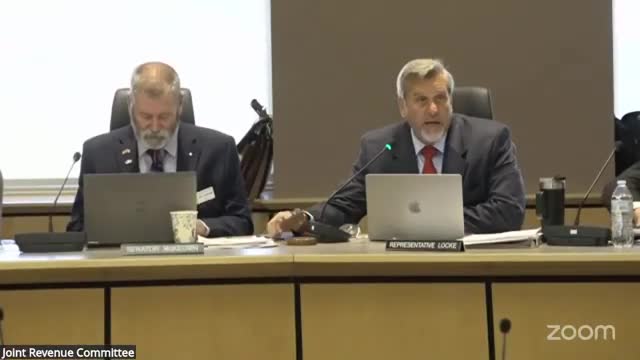
A Wyoming interim committee spent extended discussion time on whether property owned by government entities should be taxable and, if so, which parts — land or improvements — counties can assess. The review followed a Wyoming Supreme Court decision about a parcel held for a state hospital and a legislative response in 2025.
The court case involved a little over a 3-acre parcel of state land held for the state hospital that had been leased to a private party running a gas station since 1999. "The county assessor reclassified the land as taxable," said Josh Anderson of the Legislative Service Office, describing events, "and sent a tax assessment on the property in 2021, which was not appealed and was paid by the lessee. Then in 2022 [the county] sent another assessment that was appealed by the state." The court rejected the state's arguments for an implied exemption based on ownership or management and said exemptions must be expressly created by the legislature. Anderson summarized the legislative response: "The legislature passed Senate File 81 last year," adding that the bill created a temporary, express exemption for all state lands, and that change is scheduled to be repealed on 01/01/2027.
Why it matters: whether state-owned land used by private businesses — from truck stops on state grazing land to concession buildings on trust lands — is taxable affects county tax bases and local budgets. "Yes, mister chairman. I think with that, paragraph 46, that would make all the land exempt," Anderson told the committee about the 2025 language, while adding that "the county could still tax the improvement to the land, the gas station, but just not the underlying land that's owned by the state, at least until 01/01/2027." County assessors told the committee they generally tax improvements on state land that are not owned by the state, but they have lacked consistent statutory guidance and have avoided legal fights in some cases because local offices lack the resources for protracted litigation.
Local assessors and county officials testified that practice has varied across the state. Dixie Huxtable, a county assessor, said local offices "are currently taxing improvements on state land that are not owned by the state or used for a governmental purpose," and that historically assessors often did not pursue taxation when legal counsel would not take contested cases. Albany County Assessor Chelsea Matthews said an example of locally taxed state-adjacent property is Pilot Hill trail system land; she said the land was "currently exempt, but they do not charge a fee to enter as of right now." Committee members pressed for more detail about how often assessors treat land as untaxed and the number of similar lease arrangements statewide.
Several committee members urged the group to consider a uniform statutory definition of "governmental purpose" so that federal, state, county, municipal and school district exemptions follow the same standard. Anderson noted current statute treats these categories differently: federal and state lands are treated with lists of exclusions, municipalities have a list of things that are explicitly governmental, counties have a single-use test, and school districts have their own line. Ken Gill of the Property Tax Division described the mid-1950s constitutional change that required property to be "used for a governmental purpose" to qualify for exemption and said the Supreme Court's recent ruling effectively returned the issue to the legislature for definition.
What the committee directed: members asked assessors to provide more information on particular local examples (including hatcheries and wind-turbine sites on leased state land), and several lawmakers asked staff to locate prior bills and drafts that tried to define governmental purpose across property types. Committee members agreed to keep the topic on the agenda for further study and to review earlier legislative drafts that attempted to define "governmental purpose." No formal rule changes or votes were taken during the meeting.
Context and outstanding questions: the committee discussed grazing leases in particular: the 2025 law added grazing leases explicitly to the definition of a state governmental purpose and separately created a temporary, broad exemption for state land that is set to sunset on 01/01/2027. Several members asked how the repeal would affect municipalities and counties if no further legislative action occurs. Stakeholders — assessors, county attorneys, the Department of Revenue and the State Land Office — told the committee that cases are relatively few but legally complex, and that a single uniform definition would reduce inconsistent local treatment.
Ending: the committee did not adopt policy at the hearing but asked staff to gather additional data and prior bill language and signaled willingness to consider a broader statutory rewrite that would standardize the governmental-purpose test across all government-owned property.
The court case involved a little over a 3-acre parcel of state land held for the state hospital that had been leased to a private party running a gas station since 1999. "The county assessor reclassified the land as taxable," said Josh Anderson of the Legislative Service Office, describing events, "and sent a tax assessment on the property in 2021, which was not appealed and was paid by the lessee. Then in 2022 [the county] sent another assessment that was appealed by the state." The court rejected the state's arguments for an implied exemption based on ownership or management and said exemptions must be expressly created by the legislature. Anderson summarized the legislative response: "The legislature passed Senate File 81 last year," adding that the bill created a temporary, express exemption for all state lands, and that change is scheduled to be repealed on 01/01/2027.
Why it matters: whether state-owned land used by private businesses — from truck stops on state grazing land to concession buildings on trust lands — is taxable affects county tax bases and local budgets. "Yes, mister chairman. I think with that, paragraph 46, that would make all the land exempt," Anderson told the committee about the 2025 language, while adding that "the county could still tax the improvement to the land, the gas station, but just not the underlying land that's owned by the state, at least until 01/01/2027." County assessors told the committee they generally tax improvements on state land that are not owned by the state, but they have lacked consistent statutory guidance and have avoided legal fights in some cases because local offices lack the resources for protracted litigation.
Local assessors and county officials testified that practice has varied across the state. Dixie Huxtable, a county assessor, said local offices "are currently taxing improvements on state land that are not owned by the state or used for a governmental purpose," and that historically assessors often did not pursue taxation when legal counsel would not take contested cases. Albany County Assessor Chelsea Matthews said an example of locally taxed state-adjacent property is Pilot Hill trail system land; she said the land was "currently exempt, but they do not charge a fee to enter as of right now." Committee members pressed for more detail about how often assessors treat land as untaxed and the number of similar lease arrangements statewide.
Several committee members urged the group to consider a uniform statutory definition of "governmental purpose" so that federal, state, county, municipal and school district exemptions follow the same standard. Anderson noted current statute treats these categories differently: federal and state lands are treated with lists of exclusions, municipalities have a list of things that are explicitly governmental, counties have a single-use test, and school districts have their own line. Ken Gill of the Property Tax Division described the mid-1950s constitutional change that required property to be "used for a governmental purpose" to qualify for exemption and said the Supreme Court's recent ruling effectively returned the issue to the legislature for definition.
What the committee directed: members asked assessors to provide more information on particular local examples (including hatcheries and wind-turbine sites on leased state land), and several lawmakers asked staff to locate prior bills and drafts that tried to define governmental purpose across property types. Committee members agreed to keep the topic on the agenda for further study and to review earlier legislative drafts that attempted to define "governmental purpose." No formal rule changes or votes were taken during the meeting.
Context and outstanding questions: the committee discussed grazing leases in particular: the 2025 law added grazing leases explicitly to the definition of a state governmental purpose and separately created a temporary, broad exemption for state land that is set to sunset on 01/01/2027. Several members asked how the repeal would affect municipalities and counties if no further legislative action occurs. Stakeholders — assessors, county attorneys, the Department of Revenue and the State Land Office — told the committee that cases are relatively few but legally complex, and that a single uniform definition would reduce inconsistent local treatment.
Ending: the committee did not adopt policy at the hearing but asked staff to gather additional data and prior bill language and signaled willingness to consider a broader statutory rewrite that would standardize the governmental-purpose test across all government-owned property.
View the Full Meeting & All Its Details
This article offers just a summary. Unlock complete video, transcripts, and insights as a Founder Member.
✓
Watch full, unedited meeting videos
✓
Search every word spoken in unlimited transcripts
✓
AI summaries & real-time alerts (all government levels)
✓
Permanent access to expanding government content
30-day money-back guarantee
