Residents, education and local officials warn committee: deep property‑tax cuts threaten services
August 22, 2025 | Revenue, Joint & Standing, Committees, Legislative, Wyoming
This article was created by AI summarizing key points discussed. AI makes mistakes, so for full details and context, please refer to the video of the full meeting. Please report any errors so we can fix them. Report an error »
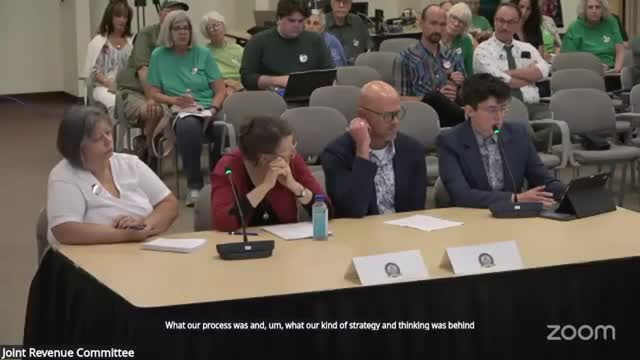
During public comment the Joint Revenue Interim Committee heard a string of residents, organizational representatives and local officials urge caution about additional property‑tax reductions and stress the role of property taxes in funding schools, public safety and local services.
Speakers described a range of community services funded largely by property taxes that would be affected by deeper cuts. Amber Pollock, Casper City Council, described Casper’s approach to its 2026 budget after state exemptions: city staff and council worked with assessors to estimate revenue loss, planned for a roughly $1.8 million general‑fund reduction and responded by leaving four full‑time positions unfunded, reducing seasonal park staffing by 50%, curtailing irrigation, fertilization and snow‑removal schedules in some parks, and trimming other discretionary services. "Our first step, to address the reduction in revenue, was to work diligently to get our numbers right," Pollock said, and she described the city’s efforts to avoid precipitate cuts while preserving core services.
Education representatives emphasized the legal and constitutional obligation to fund public education. Dirk Andrews, vice president, Wyoming Education Association, reminded the committee that the legislature is ultimately required to fully fund the foundation guarantee for districts and warned that lower property‑tax revenues shift more of the burden to the state general fund. "Education must be funded first to the level that is both adequate and equitable," Andrews said.
Several residents urged the committee to preserve senior services, libraries, parks and health‑care access. Speakers said they supported targeted exemptions for genuinely distressed homeowners but opposed broad, across‑the‑board reductions that would force local governments and school districts to cut services or draw down reserves. Some committee members and the co‑chair said prior exemptions were designed to target middle‑income homeowners and that follow‑on reforms could consider distributional effects; members encouraged continued public engagement and data‑driven analysis before further policy changes.
The committee did not take policy action at this hearing. Committee members acknowledged the public testimony and the city and education explanations and said they will continue to weigh revenue‑distribution and stability issues in subsequent meetings and draft language.
Speakers described a range of community services funded largely by property taxes that would be affected by deeper cuts. Amber Pollock, Casper City Council, described Casper’s approach to its 2026 budget after state exemptions: city staff and council worked with assessors to estimate revenue loss, planned for a roughly $1.8 million general‑fund reduction and responded by leaving four full‑time positions unfunded, reducing seasonal park staffing by 50%, curtailing irrigation, fertilization and snow‑removal schedules in some parks, and trimming other discretionary services. "Our first step, to address the reduction in revenue, was to work diligently to get our numbers right," Pollock said, and she described the city’s efforts to avoid precipitate cuts while preserving core services.
Education representatives emphasized the legal and constitutional obligation to fund public education. Dirk Andrews, vice president, Wyoming Education Association, reminded the committee that the legislature is ultimately required to fully fund the foundation guarantee for districts and warned that lower property‑tax revenues shift more of the burden to the state general fund. "Education must be funded first to the level that is both adequate and equitable," Andrews said.
Several residents urged the committee to preserve senior services, libraries, parks and health‑care access. Speakers said they supported targeted exemptions for genuinely distressed homeowners but opposed broad, across‑the‑board reductions that would force local governments and school districts to cut services or draw down reserves. Some committee members and the co‑chair said prior exemptions were designed to target middle‑income homeowners and that follow‑on reforms could consider distributional effects; members encouraged continued public engagement and data‑driven analysis before further policy changes.
The committee did not take policy action at this hearing. Committee members acknowledged the public testimony and the city and education explanations and said they will continue to weigh revenue‑distribution and stability issues in subsequent meetings and draft language.
Don't Miss a Word: See the Full Meeting!
Go beyond summaries. Unlock every video, transcript, and key insight with a Founder Membership.
✓
Get instant access to full meeting videos
✓
Search and clip any phrase from complete transcripts
✓
Receive AI-powered summaries & custom alerts
✓
Enjoy lifetime, unrestricted access to government data
30-day money-back guarantee
