Liberty County adopts development impact fee ordinance, sets $2,500 fee for single-family homes
August 22, 2025 | Liberty County, Georgia
This article was created by AI summarizing key points discussed. AI makes mistakes, so for full details and context, please refer to the video of the full meeting. Please report any errors so we can fix them. Report an error »
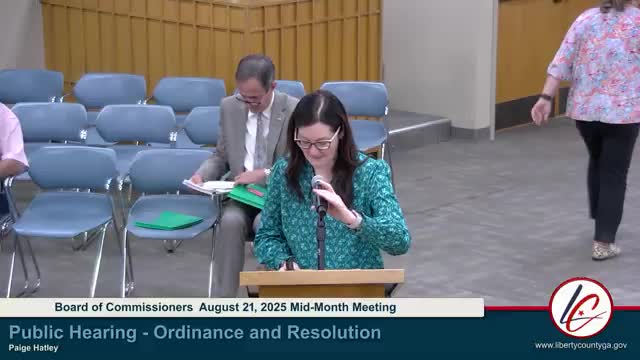
Liberty County's Board of Commissioners adopted a capital improvements element (CIE) and a development-impact-fee ordinance after a second required public hearing and a presentation from the county's consultant.
The ordinance inserts a fee schedule that sets a proposed $2,500 impact fee for a detached single-family home and applies pro rata reductions to other land-use fee calculations. The board included an effective date of Oct. 1, 2025, for collecting fees if a later administrative process and implementation steps are completed.
Why it matters: Development impact fees are a one-time charge on new development intended to help the county pay for growth-related capital improvements in parks, roads and public safety without raising the millage rate for existing taxpayers.
Paige Hatley, the consultant working with the county on the study, summarized the ordinance: "It's a 1 time fee that would be collected from new development to help pay for expanding public services in terms of parks, public safety, and roads," she said. Hatley and the advisory committee presented a recommended schedule based on regional comparisons and the county's capital needs.
Hatley noted the county compared neighboring programs; commissioners were shown a table of area fees and program adoptions. The advisory committee proposed the $2,500 figure after applying a uniform reduction from the calculated maximum fees tied to the projects listed in the CIE. Hatley said the ordinance includes a two-page fee schedule covering multiple residential and nonresidential land uses.
The board adopted the CIE first and then the ordinance, as required by state law; commissioners approved motions to adopt both documents following the public hearing. The ordinance includes standard administrative provisions required by Georgia's Development Impact Fee Act, reporting requirements and a fee-refund process in scenarios where a previously existing unit is removed.
County staff and consultants emphasized the fees apply only to new development: a relocated existing dwelling that does not increase the housing inventory would not trigger a fee, while a new rooftop would. The county will revisit the program periodically and can amend the ordinance following the statutorily required public-hearing process.
What happens next: County staff will finish implementation steps, which include administrative systems for fee collection and reporting. The board inserted an effective date of Oct. 1 to give staff time to set up procedures. Commissioners and staff said they expect to revisit the schedule as needed and to perform five-year reviews tied to comprehensive planning cycles.
The ordinance inserts a fee schedule that sets a proposed $2,500 impact fee for a detached single-family home and applies pro rata reductions to other land-use fee calculations. The board included an effective date of Oct. 1, 2025, for collecting fees if a later administrative process and implementation steps are completed.
Why it matters: Development impact fees are a one-time charge on new development intended to help the county pay for growth-related capital improvements in parks, roads and public safety without raising the millage rate for existing taxpayers.
Paige Hatley, the consultant working with the county on the study, summarized the ordinance: "It's a 1 time fee that would be collected from new development to help pay for expanding public services in terms of parks, public safety, and roads," she said. Hatley and the advisory committee presented a recommended schedule based on regional comparisons and the county's capital needs.
Hatley noted the county compared neighboring programs; commissioners were shown a table of area fees and program adoptions. The advisory committee proposed the $2,500 figure after applying a uniform reduction from the calculated maximum fees tied to the projects listed in the CIE. Hatley said the ordinance includes a two-page fee schedule covering multiple residential and nonresidential land uses.
The board adopted the CIE first and then the ordinance, as required by state law; commissioners approved motions to adopt both documents following the public hearing. The ordinance includes standard administrative provisions required by Georgia's Development Impact Fee Act, reporting requirements and a fee-refund process in scenarios where a previously existing unit is removed.
County staff and consultants emphasized the fees apply only to new development: a relocated existing dwelling that does not increase the housing inventory would not trigger a fee, while a new rooftop would. The county will revisit the program periodically and can amend the ordinance following the statutorily required public-hearing process.
What happens next: County staff will finish implementation steps, which include administrative systems for fee collection and reporting. The board inserted an effective date of Oct. 1 to give staff time to set up procedures. Commissioners and staff said they expect to revisit the schedule as needed and to perform five-year reviews tied to comprehensive planning cycles.
Don't Miss a Word: See the Full Meeting!
Go beyond summaries. Unlock every video, transcript, and key insight with a Founder Membership.
✓
Get instant access to full meeting videos
✓
Search and clip any phrase from complete transcripts
✓
Receive AI-powered summaries & custom alerts
✓
Enjoy lifetime, unrestricted access to government data
30-day money-back guarantee
