Deerfield Beach, Coconut Creek accept settlement limiting Monarch Hill expansion and securing monitoring and concessions
August 20, 2025 | Deerfield Beach City, Broward County, Florida
This article was created by AI summarizing key points discussed. AI makes mistakes, so for full details and context, please refer to the video of the full meeting. Please report any errors so we can fix them. Report an error »
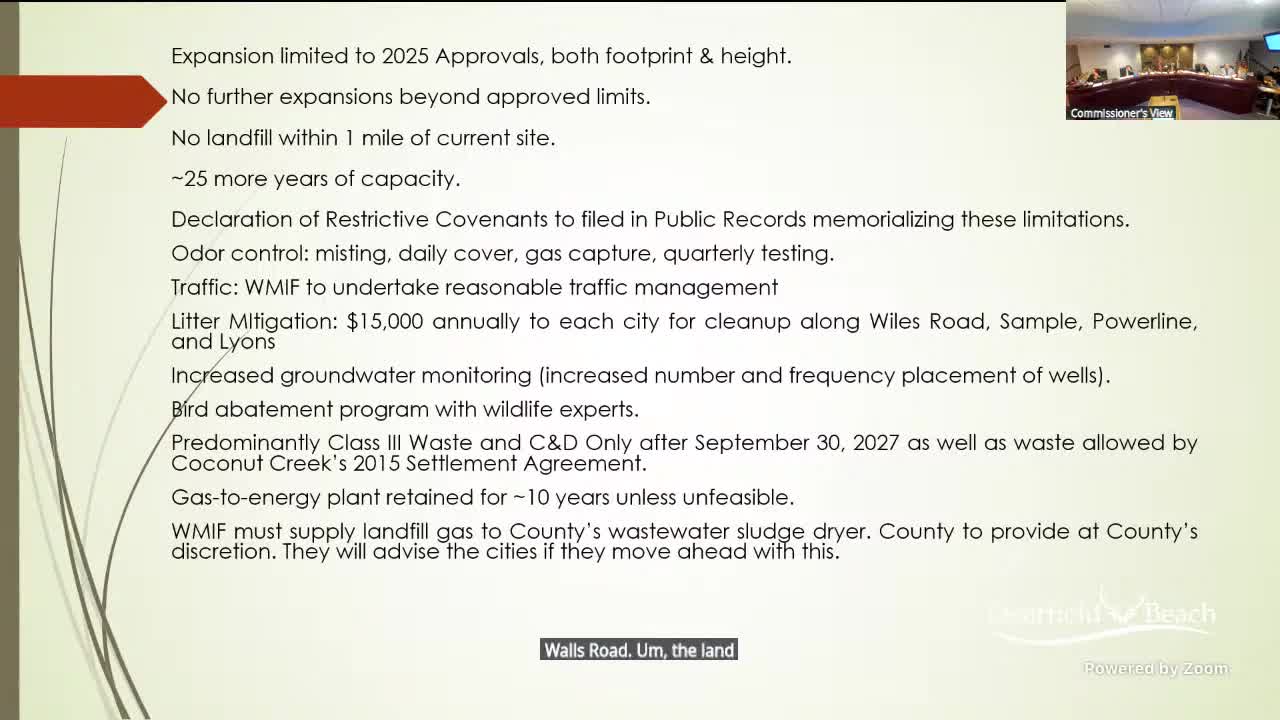
Deerfield Beach commissioners voted Aug. 19 to approve a settlement with Broward County and Waste Management Inc. of Florida over the proposed expansion of the Monarch Hill landfill. The settlement — negotiated with outside counsel and the neighboring City of Coconut Creek — imposes a series of concessions on Waste Management, limits future expansion and creates enforceable requirements intended to reduce environmental, visual and public-safety impacts on adjacent communities.
What the pact does: The agreement places a contractual ceiling on the landfill’s final elevation at 325 feet, prevents new landfilling within roughly a one-mile radius of the existing site, and establishes a post-closure planning requirement and an approximate closure horizon of about 25 years. The agreement also features a package of operational controls to address odor, litter, gas capture and monitoring, additional groundwater sampling and specified bird-abatement measures; the concessions exceed what would automatically be required under an unnegotiated permit, the city’s special counsel told commissioners.
Monetary and other commitments: As part of the settlement Deerfield Beach and Coconut Creek will be eligible for limited funds intended to mitigate local impacts. The agreement provides for an annual amount to the municipalities (the draft identifies $15,000 per year as a mitigation payment) plus an allocation of up to 5% of a county host charge that will be used for local impact projects. The settlement also includes restrictive covenants to be filed in public records; the cities — not the county or Waste Management — must agree to any future changes to those covenants.
Why city lawyers recommended settlement: Special litigation counsel Ralph DeMeo, who has litigated landfill cases across Florida, told the commission that large-scale legal challenges carry high costs and that prevailing at trial would not guarantee a better outcome. DeMeo and staff described the county’s planning and permitting authority as decisive because the landfill is located in unincorporated Broward County; he said the county could revise its rules if the litigation continued, likely diminishing the cities’ leverage. “Even if you win the battle … you will most likely lose the war,” DeMeo told the commission, arguing the negotiated package is the best obtainable result and contains several protections that would not be guaranteed in a trial victory.
Public reactions: Residents, city leaders and environmental advocates expressed mixed responses. Supporters said the settlement obtains enforceable concessions and a finite end-of-landfill horizon; others said the concessions do not go far enough, and several speakers urged continued vigilance and robust monitoring. Commissioner debate reflected the tension: some called the outcome a necessary compromise to avoid years of costly litigation with uncertain results; others described the agreement as a “bitter pill” forced by county politics and Waste Management’s leverage.
Vote and next steps: The commission approved the settlement by roll call; the mayor voted no while a majority of commissioners voted in favor. Adoption directs staff to execute settlement documents and to monitor performance; the settlement provides compliance and enforcement mechanisms, and the city will have rights to audit and request remedial action if conditions are not met. Both cities must dismiss pending appeals and administrative challenges as part of the agreement.
Bottom line: The settlement imposes a set of operational and land-use limits that the city’s counsel described as significant, but it closes a contentious local fight that city officials said left them with two options — a costly legal battle with uncertain prospects, or an enforceable agreement with concrete mitigations.
What the pact does: The agreement places a contractual ceiling on the landfill’s final elevation at 325 feet, prevents new landfilling within roughly a one-mile radius of the existing site, and establishes a post-closure planning requirement and an approximate closure horizon of about 25 years. The agreement also features a package of operational controls to address odor, litter, gas capture and monitoring, additional groundwater sampling and specified bird-abatement measures; the concessions exceed what would automatically be required under an unnegotiated permit, the city’s special counsel told commissioners.
Monetary and other commitments: As part of the settlement Deerfield Beach and Coconut Creek will be eligible for limited funds intended to mitigate local impacts. The agreement provides for an annual amount to the municipalities (the draft identifies $15,000 per year as a mitigation payment) plus an allocation of up to 5% of a county host charge that will be used for local impact projects. The settlement also includes restrictive covenants to be filed in public records; the cities — not the county or Waste Management — must agree to any future changes to those covenants.
Why city lawyers recommended settlement: Special litigation counsel Ralph DeMeo, who has litigated landfill cases across Florida, told the commission that large-scale legal challenges carry high costs and that prevailing at trial would not guarantee a better outcome. DeMeo and staff described the county’s planning and permitting authority as decisive because the landfill is located in unincorporated Broward County; he said the county could revise its rules if the litigation continued, likely diminishing the cities’ leverage. “Even if you win the battle … you will most likely lose the war,” DeMeo told the commission, arguing the negotiated package is the best obtainable result and contains several protections that would not be guaranteed in a trial victory.
Public reactions: Residents, city leaders and environmental advocates expressed mixed responses. Supporters said the settlement obtains enforceable concessions and a finite end-of-landfill horizon; others said the concessions do not go far enough, and several speakers urged continued vigilance and robust monitoring. Commissioner debate reflected the tension: some called the outcome a necessary compromise to avoid years of costly litigation with uncertain results; others described the agreement as a “bitter pill” forced by county politics and Waste Management’s leverage.
Vote and next steps: The commission approved the settlement by roll call; the mayor voted no while a majority of commissioners voted in favor. Adoption directs staff to execute settlement documents and to monitor performance; the settlement provides compliance and enforcement mechanisms, and the city will have rights to audit and request remedial action if conditions are not met. Both cities must dismiss pending appeals and administrative challenges as part of the agreement.
Bottom line: The settlement imposes a set of operational and land-use limits that the city’s counsel described as significant, but it closes a contentious local fight that city officials said left them with two options — a costly legal battle with uncertain prospects, or an enforceable agreement with concrete mitigations.
Don't Miss a Word: See the Full Meeting!
Go beyond summaries. Unlock every video, transcript, and key insight with a Founder Membership.
✓
Get instant access to full meeting videos
✓
Search and clip any phrase from complete transcripts
✓
Receive AI-powered summaries & custom alerts
✓
Enjoy lifetime, unrestricted access to government data
30-day money-back guarantee
