School board holds first reading of district cybersecurity, AI and cell‑phone policies after Governor Potek executive order
August 15, 2025 | Molalla River SD 35, School Districts, Oregon
This article was created by AI summarizing key points discussed. AI makes mistakes, so for full details and context, please refer to the video of the full meeting. Please report any errors so we can fix them. Report an error »
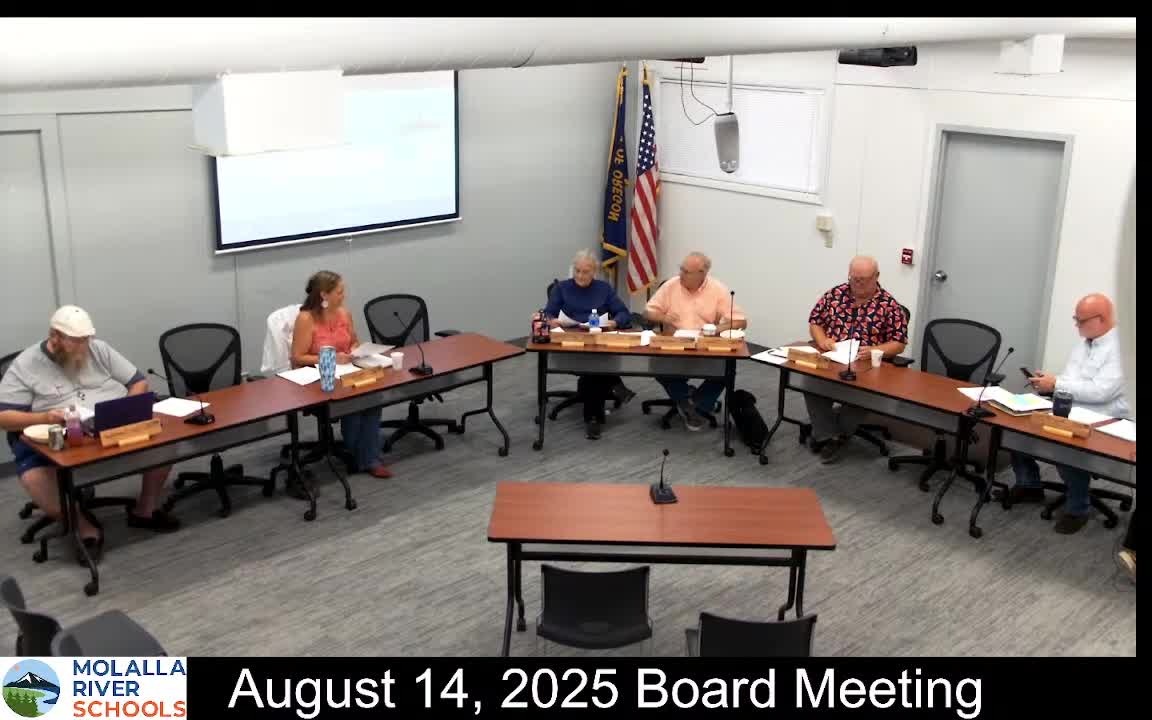
District staff presented a package of technology and safety policies during a first reading at the school board meeting, including a cybersecurity policy (EHB/EHB‑AR), electronic communication and device‑use rules (IBGA ARs), an AI use policy (IKJ and ARs) and a policy implementing a governor’s executive order banning personal electronic devices during instructional hours.
The policies were introduced as a first reading to give board members and the public an opportunity to comment before any formal action is taken. A staff presenter summarized the package and said, "This is the first reading of it so people can make their comments," and walked the board through key provisions.
The cybersecurity policy (EHB) sets out core principles — information confidentiality, integrity and availability — and the accompanying EHB‑AR positions staff responsibilities on data protection, password confidentiality and reporting suspected breaches. The staff presenter said EHB/EHB‑AR "applies broadly to all staff third party agents and district affiliates, including students." The board was told the staff rules emphasize compliance with laws on student records and privacy.
The electronic communications materials (IBGA ARs) cover both staff and student conduct online, a district technology user agreement for staff and separate student agreements (including a Chromebook contract). The presenter described the communications rules as prioritizing student welfare, data security, responsible digital citizenship and consequences for violations.
The district’s AI policy (IKJ and ARs) was presented as guidance for staff and students, noting AI "is a useful tool" while flagging compliance, risks and limits on academic use; the presenter said separate ARs clarify staff use and student expectations for AI in classwork.
The most discussed item was a policy to implement an executive order from Governor Potek that would prohibit personal electronic devices (PEDs) from "the start of regular instruction hours until the end of regular instruction hours." The packet included an exemption form. Under the proposed exemption process, the form is not required when the reason is already included in a student’s individualized education program (IEP) or in a Section 504 education plan; medical orders must be attached for medically required device use. Temporary nonmedical exemptions may be requested for documented, short‑term individual circumstances and must be approved by the principal; any device used under an approved personalized plan would be restricted to the main office or counseling office.
Board members raised practical questions about implementation. One member asked whether the five‑school‑day reference in the form and a separate 10‑day appeals window applied to "school days" or calendar days; another suggested an appeal period tied to consecutive school days (for example, 10 consecutive school days) to avoid ambiguity around breaks. A board member noted that some districts plan to secure devices in a locked location, while others are adopting a put‑away approach that leaves devices on the student but inaccessible.
Several board members and directors emphasized that the policy is being presented in response to the governor’s executive order rather than as a locally initiated change. A board member said implementation may be challenging, that parents will have concerns about communication, and that the district’s approach of allowing phones to remain on students but stored away might ease some concerns.
No vote was taken; staff and board members framed this as a policy first reading and signaled the board may revise the language after feedback. The presenter and board members flagged the need to clarify appeal timelines, the role of principals in exemption decisions, and how the district will communicate the changes to families and staff before the start of the school year.
The district will return the policies for further consideration and potential revision; board members asked staff to track operational issues and report back if the district needs changes after implementation.
The policies were introduced as a first reading to give board members and the public an opportunity to comment before any formal action is taken. A staff presenter summarized the package and said, "This is the first reading of it so people can make their comments," and walked the board through key provisions.
The cybersecurity policy (EHB) sets out core principles — information confidentiality, integrity and availability — and the accompanying EHB‑AR positions staff responsibilities on data protection, password confidentiality and reporting suspected breaches. The staff presenter said EHB/EHB‑AR "applies broadly to all staff third party agents and district affiliates, including students." The board was told the staff rules emphasize compliance with laws on student records and privacy.
The electronic communications materials (IBGA ARs) cover both staff and student conduct online, a district technology user agreement for staff and separate student agreements (including a Chromebook contract). The presenter described the communications rules as prioritizing student welfare, data security, responsible digital citizenship and consequences for violations.
The district’s AI policy (IKJ and ARs) was presented as guidance for staff and students, noting AI "is a useful tool" while flagging compliance, risks and limits on academic use; the presenter said separate ARs clarify staff use and student expectations for AI in classwork.
The most discussed item was a policy to implement an executive order from Governor Potek that would prohibit personal electronic devices (PEDs) from "the start of regular instruction hours until the end of regular instruction hours." The packet included an exemption form. Under the proposed exemption process, the form is not required when the reason is already included in a student’s individualized education program (IEP) or in a Section 504 education plan; medical orders must be attached for medically required device use. Temporary nonmedical exemptions may be requested for documented, short‑term individual circumstances and must be approved by the principal; any device used under an approved personalized plan would be restricted to the main office or counseling office.
Board members raised practical questions about implementation. One member asked whether the five‑school‑day reference in the form and a separate 10‑day appeals window applied to "school days" or calendar days; another suggested an appeal period tied to consecutive school days (for example, 10 consecutive school days) to avoid ambiguity around breaks. A board member noted that some districts plan to secure devices in a locked location, while others are adopting a put‑away approach that leaves devices on the student but inaccessible.
Several board members and directors emphasized that the policy is being presented in response to the governor’s executive order rather than as a locally initiated change. A board member said implementation may be challenging, that parents will have concerns about communication, and that the district’s approach of allowing phones to remain on students but stored away might ease some concerns.
No vote was taken; staff and board members framed this as a policy first reading and signaled the board may revise the language after feedback. The presenter and board members flagged the need to clarify appeal timelines, the role of principals in exemption decisions, and how the district will communicate the changes to families and staff before the start of the school year.
The district will return the policies for further consideration and potential revision; board members asked staff to track operational issues and report back if the district needs changes after implementation.
View the Full Meeting & All Its Details
This article offers just a summary. Unlock complete video, transcripts, and insights as a Founder Member.
✓
Watch full, unedited meeting videos
✓
Search every word spoken in unlimited transcripts
✓
AI summaries & real-time alerts (all government levels)
✓
Permanent access to expanding government content
30-day money-back guarantee
