Talent council asks staff to draft chronic nuisance ordinance after police describe repeat problem properties
July 02, 2025 | Talent, Jackson County, Oregon
This article was created by AI summarizing key points discussed. AI makes mistakes, so for full details and context, please refer to the video of the full meeting. Please report any errors so we can fix them. Report an error »
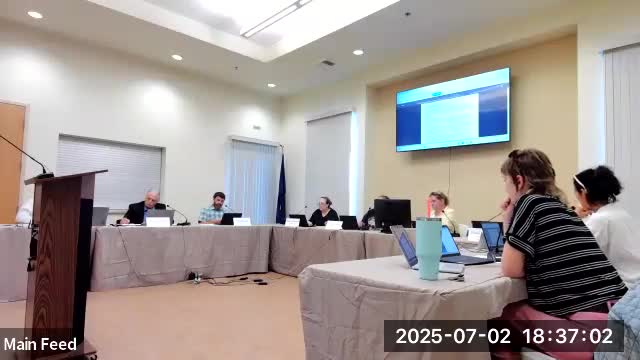
Alex, a city staff member, introduced a staff report on chronic nuisance ordinances and said, “the Oregon statute provides for individuals or local governments to be able to bring a civil suit against people who own or operate a residence that is becoming a a real nuisance to their neighbors.” He explained that a local ordinance can expand the list of conduct counted toward a nuisance and set procedures for warnings and abatement plans.
The nut graf: After a presentation and discussion that included the police chief and the city attorney, the council signaled consensus to direct staff to draft a chronic nuisance ordinance; councilors also raised concerns about administrative burden and potential impacts on vulnerable residents.
Police Chief Snook described recurring problem properties that generate frequent calls for service, saying, “there's a handful of properties that would, really would fall under some sort of chronic nuisance code.” She recounted that officers sometimes contact property owners who are unaware of activity at the residence and that in other cases property owners have not taken action and neighbors report fear for their safety.
Chief Snook and Alex described enforcement as primarily compliance‑focused: the city typically seeks voluntary compliance and issues relatively few code citations. Alex summarized remedies available under an ordinance and in court: temporary closure of a property, fines, and recovery of city abatement costs.
City Attorney Dave Lohman explained the likely role of the city attorney if the city pursues a case. “I do think, an important question is who bears the burden of going to court,” Lohman said, and he noted that bringing a chronic nuisance action would require the city attorney to file and prosecute a civil action, which could consume staff time. He and staff emphasized that many cases still resolve after administrative warning letters; staff cited the City of Ashland’s long‑standing chronic nuisance ordinance and its experience that a chief’s letter often produces compliance.
Councilors asked several clarifying questions and expressed concerns. One councilor flagged the risk that nuisance ordinances can disproportionately affect vulnerable residents or group homes and asked that the draft guard against unfair impact. Councilors asked staff to consider multiple avenues toward compliance (warnings, abatement plans, targeted support) and to track how often such cases proceed to court. Several speakers emphasized that the tool should be used when repeated behavior creates real livability or safety issues rather than as the first response to neighbor complaints.
The council did not adopt an ordinance at this meeting. By consensus the council asked staff (city attorney and police) to prepare a draft chronic nuisance ordinance for future council consideration.
Ending: Staff will prepare a draft ordinance for council review; when the draft returns the council requested detail on thresholds for notice versus immediate action, administrative burden, protections for vulnerable residents, and historical data on comparable cases.
The nut graf: After a presentation and discussion that included the police chief and the city attorney, the council signaled consensus to direct staff to draft a chronic nuisance ordinance; councilors also raised concerns about administrative burden and potential impacts on vulnerable residents.
Police Chief Snook described recurring problem properties that generate frequent calls for service, saying, “there's a handful of properties that would, really would fall under some sort of chronic nuisance code.” She recounted that officers sometimes contact property owners who are unaware of activity at the residence and that in other cases property owners have not taken action and neighbors report fear for their safety.
Chief Snook and Alex described enforcement as primarily compliance‑focused: the city typically seeks voluntary compliance and issues relatively few code citations. Alex summarized remedies available under an ordinance and in court: temporary closure of a property, fines, and recovery of city abatement costs.
City Attorney Dave Lohman explained the likely role of the city attorney if the city pursues a case. “I do think, an important question is who bears the burden of going to court,” Lohman said, and he noted that bringing a chronic nuisance action would require the city attorney to file and prosecute a civil action, which could consume staff time. He and staff emphasized that many cases still resolve after administrative warning letters; staff cited the City of Ashland’s long‑standing chronic nuisance ordinance and its experience that a chief’s letter often produces compliance.
Councilors asked several clarifying questions and expressed concerns. One councilor flagged the risk that nuisance ordinances can disproportionately affect vulnerable residents or group homes and asked that the draft guard against unfair impact. Councilors asked staff to consider multiple avenues toward compliance (warnings, abatement plans, targeted support) and to track how often such cases proceed to court. Several speakers emphasized that the tool should be used when repeated behavior creates real livability or safety issues rather than as the first response to neighbor complaints.
The council did not adopt an ordinance at this meeting. By consensus the council asked staff (city attorney and police) to prepare a draft chronic nuisance ordinance for future council consideration.
Ending: Staff will prepare a draft ordinance for council review; when the draft returns the council requested detail on thresholds for notice versus immediate action, administrative burden, protections for vulnerable residents, and historical data on comparable cases.
Don't Miss a Word: See the Full Meeting!
Go beyond summaries. Unlock every video, transcript, and key insight with a Founder Membership.
✓
Get instant access to full meeting videos
✓
Search and clip any phrase from complete transcripts
✓
Receive AI-powered summaries & custom alerts
✓
Enjoy lifetime, unrestricted access to government data
30-day money-back guarantee
