Delegates, residents debate regional real estate transfer fee to fund Cape Cod housing
August 21, 2025 | Barnstable County, Massachusetts
This article was created by AI summarizing key points discussed. AI makes mistakes, so for full details and context, please refer to the video of the full meeting. Please report any errors so we can fix them. Report an error »
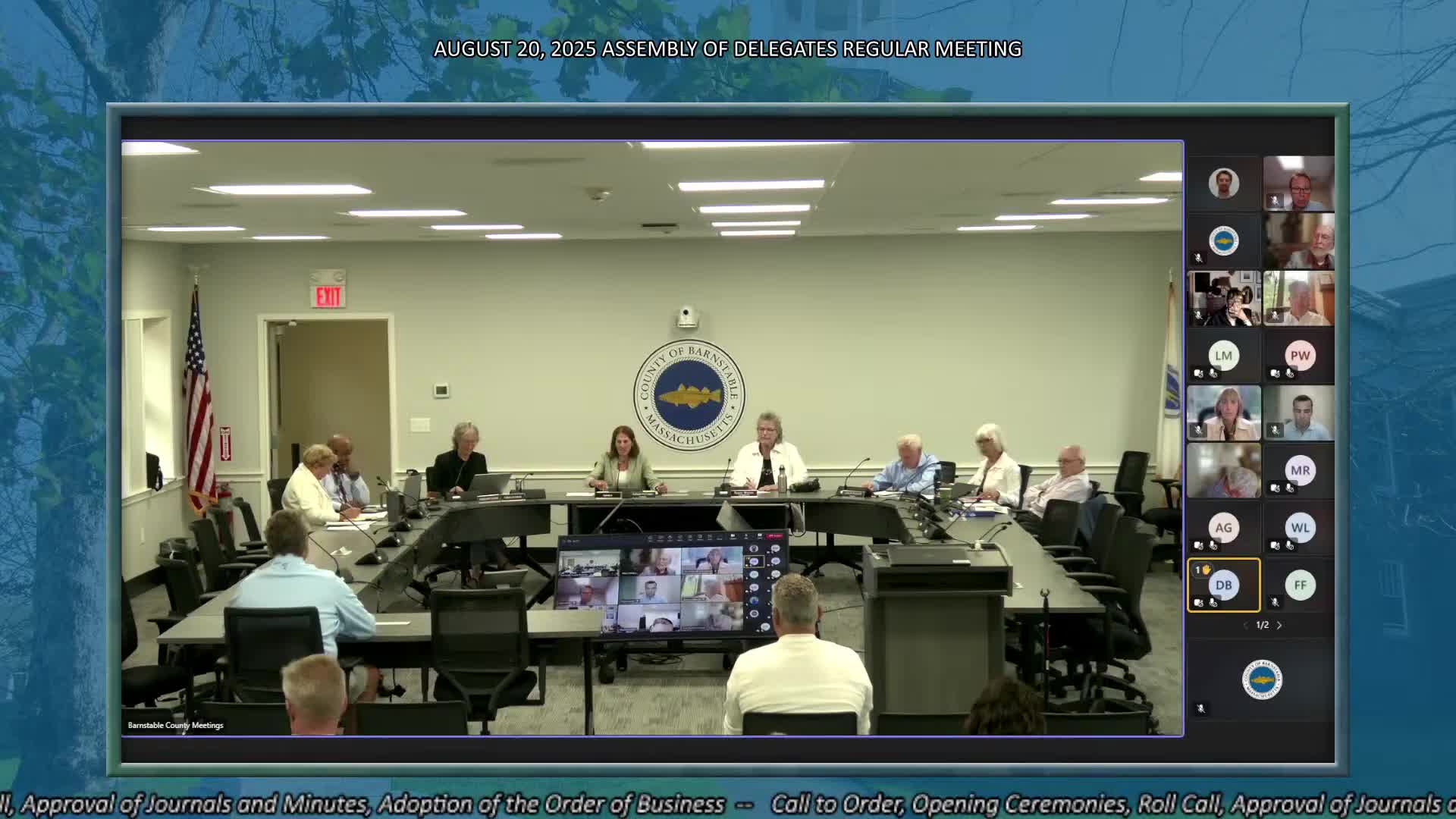
At the Aug. 20, 2025 meeting of the Cape Cod Regional Government Assembly of Delegates, delegates and more than a half-dozen public speakers discussed a proposal to seek state permission for a regional real estate transfer fee that proponents say could fund affordable and workforce housing across the Cape.
Supporters told the assembly the fee could provide a new, steady funding stream for local housing trusts and projects, while critics and nonprofit and environmental speakers urged strict limits on where and how the money would be used. Administrator Michael Dutton told delegates the effort would require both a state home rule petition and a county ordinance; he said the proposal is at an early stage and would require extensive town-by-town coordination.
The proposal discussed would assess a small percentage fee on residential sales above a to-be-determined dollar threshold; public speakers repeatedly cited a 2% example and $2,000,000 sales thresholds that are under discussion. John Terrio, a select board member in the town of Dex, told the assembly he learned of the idea from an email distributed by the Housing Assistance Corporation and offered an early data point: “in 02/2024, there were plus or minus 282 transactions over 2,000,000,” and year-to-date figures “exceed 450 transactions” when combined with 2024 numbers. Terrio said that, based on those transactions, “that’s a ton of money” if a fee is imposed and returned to home towns.
Administrator Michael Dutton described the statutory and local steps delegates would need to take. “So, essentially, it’s it’s a 2 step or a 2, a 2 pieces of legislation, 1 for the state and 1 for us locally here,” he said, explaining that a home rule petition to the Massachusetts legislature would be needed to authorize the county to collect a fee and that the county would then create a local housing trust or bank to receive and distribute revenues. Dutton said the assembly will need to choose details such as the fee rate, the sales threshold, statutory exemptions (for example family transfers and deed-restricted sales) and whether towns may opt in or opt out.
Speakers representing different interests urged the assembly to build safeguards into any program. Andrew Gottlieb, executive director of the Association to Preserve Cape Cod, asked that “the creation and allocation of a subsidy pool be used to reward and incentivize development that reflects the type of development that the Cape Cod Commission calls for” and urged protections to keep funds from subsidizing development in critical habitat and undeveloped green space. Laura Moynihan of the Falmouth Housing Trust said additional predictable funding is critical for project planning: “Project developers need to know that this type of funding source is available . . . the first step in development of affordable housing is to always verify your funding sources.”
Small builders and local officials urged attention to how funds and grants will be disbursed. Carlos Barbosa, a Hyannis small developer, warned that the region’s higher construction costs and higher interest rates have locked small builders out of grant access and urged that any regional program be structured so small developers can compete for funding. Douglas Brown, a select board member who spoke by phone, urged coordination with towns and suggested a regional model that towns can follow.
Delegates questioned feasibility and next steps. Deputy Speaker Dale Gessen and others asked whether a home rule petition must include exact rate, threshold and collection mechanics to have traction at the statehouse. Dutton responded that, while the legislature does not strictly require every operational detail, “if you have some hope of securing a vote from the legislature, then you’d have to establish those things within that petition,” and he advised delegates to coordinate closely with their select boards and the county’s state delegation.
No formal motion, vote or ordinance was adopted at the Aug. 20 assembly meeting. Delegates and staff said more work is needed: public comment and town select boards must be consulted, legal drafting must be completed, and the assembly would need to decide distribution rules if revenues are collected. “I will say, it’s incumbent on the delegates to go back to your towns, go back to your select boards,” Dutton told the assembly.
If delegates choose to proceed, the path Dutton described would require (1) a home rule petition to the Massachusetts legislature authorizing a transfer fee (with rate, threshold and exemptions to be decided) and (2) a county ordinance to create a county-level housing trust or bank and a distribution formula. The assembly’s standing committee on economic affairs reported that it has begun discussions and plans further expert briefings before drafting any petition or ordinance.
Supporters told the assembly the fee could provide a new, steady funding stream for local housing trusts and projects, while critics and nonprofit and environmental speakers urged strict limits on where and how the money would be used. Administrator Michael Dutton told delegates the effort would require both a state home rule petition and a county ordinance; he said the proposal is at an early stage and would require extensive town-by-town coordination.
The proposal discussed would assess a small percentage fee on residential sales above a to-be-determined dollar threshold; public speakers repeatedly cited a 2% example and $2,000,000 sales thresholds that are under discussion. John Terrio, a select board member in the town of Dex, told the assembly he learned of the idea from an email distributed by the Housing Assistance Corporation and offered an early data point: “in 02/2024, there were plus or minus 282 transactions over 2,000,000,” and year-to-date figures “exceed 450 transactions” when combined with 2024 numbers. Terrio said that, based on those transactions, “that’s a ton of money” if a fee is imposed and returned to home towns.
Administrator Michael Dutton described the statutory and local steps delegates would need to take. “So, essentially, it’s it’s a 2 step or a 2, a 2 pieces of legislation, 1 for the state and 1 for us locally here,” he said, explaining that a home rule petition to the Massachusetts legislature would be needed to authorize the county to collect a fee and that the county would then create a local housing trust or bank to receive and distribute revenues. Dutton said the assembly will need to choose details such as the fee rate, the sales threshold, statutory exemptions (for example family transfers and deed-restricted sales) and whether towns may opt in or opt out.
Speakers representing different interests urged the assembly to build safeguards into any program. Andrew Gottlieb, executive director of the Association to Preserve Cape Cod, asked that “the creation and allocation of a subsidy pool be used to reward and incentivize development that reflects the type of development that the Cape Cod Commission calls for” and urged protections to keep funds from subsidizing development in critical habitat and undeveloped green space. Laura Moynihan of the Falmouth Housing Trust said additional predictable funding is critical for project planning: “Project developers need to know that this type of funding source is available . . . the first step in development of affordable housing is to always verify your funding sources.”
Small builders and local officials urged attention to how funds and grants will be disbursed. Carlos Barbosa, a Hyannis small developer, warned that the region’s higher construction costs and higher interest rates have locked small builders out of grant access and urged that any regional program be structured so small developers can compete for funding. Douglas Brown, a select board member who spoke by phone, urged coordination with towns and suggested a regional model that towns can follow.
Delegates questioned feasibility and next steps. Deputy Speaker Dale Gessen and others asked whether a home rule petition must include exact rate, threshold and collection mechanics to have traction at the statehouse. Dutton responded that, while the legislature does not strictly require every operational detail, “if you have some hope of securing a vote from the legislature, then you’d have to establish those things within that petition,” and he advised delegates to coordinate closely with their select boards and the county’s state delegation.
No formal motion, vote or ordinance was adopted at the Aug. 20 assembly meeting. Delegates and staff said more work is needed: public comment and town select boards must be consulted, legal drafting must be completed, and the assembly would need to decide distribution rules if revenues are collected. “I will say, it’s incumbent on the delegates to go back to your towns, go back to your select boards,” Dutton told the assembly.
If delegates choose to proceed, the path Dutton described would require (1) a home rule petition to the Massachusetts legislature authorizing a transfer fee (with rate, threshold and exemptions to be decided) and (2) a county ordinance to create a county-level housing trust or bank and a distribution formula. The assembly’s standing committee on economic affairs reported that it has begun discussions and plans further expert briefings before drafting any petition or ordinance.
View the Full Meeting & All Its Details
This article offers just a summary. Unlock complete video, transcripts, and insights as a Founder Member.
✓
Watch full, unedited meeting videos
✓
Search every word spoken in unlimited transcripts
✓
AI summaries & real-time alerts (all government levels)
✓
Permanent access to expanding government content
30-day money-back guarantee
