Bonner County planners debate matrix, densities and whether to formally add an industrial land-use designation
September 05, 2025 | Bonner County, Idaho
This article was created by AI summarizing key points discussed. AI makes mistakes, so for full details and context, please refer to the video of the full meeting. Please report any errors so we can fix them. Report an error »
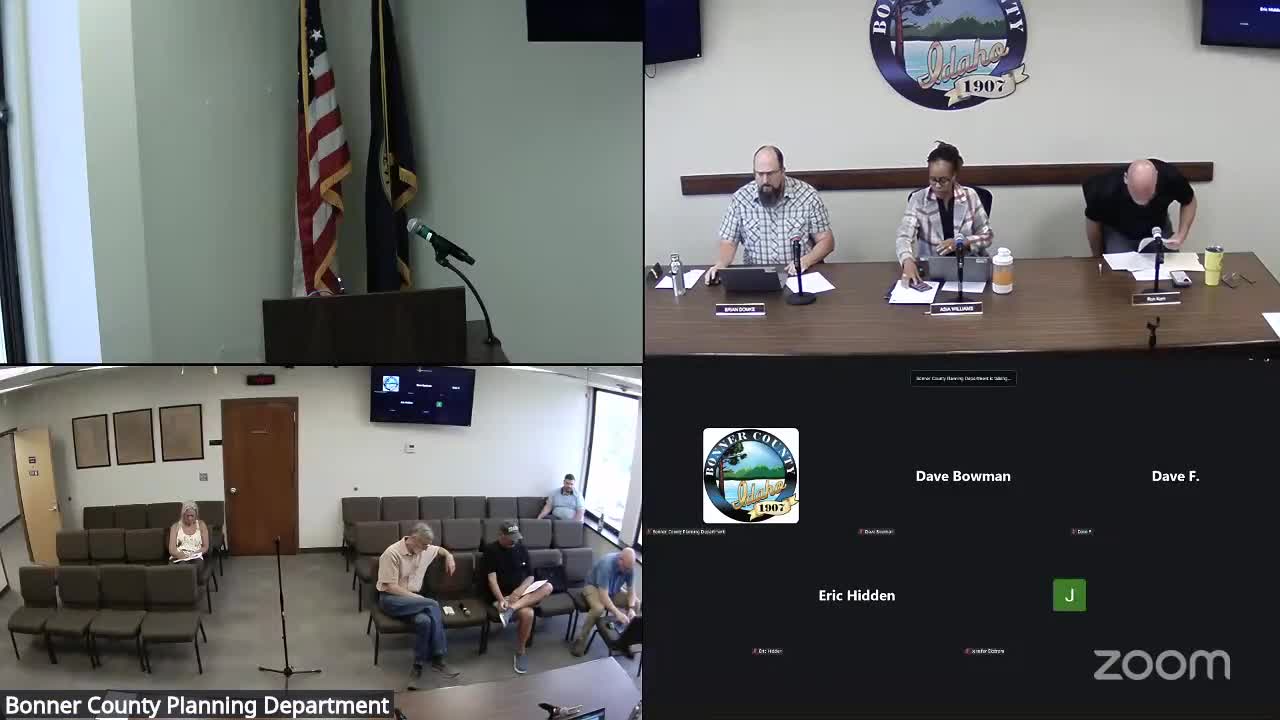
Bonner County planning commissioners and staff spent much of a workshop debating whether the draft comprehensive plan should include a compact “matrix” of land-use characteristics, how to describe residential densities for ‘suburban’ and other designations, and whether the county should add a separate industrial land-use designation or retain industrial uses inside a revised mixed-use designation. Brian, Planning staff member, opened the discussion by summarizing written comments from the Planning Commission, saying that “when he says ‘we’ of course he’s speaking for the Planning Commission — we eliminated the matrix because of a concern that the public could focus on the abbreviated uses and density in lieu of relying on the actual zoning code.”
Why it matters: the county’s comprehensive plan will guide future zoning changes, permit decisions and where industrial or higher-density residential growth could occur. Commissioners warned that an overly specific table could produce apparent conflicts with the zoning code, and that unclear density language could mislead residents about minimums or maximums.
Discussion and main points
Staff and commissioners debated two principal issues: (1) whether a quick-reference table (matrix) helps or hinders public understanding and (2) whether industrial should be a separate land-use designation or be addressed inside a clarified mixed-use designation with clear buffering and design standards. Several commissioners and attendees said a matrix can be a helpful quick reference if it does not rephrase or truncate the longer narrative in ways that create apparent conflicts with the zoning code. Don Davis noted that prior matrices “very much truncated what was in the total language” and led to confusion in past zone-change hearings when text and table appeared inconsistent. Alan, Commenter, urged removing density numbers from any matrix and instead referencing the zoning code for numeric standards: “if you do any more than that, it’s just gonna be a problem.”
On densities, participants repeatedly said that the plan’s land-use labels should express guardrails, not replicate or freeze current zoning limits. Multiple participants referenced a commonly cited threshold: ‘‘suburban’’ being associated with lot sizes down to roughly 2.5 acres where on‑site septic is expected, while ‘‘rural residential’’ commonly uses a 5‑acre minimum. Dave Bowman said the 2.5‑acre threshold reflects service constraints: “to have an effective septic system… 2 and a half acres is kind of the best we can do.” Several speakers emphasized that those are minimums, not maximums; Matt Linscott noted the old matrix’s “0 to 2.5 acres” phrasing had led people to think parcels larger than that could not be designated suburban.
On industrial versus mixed use and buffering, speakers were divided. Some, including Commissioner Donke and others, proposed a distinct industrial designation to make clear where heavy or light industrial uses should be located and to define criteria for those locations. Others worried a separate designation would be difficult to map and could unnecessarily constrain future economic development. Frank Frankenbach and others argued that strict layering of land‑use designations to create buffers — e.g., requiring a ring of nonresidential categories between heavy industry and housing — could make it difficult to site new industrial uses in a county with many existing nonconforming industrial uses (sawmills, gravel pits). As one participant put it, many existing industrial activities are already adjacent to residences (for example, the sawmill in Laclede), so requiring idealized buffers everywhere may be impractical.
Several participants recommended a middle path: retain industrial uses in a clarified mixed-use designation but add clear policy-level standards for buffering, setbacks and design (and, where appropriate, point readers to the specific zoning code sections for numerical density standards). Brian summarized the group’s direction near the meeting’s end: from what he heard, the group would “eliminate the proposal [for a new standalone industrial zone], but to spend the time needed to redefine the mixed use to be sure that we are not going to end up with a scenario where we’re putting zone districts of having industrial right next to residential because we don’t have clear enough definition of appropriate design standards, buffering, setbacks, and things of that nature.”
Next steps and procedural direction
The commissioners directed staff to return to the next workshop and proceed top-to-bottom through the land‑use component’s text, refining mixed‑use language, adding policy statements on buffering and setbacks, and ensuring the comprehensive-plan language points readers to the applicable zoning code sections for numeric limits. Staff said some subarea plans (for example, the Blanchard / Priest River discussion including Bodie Canyon Road) have already identified candidate industrial areas and that mapping of industrial where appropriate could be revisited through subarea-plan or map work.
Ending
The board scheduled continuation of the land‑use component review at the next workshop, with staff presenting section-by-section and the commission taking public comment on each section as it is discussed. The group’s working direction was to avoid reintroducing a separate industrial land‑use designation at this time and instead strengthen mixed‑use policy language, buffering criteria and references to the zoning code so the comp plan guides, but does not conflict with, later zoning actions.
Why it matters: the county’s comprehensive plan will guide future zoning changes, permit decisions and where industrial or higher-density residential growth could occur. Commissioners warned that an overly specific table could produce apparent conflicts with the zoning code, and that unclear density language could mislead residents about minimums or maximums.
Discussion and main points
Staff and commissioners debated two principal issues: (1) whether a quick-reference table (matrix) helps or hinders public understanding and (2) whether industrial should be a separate land-use designation or be addressed inside a clarified mixed-use designation with clear buffering and design standards. Several commissioners and attendees said a matrix can be a helpful quick reference if it does not rephrase or truncate the longer narrative in ways that create apparent conflicts with the zoning code. Don Davis noted that prior matrices “very much truncated what was in the total language” and led to confusion in past zone-change hearings when text and table appeared inconsistent. Alan, Commenter, urged removing density numbers from any matrix and instead referencing the zoning code for numeric standards: “if you do any more than that, it’s just gonna be a problem.”
On densities, participants repeatedly said that the plan’s land-use labels should express guardrails, not replicate or freeze current zoning limits. Multiple participants referenced a commonly cited threshold: ‘‘suburban’’ being associated with lot sizes down to roughly 2.5 acres where on‑site septic is expected, while ‘‘rural residential’’ commonly uses a 5‑acre minimum. Dave Bowman said the 2.5‑acre threshold reflects service constraints: “to have an effective septic system… 2 and a half acres is kind of the best we can do.” Several speakers emphasized that those are minimums, not maximums; Matt Linscott noted the old matrix’s “0 to 2.5 acres” phrasing had led people to think parcels larger than that could not be designated suburban.
On industrial versus mixed use and buffering, speakers were divided. Some, including Commissioner Donke and others, proposed a distinct industrial designation to make clear where heavy or light industrial uses should be located and to define criteria for those locations. Others worried a separate designation would be difficult to map and could unnecessarily constrain future economic development. Frank Frankenbach and others argued that strict layering of land‑use designations to create buffers — e.g., requiring a ring of nonresidential categories between heavy industry and housing — could make it difficult to site new industrial uses in a county with many existing nonconforming industrial uses (sawmills, gravel pits). As one participant put it, many existing industrial activities are already adjacent to residences (for example, the sawmill in Laclede), so requiring idealized buffers everywhere may be impractical.
Several participants recommended a middle path: retain industrial uses in a clarified mixed-use designation but add clear policy-level standards for buffering, setbacks and design (and, where appropriate, point readers to the specific zoning code sections for numerical density standards). Brian summarized the group’s direction near the meeting’s end: from what he heard, the group would “eliminate the proposal [for a new standalone industrial zone], but to spend the time needed to redefine the mixed use to be sure that we are not going to end up with a scenario where we’re putting zone districts of having industrial right next to residential because we don’t have clear enough definition of appropriate design standards, buffering, setbacks, and things of that nature.”
Next steps and procedural direction
The commissioners directed staff to return to the next workshop and proceed top-to-bottom through the land‑use component’s text, refining mixed‑use language, adding policy statements on buffering and setbacks, and ensuring the comprehensive-plan language points readers to the applicable zoning code sections for numeric limits. Staff said some subarea plans (for example, the Blanchard / Priest River discussion including Bodie Canyon Road) have already identified candidate industrial areas and that mapping of industrial where appropriate could be revisited through subarea-plan or map work.
Ending
The board scheduled continuation of the land‑use component review at the next workshop, with staff presenting section-by-section and the commission taking public comment on each section as it is discussed. The group’s working direction was to avoid reintroducing a separate industrial land‑use designation at this time and instead strengthen mixed‑use policy language, buffering criteria and references to the zoning code so the comp plan guides, but does not conflict with, later zoning actions.
Don't Miss a Word: See the Full Meeting!
Go beyond summaries. Unlock every video, transcript, and key insight with a Founder Membership.
✓
Get instant access to full meeting videos
✓
Search and clip any phrase from complete transcripts
✓
Receive AI-powered summaries & custom alerts
✓
Enjoy lifetime, unrestricted access to government data
30-day money-back guarantee
