Public commenter questions legality of ex parte‑communication rules and Water Code section 13287 guidance
September 05, 2025 | State Water Resources Control Board, Boards and Commissions, Executive, California
This article was created by AI summarizing key points discussed. AI makes mistakes, so for full details and context, please refer to the video of the full meeting. Please report any errors so we can fix them. Report an error »
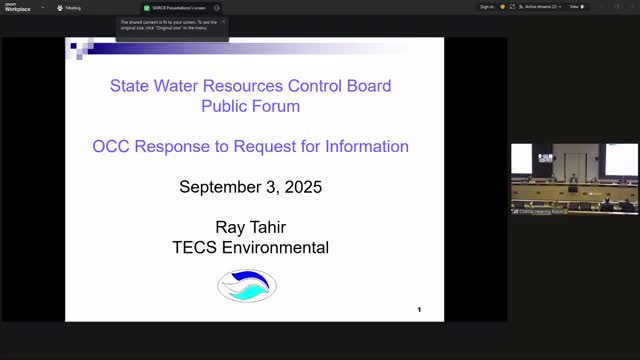
At the Sept. 3 meeting a public commenter raised legal concerns about the State Water Board's handling of permissible ex parte communications and the interpretation of Water Code section 13287. Ray Tahir of TEX Environmental reviewed prior staff responses and said the guidance accompanying section 13287 (January 2019 language and earlier Q&A) was invalid because it amended or created terms not enacted by the Legislature.
Tahir said the guidance and a disclosure model referenced in the office of chief counsel's Q&A were not part of enacted law and that the presence of the model across multiple staff materials could render related statutes (including SB 965) vulnerable. He argued that MS4 stormwater permits should be subject to the APA chapter 4.5 prohibition on ex parte communications because they identify named municipalities under Water Code section 13377, and he urged the board to resolve the legal questions before issuing a report of waste discharge for Los Angeles and Ventura MS4 permits.
Tahir's remarks included repeated references to an office of chief counsel Q&A and a staff responder identified as Mr. Lauffer; he said differences in prior staff statements create legal uncertainty. Chair Esquivel and staff interrupted to keep the public comment within time limits; the board did not provide a legal ruling during the public forum.
Why it matters: Rules about ex parte communications affect how permit proceedings, general orders, and other quasi‑adjudicative processes are conducted and who may communicate with decision makers during pendency. Tahir's comments raise procedural and legal questions about which statutory framework—section 13287's disclosure model or APA chapter 4.5—applies to particular permit types.
Board response: The chair curtailed prolonged back‑and‑forth in public forum but did not provide a legal response. Tahir requested resolution of these issues prior to certain permit reports being issued; no board action or staff directive was issued on the record during the meeting.
Ending: The record shows legal concerns raised publicly; the board may address them through counsel or a formal agenda item if needed.
Tahir said the guidance and a disclosure model referenced in the office of chief counsel's Q&A were not part of enacted law and that the presence of the model across multiple staff materials could render related statutes (including SB 965) vulnerable. He argued that MS4 stormwater permits should be subject to the APA chapter 4.5 prohibition on ex parte communications because they identify named municipalities under Water Code section 13377, and he urged the board to resolve the legal questions before issuing a report of waste discharge for Los Angeles and Ventura MS4 permits.
Tahir's remarks included repeated references to an office of chief counsel Q&A and a staff responder identified as Mr. Lauffer; he said differences in prior staff statements create legal uncertainty. Chair Esquivel and staff interrupted to keep the public comment within time limits; the board did not provide a legal ruling during the public forum.
Why it matters: Rules about ex parte communications affect how permit proceedings, general orders, and other quasi‑adjudicative processes are conducted and who may communicate with decision makers during pendency. Tahir's comments raise procedural and legal questions about which statutory framework—section 13287's disclosure model or APA chapter 4.5—applies to particular permit types.
Board response: The chair curtailed prolonged back‑and‑forth in public forum but did not provide a legal response. Tahir requested resolution of these issues prior to certain permit reports being issued; no board action or staff directive was issued on the record during the meeting.
Ending: The record shows legal concerns raised publicly; the board may address them through counsel or a formal agenda item if needed.
Don't Miss a Word: See the Full Meeting!
Go beyond summaries. Unlock every video, transcript, and key insight with a Founder Membership.
✓
Get instant access to full meeting videos
✓
Search and clip any phrase from complete transcripts
✓
Receive AI-powered summaries & custom alerts
✓
Enjoy lifetime, unrestricted access to government data
30-day money-back guarantee
