Village defends emergency adulticide spray after West Nile index spikes; residents may opt out
August 28, 2025 | Lake Bluff, Lake County, Illinois
This article was created by AI summarizing key points discussed. AI makes mistakes, so for full details and context, please refer to the video of the full meeting. Please report any errors so we can fix them. Report an error »
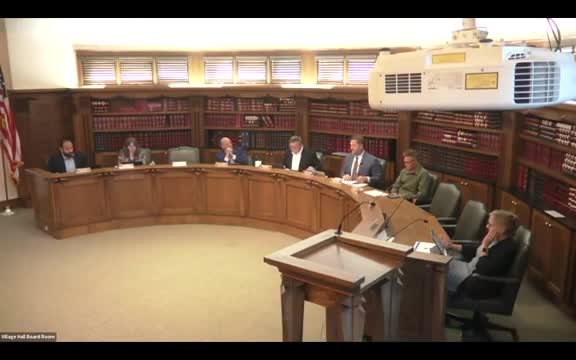
Lehi Bluff village officials said they conducted an adulticide spray for the first time in nearly five years after monitoring indicated a high percentage of mosquitoes carrying West Nile virus.
Drew, the village administrator, told trustees on Aug. 25 the decision followed consultations with the village’s mosquito-control consultant and the county health department. "We were really looking at 7 factors ... and 6 of the 7 were pointing to you should be spraying," Drew said, adding that the village had increased the number of mosquito traps to collect more data before deciding.
The village acknowledged some residents objected. Officials said the village offers an opt‑out for individual addresses; the list will remain unchanged unless a resident requests re‑enrollment. Drew reported about 30 addresses had opted out this season. "We don't advertise that because it really ineffectuates the spraying if it's off as much as it's on," he said, explaining the concern that widespread opt‑outs could reduce effectiveness.
Trustees asked about effectiveness and future monitoring. Village staff said preliminary post‑spray trap counts showed a decrease in positive mosquitoes in the short term and that a fuller seasonal report would be provided in late fall. The village also said it plans to consider adding traps to improve spatial data, noting that adding many traps would substantially increase program costs.
Officials discussed program cost briefly; the administrator characterized current annual mosquito-abatement spending as relatively low but warned that adding dozens of traps and more intensive testing would raise costs significantly.
Discussion vs. decision: the board did not take a separate policy vote at the meeting; staff reported on an operational decision that had been implemented after consultation with the health department and the village’s consultant.
What’s next: staff will provide a fall-season summary with trap results and recommendations on trap coverage and future abatement strategy.
Drew, the village administrator, told trustees on Aug. 25 the decision followed consultations with the village’s mosquito-control consultant and the county health department. "We were really looking at 7 factors ... and 6 of the 7 were pointing to you should be spraying," Drew said, adding that the village had increased the number of mosquito traps to collect more data before deciding.
The village acknowledged some residents objected. Officials said the village offers an opt‑out for individual addresses; the list will remain unchanged unless a resident requests re‑enrollment. Drew reported about 30 addresses had opted out this season. "We don't advertise that because it really ineffectuates the spraying if it's off as much as it's on," he said, explaining the concern that widespread opt‑outs could reduce effectiveness.
Trustees asked about effectiveness and future monitoring. Village staff said preliminary post‑spray trap counts showed a decrease in positive mosquitoes in the short term and that a fuller seasonal report would be provided in late fall. The village also said it plans to consider adding traps to improve spatial data, noting that adding many traps would substantially increase program costs.
Officials discussed program cost briefly; the administrator characterized current annual mosquito-abatement spending as relatively low but warned that adding dozens of traps and more intensive testing would raise costs significantly.
Discussion vs. decision: the board did not take a separate policy vote at the meeting; staff reported on an operational decision that had been implemented after consultation with the health department and the village’s consultant.
What’s next: staff will provide a fall-season summary with trap results and recommendations on trap coverage and future abatement strategy.
View the Full Meeting & All Its Details
This article offers just a summary. Unlock complete video, transcripts, and insights as a Founder Member.
✓
Watch full, unedited meeting videos
✓
Search every word spoken in unlimited transcripts
✓
AI summaries & real-time alerts (all government levels)
✓
Permanent access to expanding government content
30-day money-back guarantee
