Planning commission recommends higher multifamily densities, ADU updates to city council; adds setback tweak
August 22, 2025 | Capitola City, Santa Cruz County, California
This article was created by AI summarizing key points discussed. AI makes mistakes, so for full details and context, please refer to the video of the full meeting. Please report any errors so we can fix them. Report an error »
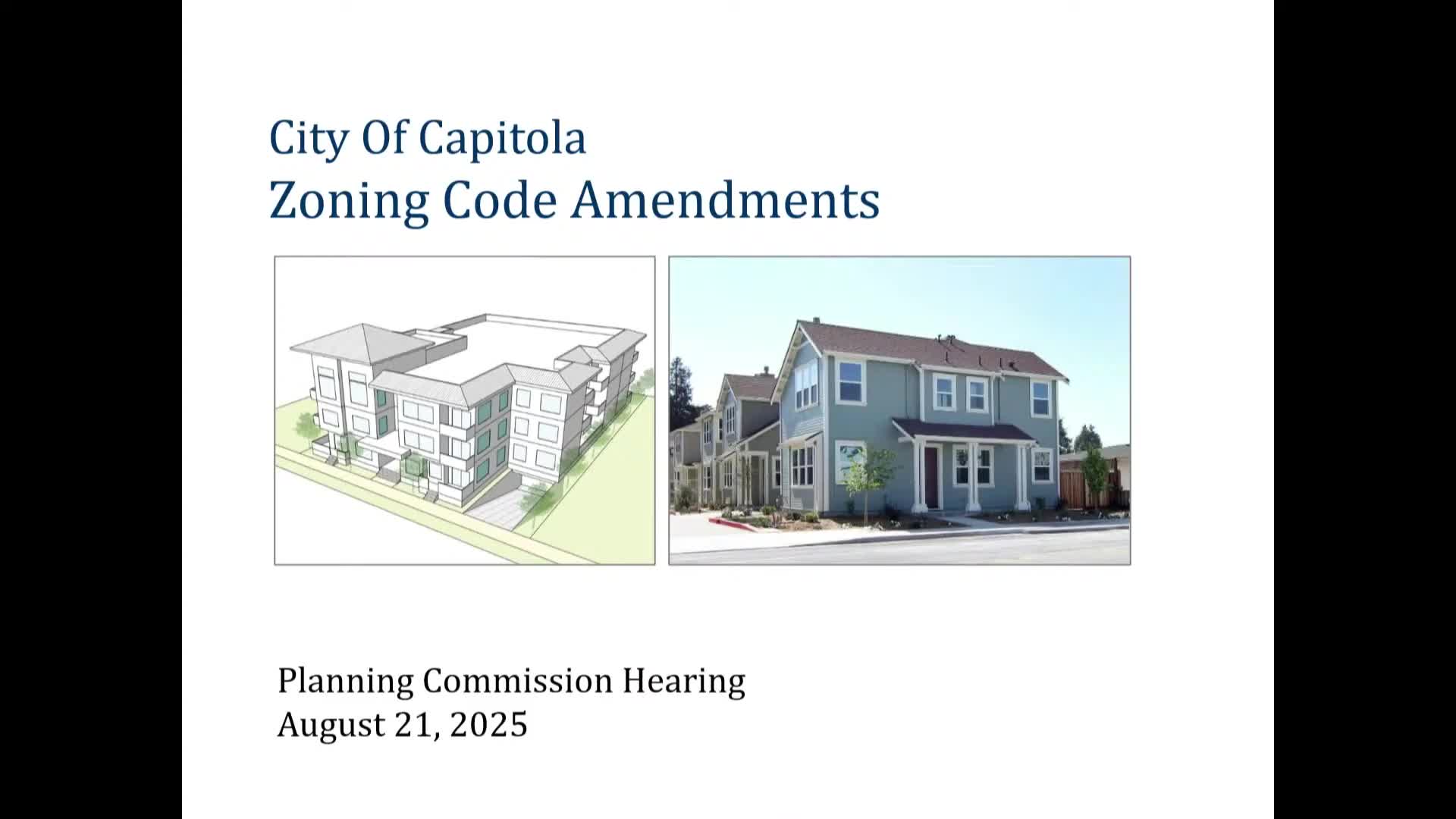
The Capitola Planning Commission on Aug. 21 voted to recommend that the City Council adopt a package of zoning and General Plan amendments intended to implement the city’s certified 2024 housing element. The recommendation includes two new residential-multifamily subzones (RM-30 and RM-40), revisions to multifamily development standards for setbacks, height, building coverage and daylight-plane rules, and updates to the city’s accessory dwelling unit (ADU) chapter.
City planning consultant Ben Noble summarized the changes and the housing-element context. He said the RM-30 and RM-40 subzones would allow up to 30 and 40 dwelling units per acre, respectively, and that the California Department of Housing and Community Development (HCD) had reviewed the approach. “The city received confirmation from HCD that, in their opinion, the proposed approach meets the city’s legal requirements under its certified housing element as well as state housing law,” Ben Noble told the commission.
Key provisions in the package include:
- New density tiers: RM-30 (30 du/acre) and RM-40 (40 du/acre).
- Height limits: RM-30 allows three stories (30-foot plate plus up to 6 feet for pitched roofs); RM-40 allows up to four stories (40-foot plate plus 6-foot roof form) with the fourth story set back a minimum of 25 feet from any side or rear property line abutting an R-1 residential parcel.
- Building coverage and setbacks adjusted to enable the higher densities (example: 600 Park Avenue proposed to change from RM-10 to RM-30 with building coverage rising from 40% to 50% and a rear setback reduced to 15 feet when abutting single-family property).
- Daylight plane and privacy provisions limiting upper-story outdoor uses and requiring staggered windows to reduce direct sightlines into adjacent homes.
ADU changes: the commission also recommended updates to the ADU chapter (17.74) to align with recent state law and HCD comments. Notable changes include clarifications for historic resources (architectural standards for city-designated historic resources to apply within the coastal zone), removal of a requirement that a homeowners’ association officer co-sign ADU ministerial applications (the city will still require any HOA approvals necessary for building permits), and changes to allow up to eight detached ADUs on existing multifamily parcels in line with state law (but not to exceed the existing number of units on the lot).
Public response was split. Neighbors near 600 Park Avenue raised concerns about height, privacy and solar obstruction if parcels are redeveloped under the new rules, and asked the commission to study impacts more closely. Jeff Lee, a Wesley Street resident, warned, “If the setbacks are not increased and the heights are not reconsidered, I think we all can imagine what that impact would be.” Developers and housing advocates, including Santa Cruz YIMBY, urged the commission to allow higher density and to extend rezoning opportunities to more parcels to produce housing.
Commission action: after deliberation the commission approved three resolutions recommending (1) the RM zoning code and map amendments, (2) a General Plan text amendment to show RM densities between 10 and 40 du/acre depending on subzone, and (3) ADU ordinance amendments. The commission made a single substantive change on the floor: note 4 of Table 17.16 was amended to increase the minimum interior-side ground-floor setback from 7 feet to 10 feet for the RM-30 and RM-40 subzones. Each resolution passed on a roll call vote; the action is a recommendation to the City Council, which will consider the ordinances in fall 2025.
Next steps: the commission’s recommendations will be transmitted to the City Council for public hearings this fall; staff noted the council will consider the items in future hearings and that the next council meeting addressing the mall redevelopment will occur on Sept. 11.
City planning consultant Ben Noble summarized the changes and the housing-element context. He said the RM-30 and RM-40 subzones would allow up to 30 and 40 dwelling units per acre, respectively, and that the California Department of Housing and Community Development (HCD) had reviewed the approach. “The city received confirmation from HCD that, in their opinion, the proposed approach meets the city’s legal requirements under its certified housing element as well as state housing law,” Ben Noble told the commission.
Key provisions in the package include:
- New density tiers: RM-30 (30 du/acre) and RM-40 (40 du/acre).
- Height limits: RM-30 allows three stories (30-foot plate plus up to 6 feet for pitched roofs); RM-40 allows up to four stories (40-foot plate plus 6-foot roof form) with the fourth story set back a minimum of 25 feet from any side or rear property line abutting an R-1 residential parcel.
- Building coverage and setbacks adjusted to enable the higher densities (example: 600 Park Avenue proposed to change from RM-10 to RM-30 with building coverage rising from 40% to 50% and a rear setback reduced to 15 feet when abutting single-family property).
- Daylight plane and privacy provisions limiting upper-story outdoor uses and requiring staggered windows to reduce direct sightlines into adjacent homes.
ADU changes: the commission also recommended updates to the ADU chapter (17.74) to align with recent state law and HCD comments. Notable changes include clarifications for historic resources (architectural standards for city-designated historic resources to apply within the coastal zone), removal of a requirement that a homeowners’ association officer co-sign ADU ministerial applications (the city will still require any HOA approvals necessary for building permits), and changes to allow up to eight detached ADUs on existing multifamily parcels in line with state law (but not to exceed the existing number of units on the lot).
Public response was split. Neighbors near 600 Park Avenue raised concerns about height, privacy and solar obstruction if parcels are redeveloped under the new rules, and asked the commission to study impacts more closely. Jeff Lee, a Wesley Street resident, warned, “If the setbacks are not increased and the heights are not reconsidered, I think we all can imagine what that impact would be.” Developers and housing advocates, including Santa Cruz YIMBY, urged the commission to allow higher density and to extend rezoning opportunities to more parcels to produce housing.
Commission action: after deliberation the commission approved three resolutions recommending (1) the RM zoning code and map amendments, (2) a General Plan text amendment to show RM densities between 10 and 40 du/acre depending on subzone, and (3) ADU ordinance amendments. The commission made a single substantive change on the floor: note 4 of Table 17.16 was amended to increase the minimum interior-side ground-floor setback from 7 feet to 10 feet for the RM-30 and RM-40 subzones. Each resolution passed on a roll call vote; the action is a recommendation to the City Council, which will consider the ordinances in fall 2025.
Next steps: the commission’s recommendations will be transmitted to the City Council for public hearings this fall; staff noted the council will consider the items in future hearings and that the next council meeting addressing the mall redevelopment will occur on Sept. 11.
View the Full Meeting & All Its Details
This article offers just a summary. Unlock complete video, transcripts, and insights as a Founder Member.
✓
Watch full, unedited meeting videos
✓
Search every word spoken in unlimited transcripts
✓
AI summaries & real-time alerts (all government levels)
✓
Permanent access to expanding government content
30-day money-back guarantee
