Capitola commission delays LUP amendment but backs zoning changes tied to Cliff Drive resiliency project
September 05, 2025 | Capitola City, Santa Cruz County, California
This article was created by AI summarizing key points discussed. AI makes mistakes, so for full details and context, please refer to the video of the full meeting. Please report any errors so we can fix them. Report an error »
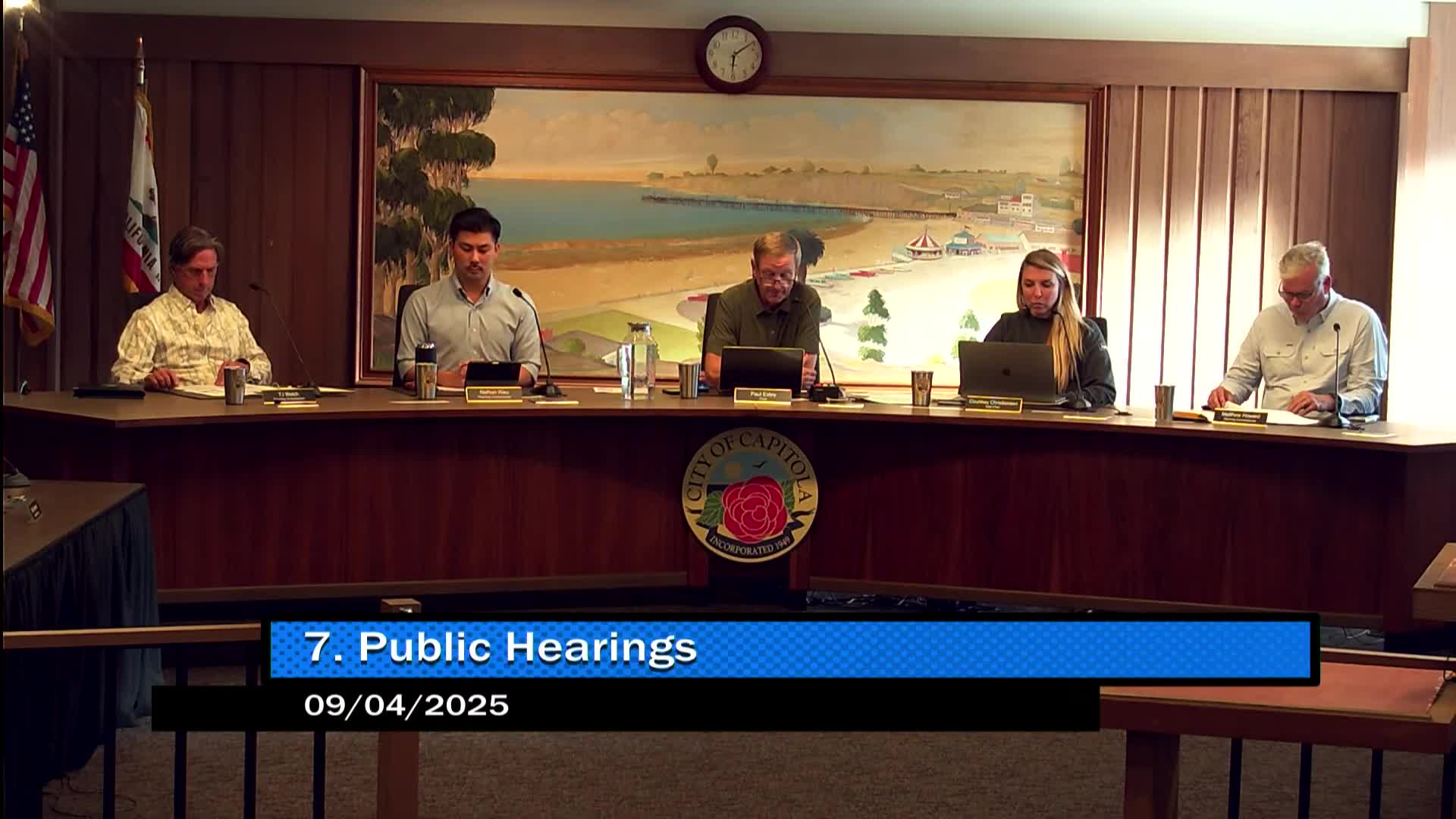
The Capitola Planning Commission on Sept. 4 continued consideration of proposed Land Use Plan (LUP) and Local Coastal Program (LCP) amendments tied to the Cliff Drive Resiliency Project, and separately recommended that the City Council approve updates to the zoning code that staff said are needed to implement shoreline adaptation work.
The LUP amendments — revisions staff described as intended to align the city’s policies with current sea level‑rise and coastal adaptation planning — were continued so staff could fold in edits requested by the California Coastal Commission and other clarifying language. Commissioners voted 5‑0 to continue the LUP action and asked staff to return with a clean, consolidated draft at the next planning‑commission meeting.
The commission approved, by the same 5‑0 margin, a resolution recommending that the City Council adopt changes to Capitola Municipal Code chapters cited by staff (including 17.32, 17.64, 17.76 and 17.78) with the meeting’s edits. That recommendation includes replacing repeated references to “pedestrian and bicycle” with the term “multimodal.” The council will have final authority on the ordinance amendments.
Project team members described the Cliff Drive Resiliency Project as a multi‑phase effort focused first on the portion of Cliff Drive where bluff failure risk is highest. “Council elected, and recommended us to proceed with alternative 3, which was the full bluff protection,” said Robert Stevens, project manager at CSW, referencing the council’s 2024 direction. The full‑protection concept presented to the commission would retain two lanes of travel, add bicycle facilities and convert existing perpendicular parking to angled parking while constructing a shotcrete (concrete) soil‑nail/bluff face protection system with anchors embedded in the slope.
Consultant Breeze Kinsey of CivicNet said the LUP/LCP edits are intended to implement California Coastal Act policy locally and to clarify how the city will evaluate bluff stabilization and public access as hazards worsen. “This update is focused on ensuring consistency with current sea level rise and adaptation planning and specifically focused on the Cliff Drive corridor,” Kinsey said.
Staff told the commission the project will be built in phases because the Federal Highway Administration (FHWA) award the city has received will not cover construction of the entire corridor at once. Project cost estimates provided by the consultant placed the overall project in “the $30 million to $45 million” range in today’s dollars; staff said the FHWA award would cover the full 125‑foot segment identified as Phase 1. The commission heard that later phases, including long‑range integration of a permanent stair to Hooper Beach, would be advanced as funding permits.
A key topic of deliberation was technical standards language the Coastal Commission had requested be added to the city’s documents. Coastal staff proposed expressly requiring geotechnical stability analyses to demonstrate minimum factors of safety (1.5 for static conditions and 1.1 for pseudo‑static/seismic conditions). Planning staff recommended a narrower, implementation‑level approach: retain a 50‑year planning horizon and require site‑specific analysis prepared and sealed by a California‑licensed geotechnical engineer or certified engineering geologist, and allow that engineer’s sealed analysis to justify alternate approaches when appropriate. As staff put it, the LUP should not be the place for overly prescriptive engineering numbers; implementation standards and site reports are the right forum.
Staff also described a set of other specific edits being proposed to the LUP and municipal code: updating references from the defunct Northwestern Pacific Railroad to the Santa Cruz Regional Transportation Commission (who now holds regional rail lands), clarifying that the wooden Hooper Beach staircase is frequently damaged and temporarily closed by storm events, and removing a requirement that nonnative vegetation be removed in all instances (staff recommended removal be based on site‑specific analysis rather than a universal condition). Staff proposed deleting or softening one line that would have required “camouflage” treatments for drainage hardware, calling that cost‑prohibitive and sometimes impractical.
Commissioners asked about property ownership at the base of the slope, coordination with Santa Cruz County, and whether private homeowners could be integrated into phases. Staff said the roadway is within the city’s public right‑of‑way but that parcels seaward of the bluff may be city or county owned, and that Coastal Commission and County approvals will be necessary where work falls within the commission’s original jurisdiction. Staff noted the city could pursue a consolidated coastal permit or seek a combined hearing at the Coastal Commission as earlier projects have done.
No members of the public spoke on the Cliff Drive item during the public‑comment period for that hearing. Planning staff said the project and the LUP amendments will return with consolidated redlines and a staff report that reflects the Coastal Commission’s letter, the edits discussed at the meeting, and any additional changes the commission requests.
Next steps: staff will compile the edits requested by the commission and the Coastal Commission and return with a clean set of documents; the recommended municipal code changes will go to City Council for final action; construction of subsequent phases depends on securing additional funding and Coastal Commission permits.
The LUP amendments — revisions staff described as intended to align the city’s policies with current sea level‑rise and coastal adaptation planning — were continued so staff could fold in edits requested by the California Coastal Commission and other clarifying language. Commissioners voted 5‑0 to continue the LUP action and asked staff to return with a clean, consolidated draft at the next planning‑commission meeting.
The commission approved, by the same 5‑0 margin, a resolution recommending that the City Council adopt changes to Capitola Municipal Code chapters cited by staff (including 17.32, 17.64, 17.76 and 17.78) with the meeting’s edits. That recommendation includes replacing repeated references to “pedestrian and bicycle” with the term “multimodal.” The council will have final authority on the ordinance amendments.
Project team members described the Cliff Drive Resiliency Project as a multi‑phase effort focused first on the portion of Cliff Drive where bluff failure risk is highest. “Council elected, and recommended us to proceed with alternative 3, which was the full bluff protection,” said Robert Stevens, project manager at CSW, referencing the council’s 2024 direction. The full‑protection concept presented to the commission would retain two lanes of travel, add bicycle facilities and convert existing perpendicular parking to angled parking while constructing a shotcrete (concrete) soil‑nail/bluff face protection system with anchors embedded in the slope.
Consultant Breeze Kinsey of CivicNet said the LUP/LCP edits are intended to implement California Coastal Act policy locally and to clarify how the city will evaluate bluff stabilization and public access as hazards worsen. “This update is focused on ensuring consistency with current sea level rise and adaptation planning and specifically focused on the Cliff Drive corridor,” Kinsey said.
Staff told the commission the project will be built in phases because the Federal Highway Administration (FHWA) award the city has received will not cover construction of the entire corridor at once. Project cost estimates provided by the consultant placed the overall project in “the $30 million to $45 million” range in today’s dollars; staff said the FHWA award would cover the full 125‑foot segment identified as Phase 1. The commission heard that later phases, including long‑range integration of a permanent stair to Hooper Beach, would be advanced as funding permits.
A key topic of deliberation was technical standards language the Coastal Commission had requested be added to the city’s documents. Coastal staff proposed expressly requiring geotechnical stability analyses to demonstrate minimum factors of safety (1.5 for static conditions and 1.1 for pseudo‑static/seismic conditions). Planning staff recommended a narrower, implementation‑level approach: retain a 50‑year planning horizon and require site‑specific analysis prepared and sealed by a California‑licensed geotechnical engineer or certified engineering geologist, and allow that engineer’s sealed analysis to justify alternate approaches when appropriate. As staff put it, the LUP should not be the place for overly prescriptive engineering numbers; implementation standards and site reports are the right forum.
Staff also described a set of other specific edits being proposed to the LUP and municipal code: updating references from the defunct Northwestern Pacific Railroad to the Santa Cruz Regional Transportation Commission (who now holds regional rail lands), clarifying that the wooden Hooper Beach staircase is frequently damaged and temporarily closed by storm events, and removing a requirement that nonnative vegetation be removed in all instances (staff recommended removal be based on site‑specific analysis rather than a universal condition). Staff proposed deleting or softening one line that would have required “camouflage” treatments for drainage hardware, calling that cost‑prohibitive and sometimes impractical.
Commissioners asked about property ownership at the base of the slope, coordination with Santa Cruz County, and whether private homeowners could be integrated into phases. Staff said the roadway is within the city’s public right‑of‑way but that parcels seaward of the bluff may be city or county owned, and that Coastal Commission and County approvals will be necessary where work falls within the commission’s original jurisdiction. Staff noted the city could pursue a consolidated coastal permit or seek a combined hearing at the Coastal Commission as earlier projects have done.
No members of the public spoke on the Cliff Drive item during the public‑comment period for that hearing. Planning staff said the project and the LUP amendments will return with consolidated redlines and a staff report that reflects the Coastal Commission’s letter, the edits discussed at the meeting, and any additional changes the commission requests.
Next steps: staff will compile the edits requested by the commission and the Coastal Commission and return with a clean set of documents; the recommended municipal code changes will go to City Council for final action; construction of subsequent phases depends on securing additional funding and Coastal Commission permits.
Don't Miss a Word: See the Full Meeting!
Go beyond summaries. Unlock every video, transcript, and key insight with a Founder Membership.
✓
Get instant access to full meeting videos
✓
Search and clip any phrase from complete transcripts
✓
Receive AI-powered summaries & custom alerts
✓
Enjoy lifetime, unrestricted access to government data
30-day money-back guarantee
