Brexville schools warn of tighter finances as state and federal funding fall short
August 21, 2025 | Brecksville-Broadview Heights City, School Districts, Ohio
This article was created by AI summarizing key points discussed. AI makes mistakes, so for full details and context, please refer to the video of the full meeting. Please report any errors so we can fix them. Report an error »
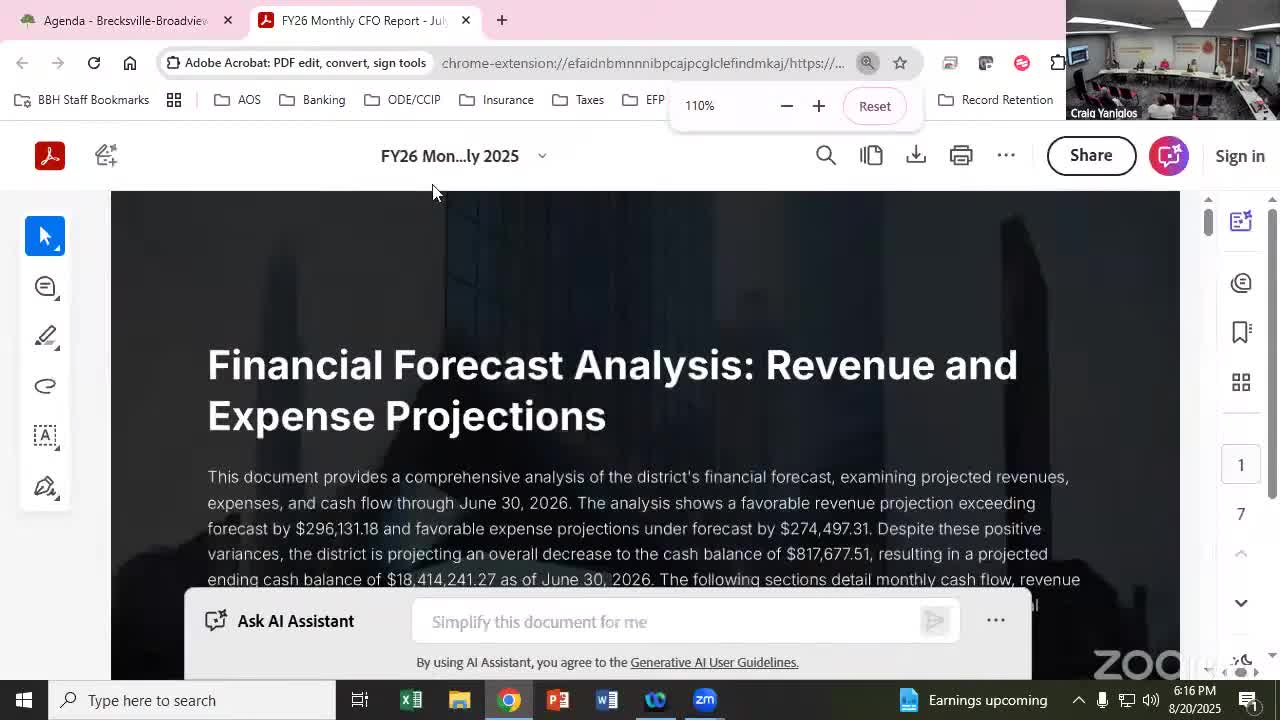
Superintendent Jeff (Superintendent) and Treasurer Craig (Treasurer/CFO) told the Brexville Board of Education on Aug. 20 that the district is projecting a modest deficit this fiscal year and faces policy-level risks that could reduce state and federal revenue. The district’s preliminary fiscal‑26 forecast shows projected expenses of about $57.9 million and current estimates of about $57.6 million, leaving a deficit spend projected at roughly $800,000 and an ending cash balance near $18.4 million (about 118 days of cash) if current assumptions hold.
Why it matters: board members were told that the combination of timing changes in pay schedules, higher salary and benefit costs this summer and possible state and federal funding cuts will strain the district’s budget and could affect program funding, staffing decisions and future levy planning.
Treasurer Craig said the district received additional property‑tax payments in July this year compared with last year, creating timing variability in revenue, and explained that recent contract and payroll timing changes (moving staff between 26 and 24 pay cycles, and some retirees receiving summer “stretch” pay and benefits) have increased salary and benefits outflows in July and August. Craig told the board that purchase‑service payments and a change in vendor billing cycles also contributed to higher July outlays.
Superintendent Jeff summarized policy risks the district is watching. He said state budget changes in House Bill 96 have reduced the state’s share of school funding and that a property‑tax reform working group and possible statutory caps on district carryover balances could shorten levy cycles for some districts. Jeff also reported that the state Department of Education (DEW) warned that the federal fiscal‑2026 budget proposal advanced at the federal level includes elimination of Title II, Title III and Title IV funding; the district’s current estimates for those programs were roughly $75,000 for Title II, about $20,000 for Title III (immigrant funding uncertain) and about $22,000 for Title IV. Jeff and Craig said total federal funding for the district, including IDEA and Title I, is about $1.2 million, and the loss of discretionary federal grants would require local offsets if enacted.
Board members asked about property‑tax collection trends and whether recent reports of higher delinquencies would affect Brexville. Craig said the district’s preliminary review suggests some of the spring shortfalls were timing issues due to changed collection dates and that fall settlement data will clarify the trend, but the district will remain conservative in forecasts until additional collections are confirmed.
Board discussion also covered state proposals to cap the percentage of carryover a district can hold and an administrative‑cost cap; Craig said Brexville is not near previously reported extremes and that an administrative calculation likely places the district near 9 percent. Jeff said continued unfunded mandates (for example, new cybersecurity incident‑response requirements) add cost without offsetting state funding.
No formal fiscal action was taken at the meeting; the board received the forecast and instructed staff to continue monitoring fall tax settlements and legislative activity. Superintendent Jeff asked the board to consider moving the October forecast meeting from Oct. 15 to Monday, Oct. 13, to accommodate the earlier state deadline; board members expressed no objection during the discussion.
The district said staff will present an updated forecast after fall collections and when state budget changes are finalized.
Ending: The board scheduled follow‑up reporting and an October forecast; no budget revisions or levies were approved at the Aug. 20 meeting.
Why it matters: board members were told that the combination of timing changes in pay schedules, higher salary and benefit costs this summer and possible state and federal funding cuts will strain the district’s budget and could affect program funding, staffing decisions and future levy planning.
Treasurer Craig said the district received additional property‑tax payments in July this year compared with last year, creating timing variability in revenue, and explained that recent contract and payroll timing changes (moving staff between 26 and 24 pay cycles, and some retirees receiving summer “stretch” pay and benefits) have increased salary and benefits outflows in July and August. Craig told the board that purchase‑service payments and a change in vendor billing cycles also contributed to higher July outlays.
Superintendent Jeff summarized policy risks the district is watching. He said state budget changes in House Bill 96 have reduced the state’s share of school funding and that a property‑tax reform working group and possible statutory caps on district carryover balances could shorten levy cycles for some districts. Jeff also reported that the state Department of Education (DEW) warned that the federal fiscal‑2026 budget proposal advanced at the federal level includes elimination of Title II, Title III and Title IV funding; the district’s current estimates for those programs were roughly $75,000 for Title II, about $20,000 for Title III (immigrant funding uncertain) and about $22,000 for Title IV. Jeff and Craig said total federal funding for the district, including IDEA and Title I, is about $1.2 million, and the loss of discretionary federal grants would require local offsets if enacted.
Board members asked about property‑tax collection trends and whether recent reports of higher delinquencies would affect Brexville. Craig said the district’s preliminary review suggests some of the spring shortfalls were timing issues due to changed collection dates and that fall settlement data will clarify the trend, but the district will remain conservative in forecasts until additional collections are confirmed.
Board discussion also covered state proposals to cap the percentage of carryover a district can hold and an administrative‑cost cap; Craig said Brexville is not near previously reported extremes and that an administrative calculation likely places the district near 9 percent. Jeff said continued unfunded mandates (for example, new cybersecurity incident‑response requirements) add cost without offsetting state funding.
No formal fiscal action was taken at the meeting; the board received the forecast and instructed staff to continue monitoring fall tax settlements and legislative activity. Superintendent Jeff asked the board to consider moving the October forecast meeting from Oct. 15 to Monday, Oct. 13, to accommodate the earlier state deadline; board members expressed no objection during the discussion.
The district said staff will present an updated forecast after fall collections and when state budget changes are finalized.
Ending: The board scheduled follow‑up reporting and an October forecast; no budget revisions or levies were approved at the Aug. 20 meeting.
View the Full Meeting & All Its Details
This article offers just a summary. Unlock complete video, transcripts, and insights as a Founder Member.
✓
Watch full, unedited meeting videos
✓
Search every word spoken in unlimited transcripts
✓
AI summaries & real-time alerts (all government levels)
✓
Permanent access to expanding government content
30-day money-back guarantee
