Addison Council directs staff to include accelerated police and fire step-plan options in FY‑26 budget materials
June 24, 2025 | Addison, Dallas County, Texas
This article was created by AI summarizing key points discussed. AI makes mistakes, so for full details and context, please refer to the video of the full meeting. Please report any errors so we can fix them. Report an error »
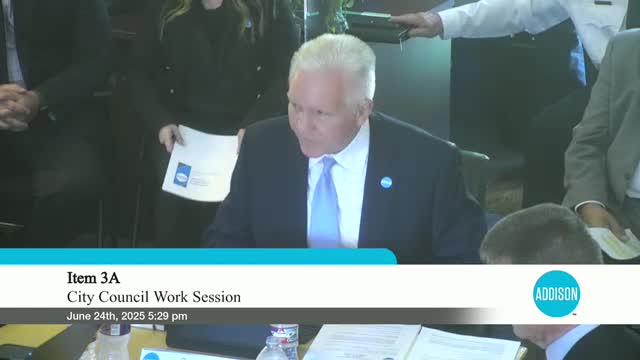
Addison City Council members discussed a plan to move sworn police and fire personnel from the town’s current open-range pay table to a multi-step pay plan and asked staff to include the most aggressive (one-year) option in the draft budget while showing the cost difference if the council chose a two‑year transition.
The council’s discussion at its June 24 work session focused on four options presented by town staff intended to address recruiter/retention pressure: Option 1 shifts the pay plan by 2% and uses the remaining 2% of the 4% compensation pool for step movement over two years; Option 2 shifts by 3% and would require a decision package (estimated first-year cost about $138,000); Option 3 would reach the town’s stated “desired market position” (average plus 1) over two years (estimated first-year cost about $275,000); and Option 4 — an “all in” approach — would accomplish the market position in one year (estimated first-year cost $475,000). The town’s presenters said the FY‑27 ongoing cost for the police portion of some options was estimated around $132,991 and for fire about $122,970.
Why it matters: Staff said Addison’s last market study completed in 2023 left the town 2–5% below market for many sworn positions today; council members and chiefs said turnover in the 1–5 year service band increases overtime, recruiting and training costs and erodes institutional knowledge. Council members repeatedly framed the issue as a market-driven problem — "we're in an employee market" — and discussed tradeoffs between recruiting/retention effects and the one-time and ongoing budget impacts of each option.
Details and discussion
Staff framed the town’s compensation philosophy as seeking to pay “above average of our comparison cities,” specifically ‘‘50% plus 1’’ (as presented by Ashley Waite, staff member). Waite described the current open‑range system, the prior 2024 use of a 4% pool (2% to shift the pay plan and 2% for merit), and the effect of the 2023 market study on current positioning. She told the council: “the town compensation philosophy ... we pay above average of our comparison cities. And when we talk about above average, we're saying 50% plus 1.”
Fire Chief David Jones and the police chief (identified in the record as Chief Alexander) described local hiring practices and training timelines. Fire Chief Jones said the department can “hire a paramedic and train them to become a firefighter” rather than send a new hire to paramedic school, and he estimated field training and full on‑the‑job readiness commonly take 12–18 months.
Staff and council debated how many sworn personnel would remain at top pay or would require an extra year of transition. A staff member with modeling responsibility (Steven, staff member) told the council staff estimated roughly 20–25 sworn officers were already at the pay maximum and about 15–18 would not fully transition in year one under a two‑year plan — roughly 20% of the affected group by staff’s estimate.
Costs, timeline and budget process
- Option 1: 2% shift, uses existing FY‑26 4% pool; two‑year transition; no decision package required.
- Option 2: 3% shift; two‑year transition; decision package requested (estimated one‑time decision package ~ $138,000).
- Option 3: Market‑competitive target (average plus one); two‑year transition; estimated FY‑26 one‑time cost ~ $275,000; FY‑27 incremental estimates were provided by department (police ~$132,991; fire ~$122,970).
- Option 4: “All in” approach to reach target in one year; estimated one‑time FY‑26 cost ~$475,000.
Council direction and next steps
Council members did not take a formal roll-call vote on a specific option at the meeting, but the majority asked staff to include Option 4 (the one‑year, $475,000 “all in” approach) as a line item in the proposed budget and to present the budget impact of Option 4 along with the delta to Option 3 so council can weigh both figures during budget workshops. Staff said it will prepare a proposed budget that shows the Option 4 impact and the difference if the council elects Option 3. Councilmembers also asked staff to keep the compensation‑study cadence under review (industry standard 3–5 years was discussed) and to provide follow‑up analysis about the quantified cost of turnover (hiring, training and overtime) if possible.
What was not decided
No formal ordinance, budget appropriation or vote to adopt a compensation change occurred; council directed staff to include options in the upcoming budget materials and to return with cost impacts and comparative analysis during the budget process.
Ending
Council members emphasized public safety as a top town priority and asked staff to reflect the one‑year and two‑year options in the proposed FY‑26 budget materials for the formal budget discussions later in the summer.
The council’s discussion at its June 24 work session focused on four options presented by town staff intended to address recruiter/retention pressure: Option 1 shifts the pay plan by 2% and uses the remaining 2% of the 4% compensation pool for step movement over two years; Option 2 shifts by 3% and would require a decision package (estimated first-year cost about $138,000); Option 3 would reach the town’s stated “desired market position” (average plus 1) over two years (estimated first-year cost about $275,000); and Option 4 — an “all in” approach — would accomplish the market position in one year (estimated first-year cost $475,000). The town’s presenters said the FY‑27 ongoing cost for the police portion of some options was estimated around $132,991 and for fire about $122,970.
Why it matters: Staff said Addison’s last market study completed in 2023 left the town 2–5% below market for many sworn positions today; council members and chiefs said turnover in the 1–5 year service band increases overtime, recruiting and training costs and erodes institutional knowledge. Council members repeatedly framed the issue as a market-driven problem — "we're in an employee market" — and discussed tradeoffs between recruiting/retention effects and the one-time and ongoing budget impacts of each option.
Details and discussion
Staff framed the town’s compensation philosophy as seeking to pay “above average of our comparison cities,” specifically ‘‘50% plus 1’’ (as presented by Ashley Waite, staff member). Waite described the current open‑range system, the prior 2024 use of a 4% pool (2% to shift the pay plan and 2% for merit), and the effect of the 2023 market study on current positioning. She told the council: “the town compensation philosophy ... we pay above average of our comparison cities. And when we talk about above average, we're saying 50% plus 1.”
Fire Chief David Jones and the police chief (identified in the record as Chief Alexander) described local hiring practices and training timelines. Fire Chief Jones said the department can “hire a paramedic and train them to become a firefighter” rather than send a new hire to paramedic school, and he estimated field training and full on‑the‑job readiness commonly take 12–18 months.
Staff and council debated how many sworn personnel would remain at top pay or would require an extra year of transition. A staff member with modeling responsibility (Steven, staff member) told the council staff estimated roughly 20–25 sworn officers were already at the pay maximum and about 15–18 would not fully transition in year one under a two‑year plan — roughly 20% of the affected group by staff’s estimate.
Costs, timeline and budget process
- Option 1: 2% shift, uses existing FY‑26 4% pool; two‑year transition; no decision package required.
- Option 2: 3% shift; two‑year transition; decision package requested (estimated one‑time decision package ~ $138,000).
- Option 3: Market‑competitive target (average plus one); two‑year transition; estimated FY‑26 one‑time cost ~ $275,000; FY‑27 incremental estimates were provided by department (police ~$132,991; fire ~$122,970).
- Option 4: “All in” approach to reach target in one year; estimated one‑time FY‑26 cost ~$475,000.
Council direction and next steps
Council members did not take a formal roll-call vote on a specific option at the meeting, but the majority asked staff to include Option 4 (the one‑year, $475,000 “all in” approach) as a line item in the proposed budget and to present the budget impact of Option 4 along with the delta to Option 3 so council can weigh both figures during budget workshops. Staff said it will prepare a proposed budget that shows the Option 4 impact and the difference if the council elects Option 3. Councilmembers also asked staff to keep the compensation‑study cadence under review (industry standard 3–5 years was discussed) and to provide follow‑up analysis about the quantified cost of turnover (hiring, training and overtime) if possible.
What was not decided
No formal ordinance, budget appropriation or vote to adopt a compensation change occurred; council directed staff to include options in the upcoming budget materials and to return with cost impacts and comparative analysis during the budget process.
Ending
Council members emphasized public safety as a top town priority and asked staff to reflect the one‑year and two‑year options in the proposed FY‑26 budget materials for the formal budget discussions later in the summer.
View the Full Meeting & All Its Details
This article offers just a summary. Unlock complete video, transcripts, and insights as a Founder Member.
✓
Watch full, unedited meeting videos
✓
Search every word spoken in unlimited transcripts
✓
AI summaries & real-time alerts (all government levels)
✓
Permanent access to expanding government content
30-day money-back guarantee
