Addison council approves repeal of city tax on personal-use leased vehicles effective tax year 2026
June 24, 2025 | Addison, Dallas County, Texas
This article was created by AI summarizing key points discussed. AI makes mistakes, so for full details and context, please refer to the video of the full meeting. Please report any errors so we can fix them. Report an error »
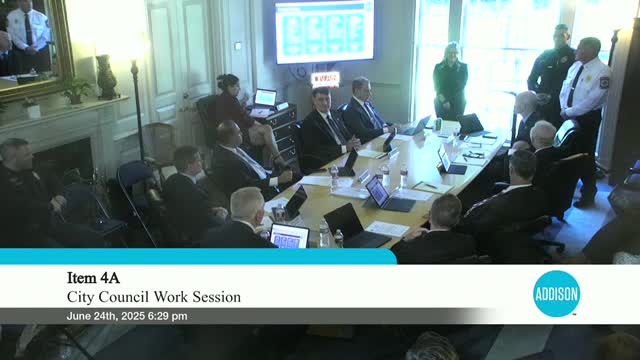
The Addison City Council voted to repeal the town’s personal property tax on motor vehicles leased for personal use and set an effective date that aligns with the appraisal district’s processing schedule.
Lede and action
At the council’s June 24 meeting, Steven Glickman, the town chief financial officer, presented an ordinance to repeal Section 70‑432 of the code (taxation of motor vehicles leased for personal use). Council approved the ordinance in the meeting’s regular session.
Why it matters
Staff explained the repeal implements an option the Texas Legislature authorized in 2001 that allows municipalities to exempt personal property tax on leased personal vehicles. Addison had continued to levy that tax; staff said the city’s repeal will reduce Addison’s property‑tax revenue beginning in the tax year with an effective date of Jan. 1, 2026 (which translates to taxes payable in the 2027 tax year). The town estimates the revenue reduction at roughly $120,000 in the first affected year.
Timing and appraisal district guidance
Glickman told council staff had consulted the Dallas Central Appraisal District (DCAD) and that the appraisal process runs on a January–December cycle; DCAD advised staff that attempting to change the tax during the current appraisal process could create filing errors or uneven taxpayer treatment because leasing companies would need to resubmit documentation during the cycle. To avoid administrative errors and taxpayer confusion, the ordinance sets the effective date to the tax year beginning Jan. 1, 2026.
Budget context
Council members asked whether the $120,000 loss would be difficult to absorb; Glickman said the estimate represented approximately 0.3% of overall property‑tax revenue and that new development and normal reappraisal increases would likely offset the revenue reduction in the coming year. The town did not adopt an offsetting revenue measure at the meeting; council approved the repeal ordinance as presented.
Ending
The ordinance passed on June 24 and will take effect for the tax year beginning Jan. 1, 2026. Staff will reflect the change in upcoming budget and tax‑rate materials and continue to monitor development and reappraisal to identify impacts to ongoing revenue.
Lede and action
At the council’s June 24 meeting, Steven Glickman, the town chief financial officer, presented an ordinance to repeal Section 70‑432 of the code (taxation of motor vehicles leased for personal use). Council approved the ordinance in the meeting’s regular session.
Why it matters
Staff explained the repeal implements an option the Texas Legislature authorized in 2001 that allows municipalities to exempt personal property tax on leased personal vehicles. Addison had continued to levy that tax; staff said the city’s repeal will reduce Addison’s property‑tax revenue beginning in the tax year with an effective date of Jan. 1, 2026 (which translates to taxes payable in the 2027 tax year). The town estimates the revenue reduction at roughly $120,000 in the first affected year.
Timing and appraisal district guidance
Glickman told council staff had consulted the Dallas Central Appraisal District (DCAD) and that the appraisal process runs on a January–December cycle; DCAD advised staff that attempting to change the tax during the current appraisal process could create filing errors or uneven taxpayer treatment because leasing companies would need to resubmit documentation during the cycle. To avoid administrative errors and taxpayer confusion, the ordinance sets the effective date to the tax year beginning Jan. 1, 2026.
Budget context
Council members asked whether the $120,000 loss would be difficult to absorb; Glickman said the estimate represented approximately 0.3% of overall property‑tax revenue and that new development and normal reappraisal increases would likely offset the revenue reduction in the coming year. The town did not adopt an offsetting revenue measure at the meeting; council approved the repeal ordinance as presented.
Ending
The ordinance passed on June 24 and will take effect for the tax year beginning Jan. 1, 2026. Staff will reflect the change in upcoming budget and tax‑rate materials and continue to monitor development and reappraisal to identify impacts to ongoing revenue.
Don't Miss a Word: See the Full Meeting!
Go beyond summaries. Unlock every video, transcript, and key insight with a Founder Membership.
✓
Get instant access to full meeting videos
✓
Search and clip any phrase from complete transcripts
✓
Receive AI-powered summaries & custom alerts
✓
Enjoy lifetime, unrestricted access to government data
30-day money-back guarantee
