Athletic trainers say wet-bulb globe temperature guides outdoor practice limits amid heat, lightning
September 03, 2025 | Events, Hillsborough, School Districts, Florida
This article was created by AI summarizing key points discussed. AI makes mistakes, so for full details and context, please refer to the video of the full meeting. Please report any errors so we can fix them. Report an error »
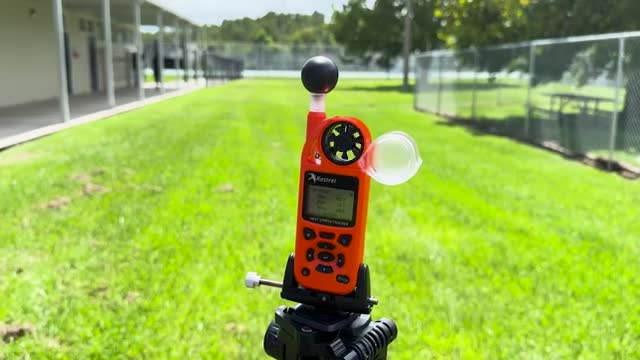
An athletic trainer said trainers use the wet-bulb globe temperature to decide whether and how long student practices and band rehearsals can be held outdoors and whether protective equipment should be worn.
The wet-bulb globe temperature, the trainer said, “is trying to measure heat stress. So it takes into effect, like direct sunlight. So, like, ambient temperature, sun, if there's any cloud coverage, wind, humidity, and it throws all of that into an equation and it spits out the kind of like a feels like temperature. It's important because it helps us determine if it's safe to be outside for practices and games. So it does let us know, like, can we be outside if we can?”
That measurement, the trainer said, is taken during the last school period and communicated to athletic directors, who pass the information to coaches and band directors. “Our standard that all the athletic trainers do, we take the wet bulb temperature during the last school period and then we send it to our, athletic directors and they get the information out to the coaches and, like, band directors, like, people who are gonna be trying to be outside in the afternoons,” the trainer said. The trainer added that they “continuously monitor the wet bulb through practices until we're done.”
Coaching staff described operational changes triggered by those readings. “My first year of coaching, we were practicing in the afternoons because that's what the team was used to. But we moved we quickly moved to the mornings because a lot of our run our practice were canceled,” a coach said. “Either there there's 2 big factors. It was either way too hot, the wet glow bulb. It was, always too high.” The coach also said lightning canceled some sessions: “And on the days that it wasn't too high, there was lightning. So we'd, you know, we'd have 5 practice scheduled and we'd maybe get 2 of them in because of the heat or or the lightning.”
Trainers described operational restrictions tied to WBGT readings, including limits on how long students can be outside and whether helmets and shoulder pads may be worn. “Like, how long can we be outside for practice? And if, like, helmets and shoulder pads and all that kind stuff can be worn,” the athletic trainer said.
Staff emphasized hydration and basic preparation as a mitigation step. “The thing I really, really try to get kids to work on is being hydrated. So like drinking plenty of water before, during, after practices, making sure they're eating well too. Because if they're coming in dehydrated and not having rested or eaten enough for practice, that's already putting them at a higher risk for something happening to them,” the trainer said.
No formal policy, ordinance or vote was mentioned in the transcript; the discussion described current practice by trainers and coaches rather than a new, binding rule.
The comments combined technical explanation (how WBGT is calculated), operational protocol (who is notified and when), past changes to scheduling and recurring safety emphasis (hydration and cancellation for lightning).
The wet-bulb globe temperature, the trainer said, “is trying to measure heat stress. So it takes into effect, like direct sunlight. So, like, ambient temperature, sun, if there's any cloud coverage, wind, humidity, and it throws all of that into an equation and it spits out the kind of like a feels like temperature. It's important because it helps us determine if it's safe to be outside for practices and games. So it does let us know, like, can we be outside if we can?”
That measurement, the trainer said, is taken during the last school period and communicated to athletic directors, who pass the information to coaches and band directors. “Our standard that all the athletic trainers do, we take the wet bulb temperature during the last school period and then we send it to our, athletic directors and they get the information out to the coaches and, like, band directors, like, people who are gonna be trying to be outside in the afternoons,” the trainer said. The trainer added that they “continuously monitor the wet bulb through practices until we're done.”
Coaching staff described operational changes triggered by those readings. “My first year of coaching, we were practicing in the afternoons because that's what the team was used to. But we moved we quickly moved to the mornings because a lot of our run our practice were canceled,” a coach said. “Either there there's 2 big factors. It was either way too hot, the wet glow bulb. It was, always too high.” The coach also said lightning canceled some sessions: “And on the days that it wasn't too high, there was lightning. So we'd, you know, we'd have 5 practice scheduled and we'd maybe get 2 of them in because of the heat or or the lightning.”
Trainers described operational restrictions tied to WBGT readings, including limits on how long students can be outside and whether helmets and shoulder pads may be worn. “Like, how long can we be outside for practice? And if, like, helmets and shoulder pads and all that kind stuff can be worn,” the athletic trainer said.
Staff emphasized hydration and basic preparation as a mitigation step. “The thing I really, really try to get kids to work on is being hydrated. So like drinking plenty of water before, during, after practices, making sure they're eating well too. Because if they're coming in dehydrated and not having rested or eaten enough for practice, that's already putting them at a higher risk for something happening to them,” the trainer said.
No formal policy, ordinance or vote was mentioned in the transcript; the discussion described current practice by trainers and coaches rather than a new, binding rule.
The comments combined technical explanation (how WBGT is calculated), operational protocol (who is notified and when), past changes to scheduling and recurring safety emphasis (hydration and cancellation for lightning).
View the Full Meeting & All Its Details
This article offers just a summary. Unlock complete video, transcripts, and insights as a Founder Member.
✓
Watch full, unedited meeting videos
✓
Search every word spoken in unlimited transcripts
✓
AI summaries & real-time alerts (all government levels)
✓
Permanent access to expanding government content
30-day money-back guarantee
