LA County leaders warn federal order and funding cuts could disrupt Housing First programs
September 03, 2025 | Los Angeles County, California
This article was created by AI summarizing key points discussed. AI makes mistakes, so for full details and context, please refer to the video of the full meeting. Please report any errors so we can fix them. Report an error »
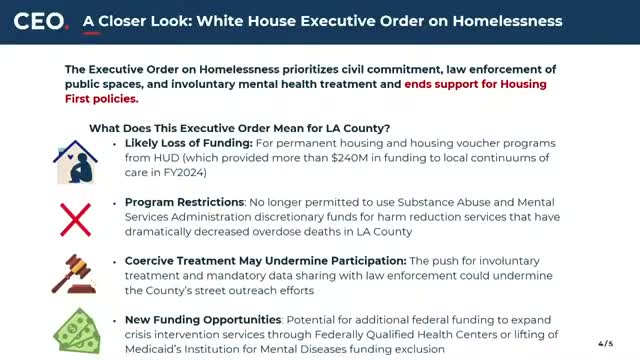
County human services and public health officials told the Los Angeles County Board of Supervisors on Sept. 2 that a July federal executive order and pending federal budget changes could jeopardize funding for permanent supportive housing and other programs the county relies on to reduce homelessness.
The board heard detailed briefings from the chief executive office and department leaders about the potential impacts of the executive order "Ending Crime and Disorder on America's Streets," issued July 24, and of proposed congressional appropriations that officials say would carve deeply into housing and homelessness funding streams.
"These numbers are gonna continue to change and evolve in the coming weeks and months," Chief Deputy CEO Joe Nikita told supervisors as he introduced the briefing, stressing the county is still refining its estimates.
The executive order directs federal agencies to deprioritize support for Housing First, to encourage funding for interim housing and to expand data sharing and enforcement priorities tied to open camping and drug use, county Director of Homeless Services and Housing Sarah Mahan told the board. "It is important to note that this executive order is not self executing," Mahan said, meaning localities will be affected only when federal agencies issue implementing guidance.
Officials said the county could face both immediate and longer-term pressures. Los Angeles Continuum of Care (CoC) programs received more than $220 million in HUD funding in fiscal 2024, the County said, with roughly 77% of that supporting permanent supportive housing (PSH). Emilio Salas, executive director of the Los Angeles County Development Authority, told the board proposed appropriations could leave housing assistance payments flat while cutting administrative fees, which would force staffing reductions and reduce the number of households the Housing Choice Voucher program can serve.
"I've never experienced this level of impact as it relates to pressures coming from all sides of the housing ecosystem," Salas said, explaining that House and Senate versions of appropriations would both produce funding shortfalls for vouchers, public housing operating subsidies and capital funding.
Public health and behavioral health leaders told the board the order also threatens harm reduction programs and could increase demand for institutional or involuntary treatment. "The executive order undermines comprehensive harm reduction approaches," Anish Mahajan, chief deputy at Public Health, said, while Department of Mental Health leaders cautioned that the order’s emphasis on civil commitment raises legal and operational questions that largely depend on how state law and federal guidance interact.
Department leaders urged the board to pursue multiple strategies: advocacy in Washington, participation in national coalitions, litigation where appropriate, and local contingency planning. Angela Ovalle, acting branch manager for legislative affairs, said county advocates are meeting with congressional offices and federal agencies and are assembling requests for appropriations and regulatory input.
The board received and filed the report after public comment by service providers, immigrant-rights groups and residents who called for urgent protections for wildfire survivors and families affected by aggressive immigration enforcement.
What happens next will depend on the text of federal implementing guidance and the final congressional appropriations. County officials said they are tracking HUD’s upcoming Notice of Funding Opportunity for CoC grants and planning mitigation strategies, including potential use of local dollars to fill gaps.
Ending
County leaders said they are preparing for multiple scenarios, including flat or reduced federal funding, and are using advocacy and contingency planning to try to preserve local PSH investments. Supervisors pressed officials on timelines, outreach and the possible use of Measure A and other county funds to blunt funding shocks while urging continued federal engagement.
The board heard detailed briefings from the chief executive office and department leaders about the potential impacts of the executive order "Ending Crime and Disorder on America's Streets," issued July 24, and of proposed congressional appropriations that officials say would carve deeply into housing and homelessness funding streams.
"These numbers are gonna continue to change and evolve in the coming weeks and months," Chief Deputy CEO Joe Nikita told supervisors as he introduced the briefing, stressing the county is still refining its estimates.
The executive order directs federal agencies to deprioritize support for Housing First, to encourage funding for interim housing and to expand data sharing and enforcement priorities tied to open camping and drug use, county Director of Homeless Services and Housing Sarah Mahan told the board. "It is important to note that this executive order is not self executing," Mahan said, meaning localities will be affected only when federal agencies issue implementing guidance.
Officials said the county could face both immediate and longer-term pressures. Los Angeles Continuum of Care (CoC) programs received more than $220 million in HUD funding in fiscal 2024, the County said, with roughly 77% of that supporting permanent supportive housing (PSH). Emilio Salas, executive director of the Los Angeles County Development Authority, told the board proposed appropriations could leave housing assistance payments flat while cutting administrative fees, which would force staffing reductions and reduce the number of households the Housing Choice Voucher program can serve.
"I've never experienced this level of impact as it relates to pressures coming from all sides of the housing ecosystem," Salas said, explaining that House and Senate versions of appropriations would both produce funding shortfalls for vouchers, public housing operating subsidies and capital funding.
Public health and behavioral health leaders told the board the order also threatens harm reduction programs and could increase demand for institutional or involuntary treatment. "The executive order undermines comprehensive harm reduction approaches," Anish Mahajan, chief deputy at Public Health, said, while Department of Mental Health leaders cautioned that the order’s emphasis on civil commitment raises legal and operational questions that largely depend on how state law and federal guidance interact.
Department leaders urged the board to pursue multiple strategies: advocacy in Washington, participation in national coalitions, litigation where appropriate, and local contingency planning. Angela Ovalle, acting branch manager for legislative affairs, said county advocates are meeting with congressional offices and federal agencies and are assembling requests for appropriations and regulatory input.
The board received and filed the report after public comment by service providers, immigrant-rights groups and residents who called for urgent protections for wildfire survivors and families affected by aggressive immigration enforcement.
What happens next will depend on the text of federal implementing guidance and the final congressional appropriations. County officials said they are tracking HUD’s upcoming Notice of Funding Opportunity for CoC grants and planning mitigation strategies, including potential use of local dollars to fill gaps.
Ending
County leaders said they are preparing for multiple scenarios, including flat or reduced federal funding, and are using advocacy and contingency planning to try to preserve local PSH investments. Supervisors pressed officials on timelines, outreach and the possible use of Measure A and other county funds to blunt funding shocks while urging continued federal engagement.
Don't Miss a Word: See the Full Meeting!
Go beyond summaries. Unlock every video, transcript, and key insight with a Founder Membership.
✓
Get instant access to full meeting videos
✓
Search and clip any phrase from complete transcripts
✓
Receive AI-powered summaries & custom alerts
✓
Enjoy lifetime, unrestricted access to government data
30-day money-back guarantee
