Board adopts countywide 82°F maximum indoor temperature threshold for rental housing with phased compliance
August 06, 2025 | Los Angeles County, California
This article was created by AI summarizing key points discussed. AI makes mistakes, so for full details and context, please refer to the video of the full meeting. Please report any errors so we can fix them. Report an error »
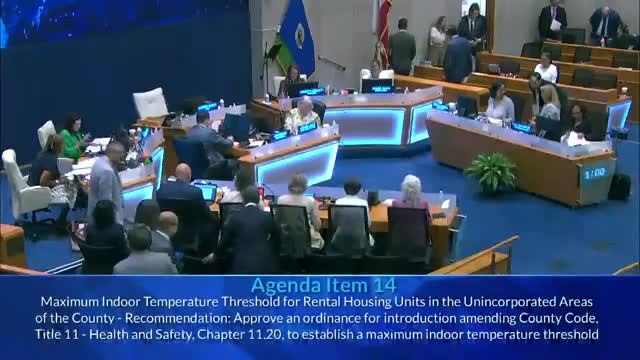
The Board of Supervisors voted Aug. 5 to adopt a county ordinance establishing a maximum indoor temperature threshold of 82 degrees Fahrenheit for rental housing in unincorporated Los Angeles County, requiring landlords to maintain habitable rooms at or below that temperature when indoor conditions threaten tenant health.
The ordinance, authored by Supervisors Hilda Solis and Lindsey Horvath and amended on the floor, establishes a program that emphasizes education and passive cooling measures, a complaint‑response enforcement model and a phased compliance schedule. Director of Public Health Barbara Ferrer presented the public‑health rationale for the threshold and described stakeholder outreach the department used to shape the ordinance.
Key elements approved by the board:
- A single maximum indoor residential threshold of 82°F for all habitable rooms in rental units; tenants may install additional cooling devices and are protected from retaliation; landlords retain responsibility to ensure habitability;
- Enforcement will be complaint based and handled through the county’s renter habitability program; enforcement actions will not begin until Jan. 1, 2027, to allow for outreach and a compliance ramp;
- Landlords may request extensions of up to two years; the board amended the motion to permit additional extension options and directed a report back on financial and technical assistance for small landlords, with a specific request that the Internal Services Department collaborate with the CEO and other county offices to propose funding options and eligibility guidelines within six months;
- The ordinance applies to most rental housing in unincorporated areas; excluded categories include owner‑occupied rentals, mobile home parks, RVs, and properties already covered by other routine habitability inspections.
During debate, supervisors and departmental staff emphasized a “passive‑first” approach — encouraging shade, reflective roofing, insulation and natural ventilation to reduce cooling needs — and noted programs and rebates already available: SoCalREN multifamily programs, Clean Power Alliance support and point‑of‑sale rebates for low‑income window units. Clean Power Alliance staff told the board that, based on modeling, adding air conditioning to every rental unit would increase countywide electric demand by 100–250 megawatts — a number the utility said the grid can accommodate — and that Clean Power Alliance has programs to provide heavily discounted or free window units for eligible customers.
Board changes and votes: The board added an amendment (co‑authored by Supervisors Janice Hahn and Lindsey Horvath) creating additional ramp‑up provisions for “small property landlords” (properties defined in county code as owning 10 units or fewer). The amendment requires small landlords to ensure at least one habitable room reaches the 82°F threshold by Jan. 1, 2027, and to achieve whole‑unit compliance by Jan. 1, 2032, with programmatic supports and a separate report back to identify eligible funding sources and a disbursement plan. The ordinance and amendments passed the board by a 4–0 vote.
Why it matters: Public‑health officials cited evidence that heat is the leading weather‑related killer and that many heat deaths occur in residences without cooling. Advocates urged countywide application to protect multi‑generational and crowded homes where “one cool room” would not be sufficient; landlord groups warned of electrical‑infrastructure and cost issues and supported the small‑landlord compromise to allow time for upgrades. The county directed a six‑month report back from ISD and the CEO’s office outlining potential funding sources (state and utility rebates, Climate Equity Fund, other grants) and an eligibility/disbursement plan to help smaller property owners comply.
The ordinance, authored by Supervisors Hilda Solis and Lindsey Horvath and amended on the floor, establishes a program that emphasizes education and passive cooling measures, a complaint‑response enforcement model and a phased compliance schedule. Director of Public Health Barbara Ferrer presented the public‑health rationale for the threshold and described stakeholder outreach the department used to shape the ordinance.
Key elements approved by the board:
- A single maximum indoor residential threshold of 82°F for all habitable rooms in rental units; tenants may install additional cooling devices and are protected from retaliation; landlords retain responsibility to ensure habitability;
- Enforcement will be complaint based and handled through the county’s renter habitability program; enforcement actions will not begin until Jan. 1, 2027, to allow for outreach and a compliance ramp;
- Landlords may request extensions of up to two years; the board amended the motion to permit additional extension options and directed a report back on financial and technical assistance for small landlords, with a specific request that the Internal Services Department collaborate with the CEO and other county offices to propose funding options and eligibility guidelines within six months;
- The ordinance applies to most rental housing in unincorporated areas; excluded categories include owner‑occupied rentals, mobile home parks, RVs, and properties already covered by other routine habitability inspections.
During debate, supervisors and departmental staff emphasized a “passive‑first” approach — encouraging shade, reflective roofing, insulation and natural ventilation to reduce cooling needs — and noted programs and rebates already available: SoCalREN multifamily programs, Clean Power Alliance support and point‑of‑sale rebates for low‑income window units. Clean Power Alliance staff told the board that, based on modeling, adding air conditioning to every rental unit would increase countywide electric demand by 100–250 megawatts — a number the utility said the grid can accommodate — and that Clean Power Alliance has programs to provide heavily discounted or free window units for eligible customers.
Board changes and votes: The board added an amendment (co‑authored by Supervisors Janice Hahn and Lindsey Horvath) creating additional ramp‑up provisions for “small property landlords” (properties defined in county code as owning 10 units or fewer). The amendment requires small landlords to ensure at least one habitable room reaches the 82°F threshold by Jan. 1, 2027, and to achieve whole‑unit compliance by Jan. 1, 2032, with programmatic supports and a separate report back to identify eligible funding sources and a disbursement plan. The ordinance and amendments passed the board by a 4–0 vote.
Why it matters: Public‑health officials cited evidence that heat is the leading weather‑related killer and that many heat deaths occur in residences without cooling. Advocates urged countywide application to protect multi‑generational and crowded homes where “one cool room” would not be sufficient; landlord groups warned of electrical‑infrastructure and cost issues and supported the small‑landlord compromise to allow time for upgrades. The county directed a six‑month report back from ISD and the CEO’s office outlining potential funding sources (state and utility rebates, Climate Equity Fund, other grants) and an eligibility/disbursement plan to help smaller property owners comply.
Don't Miss a Word: See the Full Meeting!
Go beyond summaries. Unlock every video, transcript, and key insight with a Founder Membership.
✓
Get instant access to full meeting videos
✓
Search and clip any phrase from complete transcripts
✓
Receive AI-powered summaries & custom alerts
✓
Enjoy lifetime, unrestricted access to government data
30-day money-back guarantee
