Governing body holds special meeting only to consider entering executive session; no board action expected
September 03, 2025 | Groveport Madison Local, School Districts, Ohio
This article was created by AI summarizing key points discussed. AI makes mistakes, so for full details and context, please refer to the video of the full meeting. Please report any errors so we can fix them. Report an error »
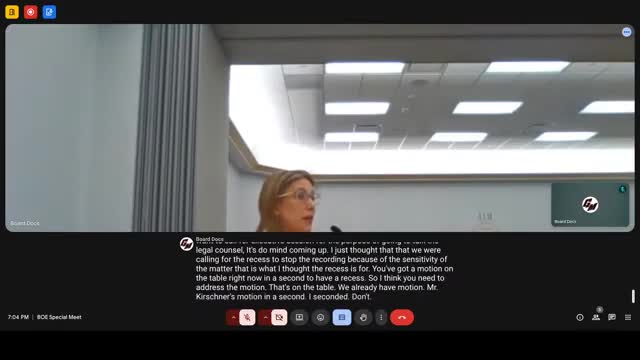
A staff member told attendees that the meeting was convened solely to consider entering an executive session and that no board action would be taken. “This is a special meeting only to consider entering executive session for the purposes outlined in the notice. Those are the only matters that may be discussed, and no board action will be taken,” the staff member said (Speaker 3).
The staff member said the limitation was meant to match the meeting notice and to preserve confidentiality required by law, and referenced statutory language in the record as cited during the meeting (transcript references: “RC11 DCTatus” and “RC1122 G5”). The staff member added that the notice and the special-meeting scope restrict discussion to the listed purpose and that other topics or general conversation were not allowed during this session.
The transcript shows no motion record, no mover/second, and no roll-call or recorded vote about any substantive policy or action. Meeting participants were repeatedly told the session’s subject was limited to the executive-session question and related confidential matters; the record does not document any formal decision to adopt policy or take administrative action during this meeting.
Comments in the record emphasized procedural limits: the meeting was described as a one-day, special meeting called only to address whether to go into executive session; participants were told that topics outside that narrow scope should not be discussed in the forum. The record also includes the speaker’s admonition that confidentiality rules apply to matters appropriate for executive session.
What the transcript does not specify: the governing body named in the notice, the precise statutory citations beyond the fragments recorded verbally, any formal motion or vote, and any follow-up assignments or dates for future public action. The transcript entries and the excerpted statutory references are included in the meeting record for verification.
The staff member said the limitation was meant to match the meeting notice and to preserve confidentiality required by law, and referenced statutory language in the record as cited during the meeting (transcript references: “RC11 DCTatus” and “RC1122 G5”). The staff member added that the notice and the special-meeting scope restrict discussion to the listed purpose and that other topics or general conversation were not allowed during this session.
The transcript shows no motion record, no mover/second, and no roll-call or recorded vote about any substantive policy or action. Meeting participants were repeatedly told the session’s subject was limited to the executive-session question and related confidential matters; the record does not document any formal decision to adopt policy or take administrative action during this meeting.
Comments in the record emphasized procedural limits: the meeting was described as a one-day, special meeting called only to address whether to go into executive session; participants were told that topics outside that narrow scope should not be discussed in the forum. The record also includes the speaker’s admonition that confidentiality rules apply to matters appropriate for executive session.
What the transcript does not specify: the governing body named in the notice, the precise statutory citations beyond the fragments recorded verbally, any formal motion or vote, and any follow-up assignments or dates for future public action. The transcript entries and the excerpted statutory references are included in the meeting record for verification.
Don't Miss a Word: See the Full Meeting!
Go beyond summaries. Unlock every video, transcript, and key insight with a Founder Membership.
✓
Get instant access to full meeting videos
✓
Search and clip any phrase from complete transcripts
✓
Receive AI-powered summaries & custom alerts
✓
Enjoy lifetime, unrestricted access to government data
30-day money-back guarantee
