District 211 OKs North Cook intergovernmental agreements after debate over costs and West 40 provisions
June 12, 2025 | Township HSD 211, School Boards, Illinois
This article was created by AI summarizing key points discussed. AI makes mistakes, so for full details and context, please refer to the video of the full meeting. Please report any errors so we can fix them. Report an error »
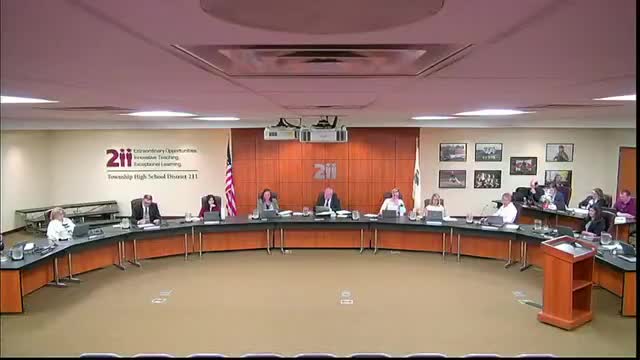
The Township HSD 211 Board of Education voted to approve intergovernmental agreements with the North Cook Intermediate Service Center and the Regional Office of Education for the 2025–26 academic year, 6–1, after a lengthy discussion about costs and contractual terms.
The agreements give District 211 the ability to place students in three NCISC alternative programs and to access on-site student advocates provided by NCISC. Approval does not obligate the district to send students to the programs; it preserves the district’s ability to use them if needed.
Board members and staff discussed program cost mechanics and contractual language related to a partner called West 40. Dr. Lisa Small, superintendent, said the district’s relationship with NCISC has existed for years and that “we are within the region, the North Cook Region,” underscoring that District 211 receives placement priority as a member district. A staff member identified in the meeting as Mr. Hildebrand explained that the on-site advocates currently work with all five district schools “at no cost to the district” for this coming year because initial start-up charges had been absorbed and later covered by the ROE.
Board member Michael Dombrowski voted no and outlined several concerns: that the agreement appeared to guarantee advocacy to West 40 and could reduce the district’s share of Illinois evidence-based funding; that the district might be exposed to unemployment costs if West 40 terminated advocate staff; and that some contractual language appeared to create minimums for West 40 placements. “So for those reasons, I’m not in favor of the agreement,” Dombrowski said.
Other board members said the NCISC options were valuable. Board member Rosenblum described the district’s on-site advocates as “such a huge help to our student services team” and said the in-school advocates help keep students in the school environment and connected to services. District staff noted they have used NCISC placements infrequently—“three to four times” since 2016—but that the embedded advocates (ALOP) operate regularly and are seen as beneficial.
During the discussion, board members sought clarification about whether NCISC placements are available to nonmember districts, how West 40’s per-student charges work, and whether the district would face a minimum-payment obligation if it used the West 40 option. Staff responses varied: one staff member said the West 40 arrangement is “per head” and “only if we use it,” while another acknowledged the contract text could be read as including a minimum guarantee and offered to investigate further. Mr. Dombrowski flagged the ambiguity and financial risk as his primary reasons for voting no.
The formal motion to approve the NCISC intergovernmental agreements passed on roll call: Van Dyke, Campbell, Lopez, Baron, Russell and Rosenblum voted yes; Dombrowski voted no. The board authorized the superintendent or designee to sign the agreement on behalf of District 211.
Board members also noted that the district’s embedded ALOP advocates have been in place for multiple years and that the NCISC arrangement supplements but does not replace existing, in-school supports. Staff said additional follow-up would be provided to the board on the specific West 40 financial terms and any minimums or unemployment contingencies referenced in the contract.
The vote preserves the district’s ability to place students in NCISC programs while prompting board direction to clarify contract language and financial exposure before any large-scale use of West 40 services.
The agreements give District 211 the ability to place students in three NCISC alternative programs and to access on-site student advocates provided by NCISC. Approval does not obligate the district to send students to the programs; it preserves the district’s ability to use them if needed.
Board members and staff discussed program cost mechanics and contractual language related to a partner called West 40. Dr. Lisa Small, superintendent, said the district’s relationship with NCISC has existed for years and that “we are within the region, the North Cook Region,” underscoring that District 211 receives placement priority as a member district. A staff member identified in the meeting as Mr. Hildebrand explained that the on-site advocates currently work with all five district schools “at no cost to the district” for this coming year because initial start-up charges had been absorbed and later covered by the ROE.
Board member Michael Dombrowski voted no and outlined several concerns: that the agreement appeared to guarantee advocacy to West 40 and could reduce the district’s share of Illinois evidence-based funding; that the district might be exposed to unemployment costs if West 40 terminated advocate staff; and that some contractual language appeared to create minimums for West 40 placements. “So for those reasons, I’m not in favor of the agreement,” Dombrowski said.
Other board members said the NCISC options were valuable. Board member Rosenblum described the district’s on-site advocates as “such a huge help to our student services team” and said the in-school advocates help keep students in the school environment and connected to services. District staff noted they have used NCISC placements infrequently—“three to four times” since 2016—but that the embedded advocates (ALOP) operate regularly and are seen as beneficial.
During the discussion, board members sought clarification about whether NCISC placements are available to nonmember districts, how West 40’s per-student charges work, and whether the district would face a minimum-payment obligation if it used the West 40 option. Staff responses varied: one staff member said the West 40 arrangement is “per head” and “only if we use it,” while another acknowledged the contract text could be read as including a minimum guarantee and offered to investigate further. Mr. Dombrowski flagged the ambiguity and financial risk as his primary reasons for voting no.
The formal motion to approve the NCISC intergovernmental agreements passed on roll call: Van Dyke, Campbell, Lopez, Baron, Russell and Rosenblum voted yes; Dombrowski voted no. The board authorized the superintendent or designee to sign the agreement on behalf of District 211.
Board members also noted that the district’s embedded ALOP advocates have been in place for multiple years and that the NCISC arrangement supplements but does not replace existing, in-school supports. Staff said additional follow-up would be provided to the board on the specific West 40 financial terms and any minimums or unemployment contingencies referenced in the contract.
The vote preserves the district’s ability to place students in NCISC programs while prompting board direction to clarify contract language and financial exposure before any large-scale use of West 40 services.
Don't Miss a Word: See the Full Meeting!
Go beyond summaries. Unlock every video, transcript, and key insight with a Founder Membership.
✓
Get instant access to full meeting videos
✓
Search and clip any phrase from complete transcripts
✓
Receive AI-powered summaries & custom alerts
✓
Enjoy lifetime, unrestricted access to government data
30-day money-back guarantee
