Consultant tells District 59 enrollment likely to stabilize; boundary tweaks could address building capacity
June 12, 2025 | Comm Cons SD 59, School Boards, Illinois
This article was created by AI summarizing key points discussed. AI makes mistakes, so for full details and context, please refer to the video of the full meeting. Please report any errors so we can fix them. Report an error »
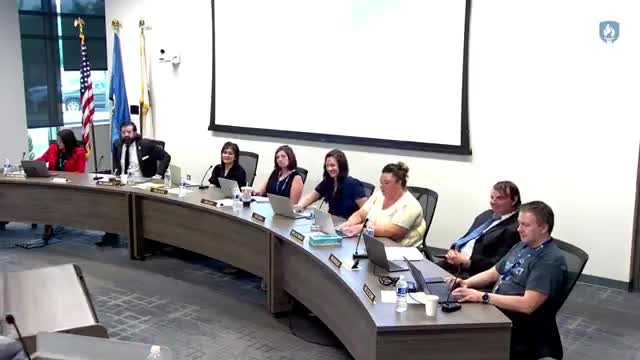
A consultant told the Community Consolidated School District 59 board Tuesday that the district’s overall enrollment is likely to remain stable in the near term but that uneven grade‑level waves and program choices have created capacity imbalances across some schools.
Rob Schwartz of RSP and Associates walked the board through maps, cohort trends, migration rates and yield calculations that underlie five‑year projections. He said the district has not experienced the steep declines seen in some nearby districts, but that aging housing, lower live births and migration patterns explain why some older grades are larger than incoming kindergarten cohorts.
RSP’s analysis differentiates students who reside within a school attendance boundary from students who actually attend a given building; the consultant showed examples where some elementary schools “gain” students through choice or program placement while others show underutilized space. Schwartz said attend/reside differences, dual-language program locations and special programs are key drivers of those patterns.
The presentation included detailed visuals: planning-area yield rates (how many students typical unit types produce), maps of student density, and capacity/utilization tables that show functional capacity shaded by utilization bands (under 70 percent flagged as potential concern; over 100 percent flagged for review). Schwartz advised that a facility functional‑capacity analysis be paired with enrollment forecasts before pursuing boundary changes.
Board members asked about private/parochial school enrollment, new residential developments, and the role of mobile‑home and multifamily units in generating students. Schwartz said RSP factored municipal planning information and known development proposals into its projection scenarios and estimated roughly 1,200 potential new housing units in the longer term; he cautioned, however, that many proposals do not become realized projects and that the “subdivision life cycle” matters for yield.
District staff and the consultant discussed next steps: regular (annual) enrollment monitoring, a deeper review of functional capacity in each building, and community communication to explain “what‑if” scenarios. No boundary changes were recommended at the meeting; staff said the study provides a starting point for long‑range planning and staffing decisions.
RSP made the full report available to board members for further review; school leaders said they will use the materials to examine program placement, capacity management and potential minor boundary adjustments as needed.
Rob Schwartz of RSP and Associates walked the board through maps, cohort trends, migration rates and yield calculations that underlie five‑year projections. He said the district has not experienced the steep declines seen in some nearby districts, but that aging housing, lower live births and migration patterns explain why some older grades are larger than incoming kindergarten cohorts.
RSP’s analysis differentiates students who reside within a school attendance boundary from students who actually attend a given building; the consultant showed examples where some elementary schools “gain” students through choice or program placement while others show underutilized space. Schwartz said attend/reside differences, dual-language program locations and special programs are key drivers of those patterns.
The presentation included detailed visuals: planning-area yield rates (how many students typical unit types produce), maps of student density, and capacity/utilization tables that show functional capacity shaded by utilization bands (under 70 percent flagged as potential concern; over 100 percent flagged for review). Schwartz advised that a facility functional‑capacity analysis be paired with enrollment forecasts before pursuing boundary changes.
Board members asked about private/parochial school enrollment, new residential developments, and the role of mobile‑home and multifamily units in generating students. Schwartz said RSP factored municipal planning information and known development proposals into its projection scenarios and estimated roughly 1,200 potential new housing units in the longer term; he cautioned, however, that many proposals do not become realized projects and that the “subdivision life cycle” matters for yield.
District staff and the consultant discussed next steps: regular (annual) enrollment monitoring, a deeper review of functional capacity in each building, and community communication to explain “what‑if” scenarios. No boundary changes were recommended at the meeting; staff said the study provides a starting point for long‑range planning and staffing decisions.
RSP made the full report available to board members for further review; school leaders said they will use the materials to examine program placement, capacity management and potential minor boundary adjustments as needed.
View the Full Meeting & All Its Details
This article offers just a summary. Unlock complete video, transcripts, and insights as a Founder Member.
✓
Watch full, unedited meeting videos
✓
Search every word spoken in unlimited transcripts
✓
AI summaries & real-time alerts (all government levels)
✓
Permanent access to expanding government content
30-day money-back guarantee
