Newberry commission sets final fire assessment at $300 after hourslong debate
August 26, 2025 | City of Newberry , Alachua County, Florida
This article was created by AI summarizing key points discussed. AI makes mistakes, so for full details and context, please refer to the video of the full meeting. Please report any errors so we can fix them. Report an error »
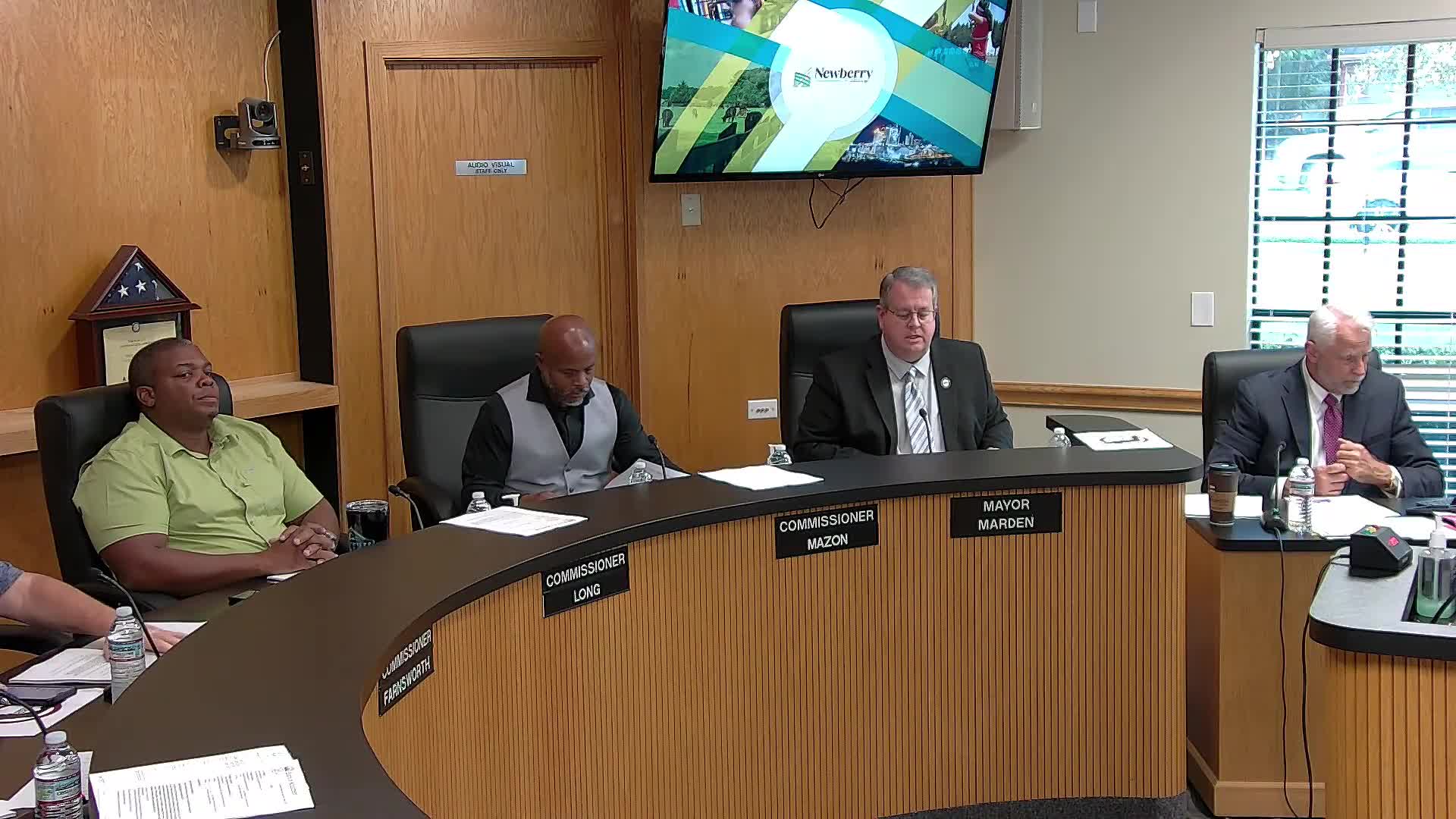
The Newberry City Commission voted 4–1 on Aug. 25 to set the city’s final residential fire assessment at $300 for fiscal year 2026, rejecting the maximum noticed rate of $419 after a presentation by staff and an extended public comment period. The vote was taken after staff summarized a three‑year call‑data study and a proposed assessment schedule intended to move the city toward a 50/50 split of fire department funding between property tax millage and non‑ad valorem fire assessments.
Why it matters: The fire assessment helps fund the city’s fire protection services and debt for fire equipment. Changing the split between assessment revenue and property tax affects how costs fall across homeowners and commercial property owners and can materially change bills for high‑square‑footage nonresidential properties.
Staff presentation and legal limits: Assistant City Manager Dallas Lee told the commission that “the funds raised through your fire assessment can only go to fund the fire protection portion of your fire department budget,” and summarized constraints from case law and practice on how assessments may be apportioned. Staff said a three‑year call study removed the single‑year outlier that drove last year’s larger increases and produced a maximum statutory residential rate of $419; staff recommended $300 as a compromise that would get the assessment closer to the commission’s policy goal without imposing the largest noticed amount.
Public comment and business concerns: Dozens of residents and business owners spoke. Some residents argued the increase is unfair and should be phased in, while several small business operators and property managers said square‑footage‑based assessments produced large jumps for low‑value, high‑area properties (RV and boat storage were cited repeatedly). Beth Fernandez, who identified herself as a resident, said the department averaged “567 calls in 3 years,” a figure she used to question the size of the increase and to ask staff for additional budget scrutiny. Todd Russo, representing Ultimate Bone RV Storage, described a large increase for his storage property and urged the commission to review how industrial/unenclosed storage is classified by the property appraiser.
County comparison and takeover worries: Commissioners and staff discussed whether the county could take over fire services and how that would affect residents’ bills. Staff said county service assessments (MSBU/MSBU equivalent) are typically higher, and gave sample comparisons (a Newberry household would pay roughly $357 annually under the county system in a sample). Staff and commissioners also said handing services to the county could mean loss of local control and not necessarily lower bills.
Commission discussion and decision: Commissioners repeatedly returned to the policy tradeoffs — shifting more revenue to assessments shifts burden toward certain commercial rate classes and square‑footage calculations, while funding through millage shifts more to homeowner tax bills. After questions and a lengthy public‑comment period, the commission approved the staff’s recommendation of $300. The roll call recorded Coleman, Clark, Long and Milling in the affirmative and Commissioner Verintore opposed; the motion passed 4–1.
Next steps and caveats: Staff and commissioners emphasized that $300 does not fully fund long‑term needs such as a future fire station or potential state changes to firefighter work schedules; staff said the budget does not set aside funds for those possibilities. Commissioners and staff said further work remains on classification and on outreach to affected commercial property owners (including potential appeals to the property appraiser) and that the city will continue to monitor call patterns and budget pressures in future years.
Why it matters: The fire assessment helps fund the city’s fire protection services and debt for fire equipment. Changing the split between assessment revenue and property tax affects how costs fall across homeowners and commercial property owners and can materially change bills for high‑square‑footage nonresidential properties.
Staff presentation and legal limits: Assistant City Manager Dallas Lee told the commission that “the funds raised through your fire assessment can only go to fund the fire protection portion of your fire department budget,” and summarized constraints from case law and practice on how assessments may be apportioned. Staff said a three‑year call study removed the single‑year outlier that drove last year’s larger increases and produced a maximum statutory residential rate of $419; staff recommended $300 as a compromise that would get the assessment closer to the commission’s policy goal without imposing the largest noticed amount.
Public comment and business concerns: Dozens of residents and business owners spoke. Some residents argued the increase is unfair and should be phased in, while several small business operators and property managers said square‑footage‑based assessments produced large jumps for low‑value, high‑area properties (RV and boat storage were cited repeatedly). Beth Fernandez, who identified herself as a resident, said the department averaged “567 calls in 3 years,” a figure she used to question the size of the increase and to ask staff for additional budget scrutiny. Todd Russo, representing Ultimate Bone RV Storage, described a large increase for his storage property and urged the commission to review how industrial/unenclosed storage is classified by the property appraiser.
County comparison and takeover worries: Commissioners and staff discussed whether the county could take over fire services and how that would affect residents’ bills. Staff said county service assessments (MSBU/MSBU equivalent) are typically higher, and gave sample comparisons (a Newberry household would pay roughly $357 annually under the county system in a sample). Staff and commissioners also said handing services to the county could mean loss of local control and not necessarily lower bills.
Commission discussion and decision: Commissioners repeatedly returned to the policy tradeoffs — shifting more revenue to assessments shifts burden toward certain commercial rate classes and square‑footage calculations, while funding through millage shifts more to homeowner tax bills. After questions and a lengthy public‑comment period, the commission approved the staff’s recommendation of $300. The roll call recorded Coleman, Clark, Long and Milling in the affirmative and Commissioner Verintore opposed; the motion passed 4–1.
Next steps and caveats: Staff and commissioners emphasized that $300 does not fully fund long‑term needs such as a future fire station or potential state changes to firefighter work schedules; staff said the budget does not set aside funds for those possibilities. Commissioners and staff said further work remains on classification and on outreach to affected commercial property owners (including potential appeals to the property appraiser) and that the city will continue to monitor call patterns and budget pressures in future years.
Don't Miss a Word: See the Full Meeting!
Go beyond summaries. Unlock every video, transcript, and key insight with a Founder Membership.
✓
Get instant access to full meeting videos
✓
Search and clip any phrase from complete transcripts
✓
Receive AI-powered summaries & custom alerts
✓
Enjoy lifetime, unrestricted access to government data
30-day money-back guarantee
