Affordable Housing commissioners ask council to rescind CET award to Spark Newburg
August 15, 2025 | Newberg, Yamhill County, Oregon
This article was created by AI summarizing key points discussed. AI makes mistakes, so for full details and context, please refer to the video of the full meeting. Please report any errors so we can fix them. Report an error »
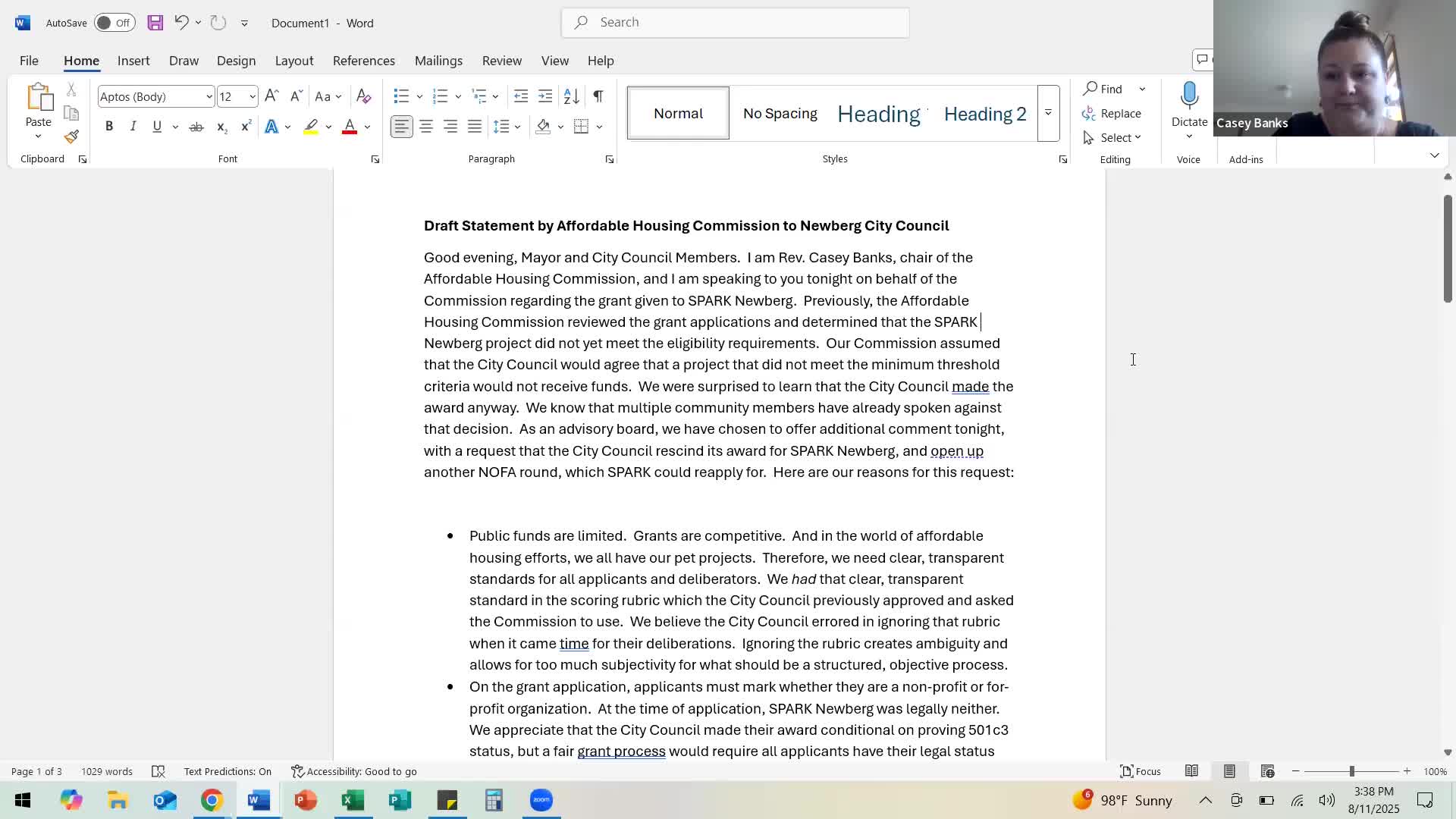
Members of the Affordable Housing Commission said at a work session they will ask the city council to rescind a Construction Excise Tax (CET) award to Spark Newburg and reopen the Notice of Funding Availability (NOFA) so the project can reapply after addressing outstanding concerns.
Reverend Casey Banks, chair of the Affordable Housing Commission, said the commission "previously reviewed the grant applications and determined that the Spark Newburg project did not yet meet the eligibility requirements. Our commission assumed that the city council would agree that a project that did not meet the minimum threshold criteria would not receive funds. We were surprised to learn that the city council made the award anyway." The commission adopted a statement on the issue to be delivered to the council at its next meeting.
The commission listed several reasons for asking the council to rescind the award. Commissioners said the scoring rubric the commission used — a rubric the city council had approved and asked the commission to apply — was not followed in the council deliberations, creating "ambiguity" and room for subjectivity. Commissioners also said Spark Newburg had not established its legal nonprofit status at the time of application, and that the council’s award appeared conditional on proof of 501(c)(3) status rather than requiring the status prior to application.
Commissioners raised financial and program-design concerns. The draft statement notes the commission has not seen a financial plan demonstrating that Spark Newburg’s model is financially sustainable and that the project would need roughly $6,000,000 in additional funds to launch; application materials reportedly say the group has applied for a federal grant but do not document the additional capital. Commissioners pointed to a past project (Peace Trail Village) that was required to secure additional funding as a condition of a city award and said the city should be consistent when judging feasibility.
The commission also flagged a lack of a property identification: if CET funds are intended for property purchase, the rubric asked applicants to identify a parcel and provide a purchase option or letter of interest from the seller; at the time of application, commissioners said Spark Newburg had not identified a property or shown seller willingness. Leanne, city staff in community development, noted a distinction between the rubric and the municipal code for CET uses but confirmed the fund can be used for land acquisition and that the rubric asked for evidence of project progression.
Commissioners expressed concern that application materials used the phrase "market competitive rent payments" in some places while the verbal presentation used the term "participant fees," and they asked for clarity about whether fees would be treated as rent by mortgage lenders and whether using the term "participant" rather than "tenant" would affect participants’ tenant rights. The commission also raised program design elements — classes, weekly meetings, unpaid internships, community service, inspections and quarterly check-ins — asking whether typical participants could hold full-time employment and care for family responsibilities while meeting four years of requirements and how dropout risk might affect both participants and program finances.
Commissioners noted the CET fund requires funded projects to provide affordable housing for at least 60 years from the date of construction and said, because Spark Newburg had not yet established nonprofit status, the commission had not been able to review dissolution or asset-transfer clauses that would govern what happens to property and funds if the organization dissolves or the program ends before 60 years.
At the end of the work session, four commission members moved, seconded and adopted a statement (voice vote) authorizing a presentation to the city council. Commissioner Samantha moved the adoption; a second was recorded but the seconder’s name was not specified in the meeting transcript. The statement asks the council to rescind the CET award and open another NOFA so Spark Newburg can address the commission’s concerns and reapply. Commissioners said they plan to present the statement during the council meeting agenda item about the legal review and eligibility for the award. "We encourage Spark Newburg to address these concerns and then reapply," the statement says.
The commission emphasized that its request is not an absolute rejection of the project but a request for a competitive process that follows published criteria and addresses financial, legal and programmatic gaps. City staff said the grant agreement ultimately originates with the city legal team and will go through staff review and negotiation before execution; the legal team was reported to be preparing an eligibility assessment for the council.
Next steps: commissioners plan to present the adopted statement to the city council at the council’s meeting slated for the 18th and to provide paper copies for council members the night of the meeting. The commission adopted the statement as four members on behalf of themselves rather than presenting it as a unanimous commission position.
Reverend Casey Banks, chair of the Affordable Housing Commission, said the commission "previously reviewed the grant applications and determined that the Spark Newburg project did not yet meet the eligibility requirements. Our commission assumed that the city council would agree that a project that did not meet the minimum threshold criteria would not receive funds. We were surprised to learn that the city council made the award anyway." The commission adopted a statement on the issue to be delivered to the council at its next meeting.
The commission listed several reasons for asking the council to rescind the award. Commissioners said the scoring rubric the commission used — a rubric the city council had approved and asked the commission to apply — was not followed in the council deliberations, creating "ambiguity" and room for subjectivity. Commissioners also said Spark Newburg had not established its legal nonprofit status at the time of application, and that the council’s award appeared conditional on proof of 501(c)(3) status rather than requiring the status prior to application.
Commissioners raised financial and program-design concerns. The draft statement notes the commission has not seen a financial plan demonstrating that Spark Newburg’s model is financially sustainable and that the project would need roughly $6,000,000 in additional funds to launch; application materials reportedly say the group has applied for a federal grant but do not document the additional capital. Commissioners pointed to a past project (Peace Trail Village) that was required to secure additional funding as a condition of a city award and said the city should be consistent when judging feasibility.
The commission also flagged a lack of a property identification: if CET funds are intended for property purchase, the rubric asked applicants to identify a parcel and provide a purchase option or letter of interest from the seller; at the time of application, commissioners said Spark Newburg had not identified a property or shown seller willingness. Leanne, city staff in community development, noted a distinction between the rubric and the municipal code for CET uses but confirmed the fund can be used for land acquisition and that the rubric asked for evidence of project progression.
Commissioners expressed concern that application materials used the phrase "market competitive rent payments" in some places while the verbal presentation used the term "participant fees," and they asked for clarity about whether fees would be treated as rent by mortgage lenders and whether using the term "participant" rather than "tenant" would affect participants’ tenant rights. The commission also raised program design elements — classes, weekly meetings, unpaid internships, community service, inspections and quarterly check-ins — asking whether typical participants could hold full-time employment and care for family responsibilities while meeting four years of requirements and how dropout risk might affect both participants and program finances.
Commissioners noted the CET fund requires funded projects to provide affordable housing for at least 60 years from the date of construction and said, because Spark Newburg had not yet established nonprofit status, the commission had not been able to review dissolution or asset-transfer clauses that would govern what happens to property and funds if the organization dissolves or the program ends before 60 years.
At the end of the work session, four commission members moved, seconded and adopted a statement (voice vote) authorizing a presentation to the city council. Commissioner Samantha moved the adoption; a second was recorded but the seconder’s name was not specified in the meeting transcript. The statement asks the council to rescind the CET award and open another NOFA so Spark Newburg can address the commission’s concerns and reapply. Commissioners said they plan to present the statement during the council meeting agenda item about the legal review and eligibility for the award. "We encourage Spark Newburg to address these concerns and then reapply," the statement says.
The commission emphasized that its request is not an absolute rejection of the project but a request for a competitive process that follows published criteria and addresses financial, legal and programmatic gaps. City staff said the grant agreement ultimately originates with the city legal team and will go through staff review and negotiation before execution; the legal team was reported to be preparing an eligibility assessment for the council.
Next steps: commissioners plan to present the adopted statement to the city council at the council’s meeting slated for the 18th and to provide paper copies for council members the night of the meeting. The commission adopted the statement as four members on behalf of themselves rather than presenting it as a unanimous commission position.
View the Full Meeting & All Its Details
This article offers just a summary. Unlock complete video, transcripts, and insights as a Founder Member.
✓
Watch full, unedited meeting videos
✓
Search every word spoken in unlimited transcripts
✓
AI summaries & real-time alerts (all government levels)
✓
Permanent access to expanding government content
30-day money-back guarantee
