Charlottesville officials outline $100 million baseline to modernize aging school buildings
August 15, 2025 | CHARLOTTESVILLE CTY PBLC SCHS, School Districts, Virginia
This article was created by AI summarizing key points discussed. AI makes mistakes, so for full details and context, please refer to the video of the full meeting. Please report any errors so we can fix them. Report an error »
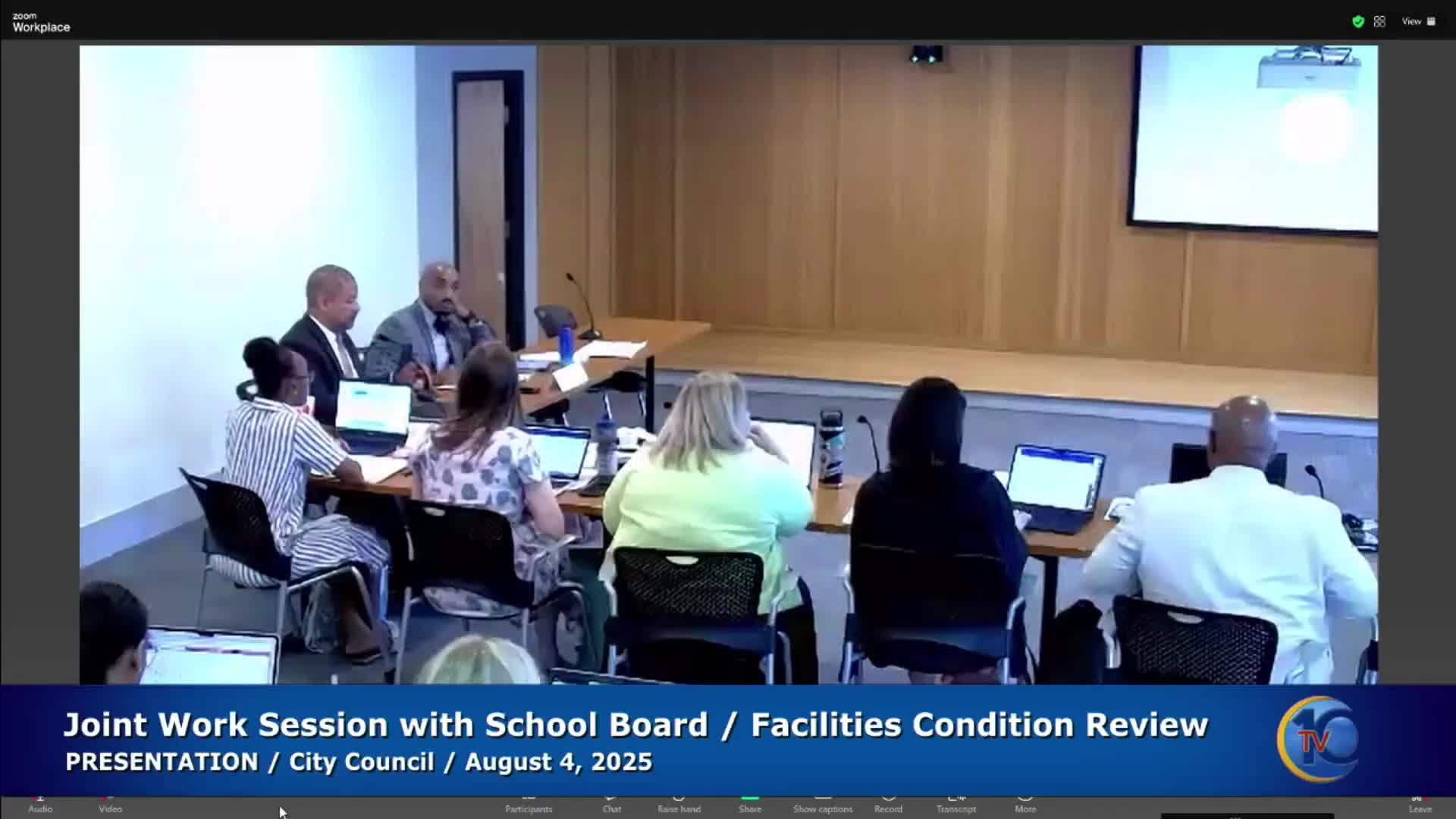
Charlottesville city and school officials on Aug. 4 told a joint City Council–School Board session that while the school system’s buildings are generally maintained, many are aging and face recurring, large-ticket needs — particularly HVAC, roofing, electrical and accessibility upgrades — and that a rough systemwide modernization “baseline” is about $100,000,000.
City Manager Sam Sanders opened the session and said the presentations were intended to give council and the school board a common factual basis ahead of the council’s Aug. 15–16 retreat. "My job is always to remind you of choices that you have to make and the discipline that comes with spending money that we have," Sanders said.
The presentations combined three threads: current building condition, enrollment and capacity projections, and the ability of existing buildings to meet modern instructional needs. James Friess, deputy city manager for operations, described the current practice of funding small, discrete summer projects and said the alternative is a school-by-school deep-renovation or modernization program. "We have about a million dollars a year, that we dedicate towards discrete projects that can be completed over the course of roughly one summer," Friess said.
Kim Powell, chief operations officer for Charlottesville City Schools, summarized enrollment trends and projections and said the division’s analysis does not show an imminent systemwide capacity shortage. "There isn't, like, an imminent capacity issue with our schools," Powell said, noting that historic growth tied to local housing shifts has stabilized since the pandemic and is now on a slight downward trend influenced by lower birth rates. Powell and staff said enrollment impacts will be zone-specific and that planned and proposed housing developments could change the outlook.
Deputy Director of Public Works Mike Goddard reviewed building-level conditions and recurring themes: aging roofs, windows, plumbing and electrical systems; undersized auditoriums or cafeterias at some sites; floor-level changes that complicate accessibility; and dated ceilings and lighting. Goddard presented a systemwide, finish-and-systems package and described the figure at the bottom of the presentation as a high-level, placeholder estimate: "You see down the bottom a $100,000,000. We're not talking about escalation costs… Anytime you see a round number in construction, you should be worried about the accuracy of that number," he said.
Officials emphasized that the $100 million figure is intended as a planning floor rather than a precise bid. Staff proposed next steps including in-depth, school-by-school assessments to produce detailed scope and cost estimates and a multi-year capital and construction plan. Friess said any deeper program would examine whether to pursue whole-building renovation, renovation plus additions, or targeted modernization projects.
Presenters noted an urgent list of capital maintenance items that must be addressed regardless of broader modernization priorities, and several council members pressed for sequencing and funding scenarios. One councilor raised the possibility of additional state funding and a local sales tax for school construction; a council speaker cited a 1% sales-tax estimate of roughly $13,000,000 annually if enacted at the state level and noted that such revenue would materially change the district’s options.
Staff also gave a brief status update on Charlottesville Middle School (the Buford replacement): teachers have moved into the new buildings and temporary occupancy is under way while renovations of the older buildings continue. Presenters invited council feedback on whether to continue the current, incremental summer-project approach or to pursue a more comprehensive, multi-year modernization program.
The joint session was for information and discussion only; no formal modernization plan or funding measure was put to a vote at the meeting.
City Manager Sam Sanders opened the session and said the presentations were intended to give council and the school board a common factual basis ahead of the council’s Aug. 15–16 retreat. "My job is always to remind you of choices that you have to make and the discipline that comes with spending money that we have," Sanders said.
The presentations combined three threads: current building condition, enrollment and capacity projections, and the ability of existing buildings to meet modern instructional needs. James Friess, deputy city manager for operations, described the current practice of funding small, discrete summer projects and said the alternative is a school-by-school deep-renovation or modernization program. "We have about a million dollars a year, that we dedicate towards discrete projects that can be completed over the course of roughly one summer," Friess said.
Kim Powell, chief operations officer for Charlottesville City Schools, summarized enrollment trends and projections and said the division’s analysis does not show an imminent systemwide capacity shortage. "There isn't, like, an imminent capacity issue with our schools," Powell said, noting that historic growth tied to local housing shifts has stabilized since the pandemic and is now on a slight downward trend influenced by lower birth rates. Powell and staff said enrollment impacts will be zone-specific and that planned and proposed housing developments could change the outlook.
Deputy Director of Public Works Mike Goddard reviewed building-level conditions and recurring themes: aging roofs, windows, plumbing and electrical systems; undersized auditoriums or cafeterias at some sites; floor-level changes that complicate accessibility; and dated ceilings and lighting. Goddard presented a systemwide, finish-and-systems package and described the figure at the bottom of the presentation as a high-level, placeholder estimate: "You see down the bottom a $100,000,000. We're not talking about escalation costs… Anytime you see a round number in construction, you should be worried about the accuracy of that number," he said.
Officials emphasized that the $100 million figure is intended as a planning floor rather than a precise bid. Staff proposed next steps including in-depth, school-by-school assessments to produce detailed scope and cost estimates and a multi-year capital and construction plan. Friess said any deeper program would examine whether to pursue whole-building renovation, renovation plus additions, or targeted modernization projects.
Presenters noted an urgent list of capital maintenance items that must be addressed regardless of broader modernization priorities, and several council members pressed for sequencing and funding scenarios. One councilor raised the possibility of additional state funding and a local sales tax for school construction; a council speaker cited a 1% sales-tax estimate of roughly $13,000,000 annually if enacted at the state level and noted that such revenue would materially change the district’s options.
Staff also gave a brief status update on Charlottesville Middle School (the Buford replacement): teachers have moved into the new buildings and temporary occupancy is under way while renovations of the older buildings continue. Presenters invited council feedback on whether to continue the current, incremental summer-project approach or to pursue a more comprehensive, multi-year modernization program.
The joint session was for information and discussion only; no formal modernization plan or funding measure was put to a vote at the meeting.
View the Full Meeting & All Its Details
This article offers just a summary. Unlock complete video, transcripts, and insights as a Founder Member.
✓
Watch full, unedited meeting videos
✓
Search every word spoken in unlimited transcripts
✓
AI summaries & real-time alerts (all government levels)
✓
Permanent access to expanding government content
30-day money-back guarantee
