Walker campus plan: new 20‑classroom Early Learning Center, swing‑space and phased reuse proposed
August 15, 2025 | CHARLOTTESVILLE CTY PBLC SCHS, School Districts, Virginia
This article was created by AI summarizing key points discussed. AI makes mistakes, so for full details and context, please refer to the video of the full meeting. Please report any errors so we can fix them. Report an error »
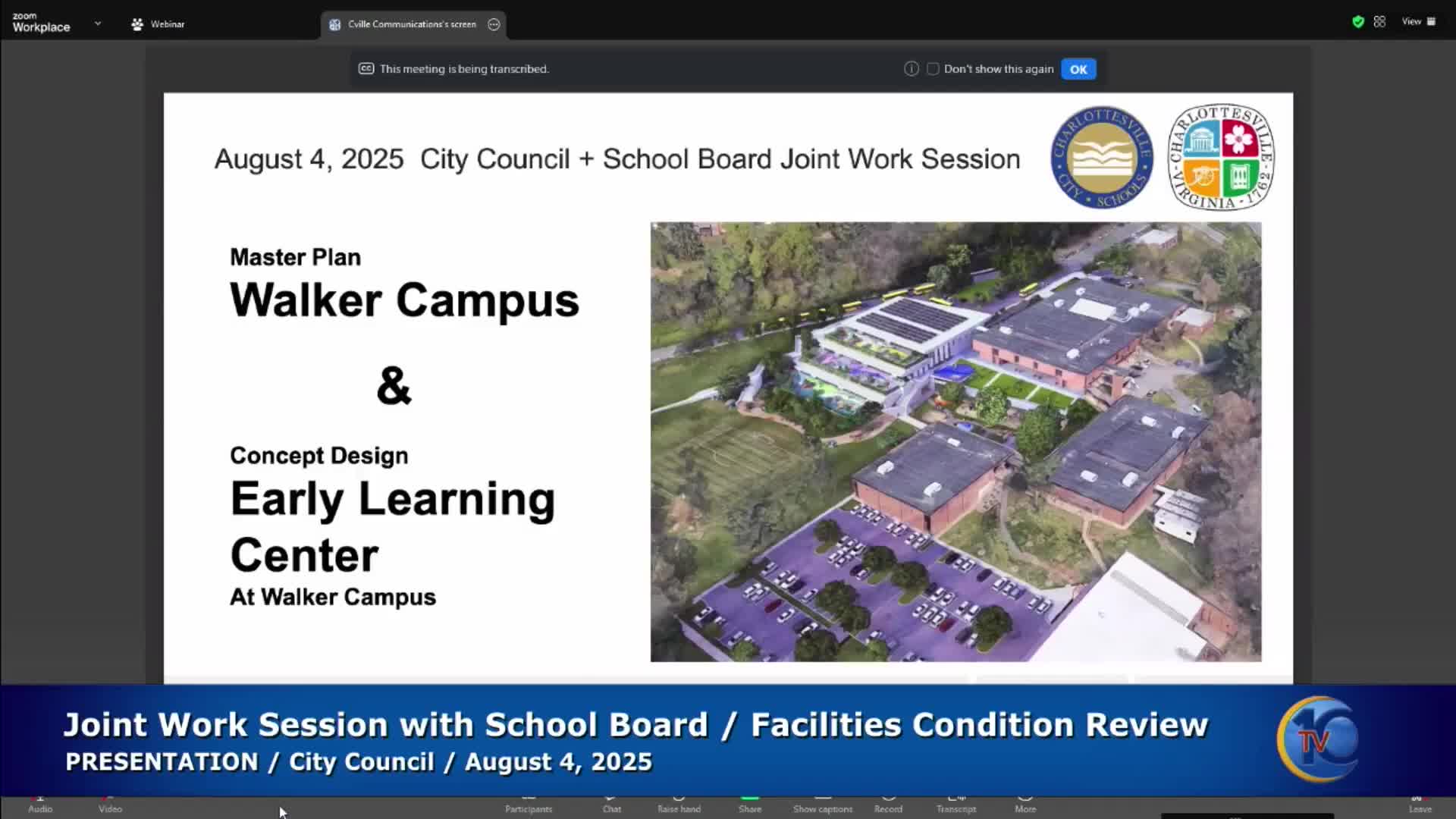
Architects and school staff on Aug. 4 presented a concept design and master plan for the Walker campus that would build a purpose‑built Early Learning Center for Charlottesville preschool programs, repurpose several existing buildings for swing space and alternative programs, and stage long‑term campus improvements in phases.
Maria Beninski, an architect working with the district, said the proposed Early Learning Center would open in fall 2028 and would initially include 20 classrooms with the capacity for a future expansion of about 12 classrooms. "This project for the Early Learning Center is the next major investment in Charlottesville City Schools facilities that's upcoming," Beninski said.
Under the concept, the preschool classrooms currently distributed across six elementary schools would move into the new, purpose‑built facility. The design locates classroom levels on terraces that step down the site to provide secured outdoor play and learning spaces adjacent to each classroom level. The new building’s bus loop and entry would be oriented to Gentry Lane, and the scheme would retain and reuse other campus buildings where practical.
The master plan presents a multistage approach: phase 1 — construct the Early Learning Center; phase 2 — relocate preschool into existing Building A as swing space while Building A is renovated; phase 3 — relocate Lugo‑McGinnis Academy (the district’s alternative high‑school program) into Building B with access to the gym; subsequent phases add long‑term parking, administrative consolidation and optional preschool expansion into Building A. Beninski emphasized that the plan is modular and that none of the later phases are required to proceed with earlier steps.
City and school staff highlighted potential benefits: a centralized, purpose‑built preschool facility; dedicated, secured outdoor spaces for early learners; a swing campus to reduce disruption during larger elementary renovations; and reuse of existing structures to limit demolition. The plan assumes demolition of a small, existing administration building on site and reuses other campus structures.
Discussion at the joint session included logistics such as transportation. Staff said preschool transportation would continue to be provided by bus and that, operationally, preschool routes would be placed on the middle‑school tier of routing (between elementary and high‑school tiers) to align with driver schedules. The project team also noted site constraints — notably a steep hillside that requires retaining‑wall work and regrading to create the proposed bus loop and terraces.
No formal approval or funding vote occurred at the meeting; staff asked for feedback and signaled they would return with refined cost estimates and program details if council and the school board want to proceed toward design and financing steps.
Maria Beninski, an architect working with the district, said the proposed Early Learning Center would open in fall 2028 and would initially include 20 classrooms with the capacity for a future expansion of about 12 classrooms. "This project for the Early Learning Center is the next major investment in Charlottesville City Schools facilities that's upcoming," Beninski said.
Under the concept, the preschool classrooms currently distributed across six elementary schools would move into the new, purpose‑built facility. The design locates classroom levels on terraces that step down the site to provide secured outdoor play and learning spaces adjacent to each classroom level. The new building’s bus loop and entry would be oriented to Gentry Lane, and the scheme would retain and reuse other campus buildings where practical.
The master plan presents a multistage approach: phase 1 — construct the Early Learning Center; phase 2 — relocate preschool into existing Building A as swing space while Building A is renovated; phase 3 — relocate Lugo‑McGinnis Academy (the district’s alternative high‑school program) into Building B with access to the gym; subsequent phases add long‑term parking, administrative consolidation and optional preschool expansion into Building A. Beninski emphasized that the plan is modular and that none of the later phases are required to proceed with earlier steps.
City and school staff highlighted potential benefits: a centralized, purpose‑built preschool facility; dedicated, secured outdoor spaces for early learners; a swing campus to reduce disruption during larger elementary renovations; and reuse of existing structures to limit demolition. The plan assumes demolition of a small, existing administration building on site and reuses other campus structures.
Discussion at the joint session included logistics such as transportation. Staff said preschool transportation would continue to be provided by bus and that, operationally, preschool routes would be placed on the middle‑school tier of routing (between elementary and high‑school tiers) to align with driver schedules. The project team also noted site constraints — notably a steep hillside that requires retaining‑wall work and regrading to create the proposed bus loop and terraces.
No formal approval or funding vote occurred at the meeting; staff asked for feedback and signaled they would return with refined cost estimates and program details if council and the school board want to proceed toward design and financing steps.
Don't Miss a Word: See the Full Meeting!
Go beyond summaries. Unlock every video, transcript, and key insight with a Founder Membership.
✓
Get instant access to full meeting videos
✓
Search and clip any phrase from complete transcripts
✓
Receive AI-powered summaries & custom alerts
✓
Enjoy lifetime, unrestricted access to government data
30-day money-back guarantee
