Haywood County public health outlines opioid treatment program, asks commissioners to reserve funds if state carryforward fails
June 16, 2025 | Haywood County, North Carolina
This article was created by AI summarizing key points discussed. AI makes mistakes, so for full details and context, please refer to the video of the full meeting. Please report any errors so we can fix them. Report an error »
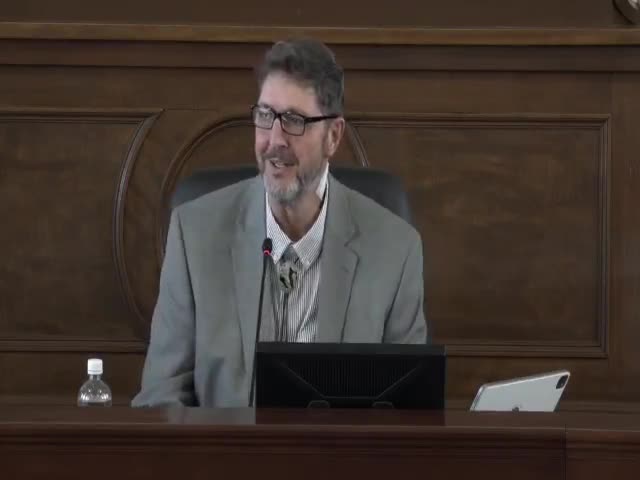
Dr. Sarah Banks briefed the Haywood County Board of Commissioners on June 16 about a consolidated public-health effort to treat substance use disorders that combines medication-assisted treatment (MAT), care coordination and referrals from recovery court and the sheriff’s office.
Banks said the program emphasizes whole-person care: "Our public health service division aims to reduce morbidity and mortality rates through early detection, treatment accountability, and education for individuals identified with substance use disorder." She described a clinic-based pathway in which patients meet weekly at first, move to biweekly visits as they stabilize, and remain on closely monitored medication regimens between visits.
The presentation included program metrics and a human example. Banks said the county began treating patients in June 2023; in roughly 24 months the program recorded 29 patients, 246 clinical visits and 164 negative drug screens, with nine patients still in care. She read a written testimonial from a recovery-court participant, Lindsay, who completed the program and returned to nursing practice; Banks said Lindsay now works in the county substance-use clinic.
On financing, county staff told commissioners they asked the General Assembly to carry forward state opioid-treatment funds. "We'd like to bring [a resolution] back at the meeting on the 21st," a county official said; commissioners were told that if the state does not carry forward the funds, the board would be asked to appropriate county opioid funds so the program can continue without interruption.
Commissioners praised the program and noted falling local substance-related deaths in recent years; Banks said improved access to Narcan and MAT, plus stronger continuity of care from detention to community treatment, likely contributed to recent declines. The board asked staff to return with a resolution at the July 21 meeting if the state's action is not confirmed.
Banks said the program emphasizes whole-person care: "Our public health service division aims to reduce morbidity and mortality rates through early detection, treatment accountability, and education for individuals identified with substance use disorder." She described a clinic-based pathway in which patients meet weekly at first, move to biweekly visits as they stabilize, and remain on closely monitored medication regimens between visits.
The presentation included program metrics and a human example. Banks said the county began treating patients in June 2023; in roughly 24 months the program recorded 29 patients, 246 clinical visits and 164 negative drug screens, with nine patients still in care. She read a written testimonial from a recovery-court participant, Lindsay, who completed the program and returned to nursing practice; Banks said Lindsay now works in the county substance-use clinic.
On financing, county staff told commissioners they asked the General Assembly to carry forward state opioid-treatment funds. "We'd like to bring [a resolution] back at the meeting on the 21st," a county official said; commissioners were told that if the state does not carry forward the funds, the board would be asked to appropriate county opioid funds so the program can continue without interruption.
Commissioners praised the program and noted falling local substance-related deaths in recent years; Banks said improved access to Narcan and MAT, plus stronger continuity of care from detention to community treatment, likely contributed to recent declines. The board asked staff to return with a resolution at the July 21 meeting if the state's action is not confirmed.
View the Full Meeting & All Its Details
This article offers just a summary. Unlock complete video, transcripts, and insights as a Founder Member.
✓
Watch full, unedited meeting videos
✓
Search every word spoken in unlimited transcripts
✓
AI summaries & real-time alerts (all government levels)
✓
Permanent access to expanding government content
30-day money-back guarantee
