Planning staff presents final parking ordinance changes; committee discusses restaurant, residential and ADA standards
June 16, 2025 | Manchester City Commissions, Manchester, Hillsborough County, New Hampshire
This article was created by AI summarizing key points discussed. AI makes mistakes, so for full details and context, please refer to the video of the full meeting. Please report any errors so we can fix them. Report an error »
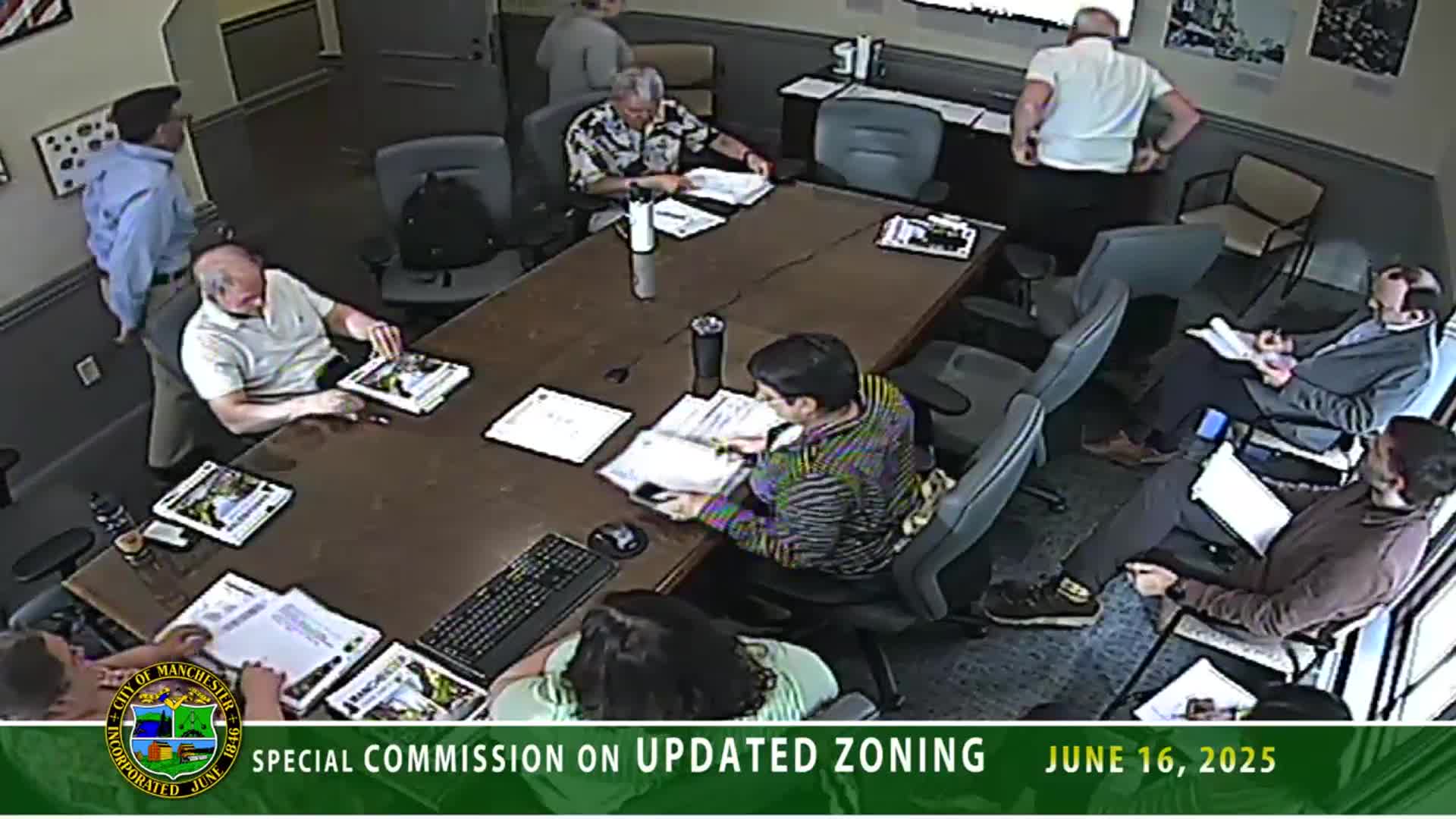
Planning staff on the Manchester City Commissions' zoning steering committee presented a near-final draft of parking ordinance revisions that would change how restaurants and retail are calculated, clarify treatment of outdoor seating in the public right-of-way, and align some rules with state and national guidance, including ITE and IBC/ADA references.
The changes staff described include exempting the Gaslight Historic Overlay District from local parking standards, reducing some commercial parking requirements in DT1 and the Milliard zoning district to half of the current commercial standard, and keeping lodging and dwelling-unit parking at one space per unit. Staff also proposed switching restaurant parking from a seat-based standard to a gross floor-area standard of one space per 125 square feet; general neighborhood retail and service uses would use one space per 300 square feet.
Kristen (staff member) told the committee the shift from seat counts to square footage was grounded in a review of ITE (Institute of Transportation Engineers) parking guidance and a set of recent local applications (for example, Dave’s Hot Chicken) that allowed staff to model a practical conversion to a 1 per 125 sq. ft. metric. Kristen said the 1/125 number “comes out pretty much in the middle” of local examples and national standards and reflects Manchester’s more urban context.
The committee also discussed how outdoor seating is treated: seating in the public right-of-way (sidewalks or street) will not trigger an additional zoning parking calculation because city clerk licensing and DPW review already govern use of the right-of-way. By contrast, outdoor seating that is fully on a business’s private lot will be counted in the parking calculation.
Other notable staff proposals: motor vehicle sales would retain the existing 1 space per 3,000 square feet of outdoor display area for vehicles offered for sale; the office portion used for vehicle sales would be 1 space per 500 square feet (revised from 1 per 400). Stacking-space requirements (for drive-through lanes) remain, and staff recommended adding stacking requirements for commercial child day-care centers to address pick-up/drop-off queues. Loading spaces were reduced in size for many smaller commercial uses so that typical deliveries could be accommodated by smaller trucks or vans instead of requiring space sized for an 18-wheeler.
Kristen and Jeff (staff member) said the draft also simplifies parking rules for small multifamily building types, adding “triple decker” as a building type (three stacked flats) and allowing tandem parking in alley-served configurations when spaces are assigned to specific units. Staff said the intent is to reflect as-built parking patterns in many neighborhoods and reduce what planners called “day-to-day enforcement surprises.”
On accessible parking, staff said they studied ADA guidance and the International Building Code (IBC) and proposed changes to make on-site accessible spaces consistent with standard stall lengths (removing an older requirement that made ADA spaces longer than other spaces). They also noted federal ADA/DOJ guidance was consulted; staff emphasized that municipal zoning enforces the IBC but that ADA or FHA obligations on private owners may be triggered by financing or federal law and are not directly enforced by the city’s zoning code.
No formal action was taken on the parking article during the meeting; staff asked the committee for final input before publishing the draft for the next public comment round. Kristen closed the discussion by asking if there were further questions and indicating staff would finalize wording for publication.
Ending: Staff said they will refine wording and illustrations (including ADA diagrams and tandem-parking illustrations from Rosa) and bring a final draft forward for the committee to review before public release.
The changes staff described include exempting the Gaslight Historic Overlay District from local parking standards, reducing some commercial parking requirements in DT1 and the Milliard zoning district to half of the current commercial standard, and keeping lodging and dwelling-unit parking at one space per unit. Staff also proposed switching restaurant parking from a seat-based standard to a gross floor-area standard of one space per 125 square feet; general neighborhood retail and service uses would use one space per 300 square feet.
Kristen (staff member) told the committee the shift from seat counts to square footage was grounded in a review of ITE (Institute of Transportation Engineers) parking guidance and a set of recent local applications (for example, Dave’s Hot Chicken) that allowed staff to model a practical conversion to a 1 per 125 sq. ft. metric. Kristen said the 1/125 number “comes out pretty much in the middle” of local examples and national standards and reflects Manchester’s more urban context.
The committee also discussed how outdoor seating is treated: seating in the public right-of-way (sidewalks or street) will not trigger an additional zoning parking calculation because city clerk licensing and DPW review already govern use of the right-of-way. By contrast, outdoor seating that is fully on a business’s private lot will be counted in the parking calculation.
Other notable staff proposals: motor vehicle sales would retain the existing 1 space per 3,000 square feet of outdoor display area for vehicles offered for sale; the office portion used for vehicle sales would be 1 space per 500 square feet (revised from 1 per 400). Stacking-space requirements (for drive-through lanes) remain, and staff recommended adding stacking requirements for commercial child day-care centers to address pick-up/drop-off queues. Loading spaces were reduced in size for many smaller commercial uses so that typical deliveries could be accommodated by smaller trucks or vans instead of requiring space sized for an 18-wheeler.
Kristen and Jeff (staff member) said the draft also simplifies parking rules for small multifamily building types, adding “triple decker” as a building type (three stacked flats) and allowing tandem parking in alley-served configurations when spaces are assigned to specific units. Staff said the intent is to reflect as-built parking patterns in many neighborhoods and reduce what planners called “day-to-day enforcement surprises.”
On accessible parking, staff said they studied ADA guidance and the International Building Code (IBC) and proposed changes to make on-site accessible spaces consistent with standard stall lengths (removing an older requirement that made ADA spaces longer than other spaces). They also noted federal ADA/DOJ guidance was consulted; staff emphasized that municipal zoning enforces the IBC but that ADA or FHA obligations on private owners may be triggered by financing or federal law and are not directly enforced by the city’s zoning code.
No formal action was taken on the parking article during the meeting; staff asked the committee for final input before publishing the draft for the next public comment round. Kristen closed the discussion by asking if there were further questions and indicating staff would finalize wording for publication.
Ending: Staff said they will refine wording and illustrations (including ADA diagrams and tandem-parking illustrations from Rosa) and bring a final draft forward for the committee to review before public release.
View the Full Meeting & All Its Details
This article offers just a summary. Unlock complete video, transcripts, and insights as a Founder Member.
✓
Watch full, unedited meeting videos
✓
Search every word spoken in unlimited transcripts
✓
AI summaries & real-time alerts (all government levels)
✓
Permanent access to expanding government content
30-day money-back guarantee
