Committee weighs limits on short-term rentals and clarifies accessory uses, congregate housing and community-garden parking
June 16, 2025 | Manchester City Commissions, Manchester, Hillsborough County, New Hampshire
This article was created by AI summarizing key points discussed. AI makes mistakes, so for full details and context, please refer to the video of the full meeting. Please report any errors so we can fix them. Report an error »
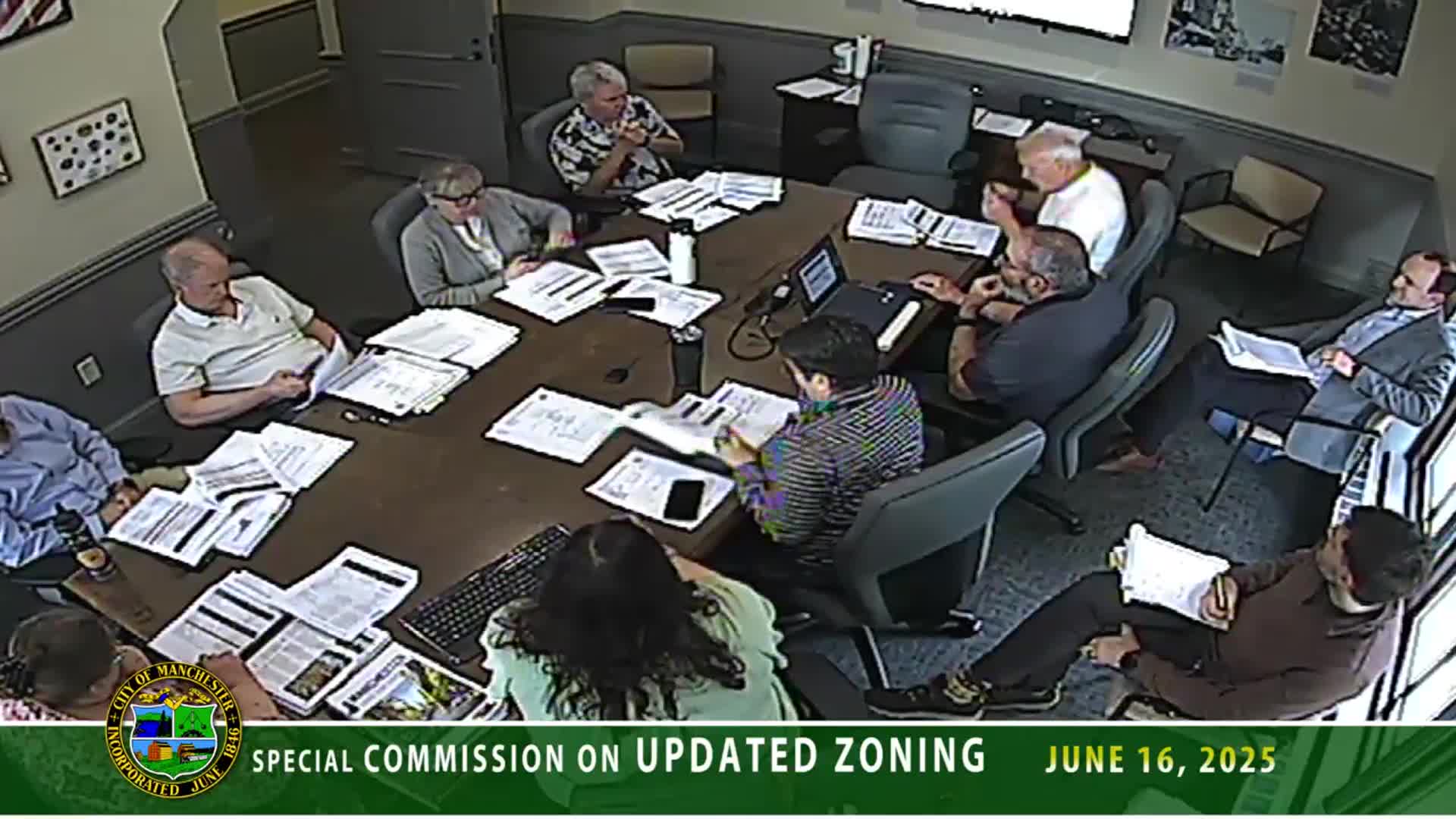
Committee members debated whether to permit short-term rentals broadly or to restrict them to higher-density commercial and mixed-use districts and allow conditional-use (CU) or special-exception (SE) review elsewhere. Staff (Kristen) and several committee members said the draft would remove short-term rentals from residential districts and permit them by right in DT1, DT2, Milliard and some MX districts, with special-exception or conditional-use review in other mixed zones. Members discussed definitions, enforcement and how to balance neighborhood impacts with housing supply concerns.
Kristen read the current draft definition of short-term rental as “rental of any residential dwelling unit or portion thereof for occupancy of less than 30 consecutive days and no more than 90 total days per year,” and said staff may adjust that phrasing. Committee members debated whether to treat short-term rentals as bed-and-breakfast uses (owner present) or to require a CU/SE so neighbors receive notice and can comment. Several members favored applying any restriction consistently across districts rather than allowing uneven treatment that could be perceived as unfair.
On accessory uses, staff proposed aligning family day-care parking with state rules: accessory family day care serving six or fewer children would not require an extra on-site parking space; larger facilities would. The committee discussed beekeeping and backyard-chicken allowances as accessory uses in residential districts (subject to size and limits); staff said principal-use community gardens on private lots would need parking because they attract users who will drive and unload supplies, while community gardens in parks or on public property remain exempt from zoning.
The committee also discussed congregate housing: staff reported state-level proposals (referenced as a pending House bill) could restrict municipalities’ ability to limit occupancy and warned the committee that the proposed state language could undermine Manchester’s current local limits on unrelated-occupant counts. Staff said they are defining congregate housing more narrowly in the draft so that true service-oriented facilities (with onsite services) are regulated distinctly from unrelated-rooming-house scenarios.
Members emphasized enforcement and transparency: conditional-use and special-exception processes provide public notice and an opportunity for neighbors to raise concerns, staff said. No committee vote was held on short-term rentals or accessory-use changes; staff said the topic will return in the next public-comment round and that aldermen will receive briefings on the draft.
Ending: Staff said it will return with refined language on short-term-rental definitions, accessory-use thresholds (beekeeping/chickens), and congregate-housing definitions before the August public release.
Kristen read the current draft definition of short-term rental as “rental of any residential dwelling unit or portion thereof for occupancy of less than 30 consecutive days and no more than 90 total days per year,” and said staff may adjust that phrasing. Committee members debated whether to treat short-term rentals as bed-and-breakfast uses (owner present) or to require a CU/SE so neighbors receive notice and can comment. Several members favored applying any restriction consistently across districts rather than allowing uneven treatment that could be perceived as unfair.
On accessory uses, staff proposed aligning family day-care parking with state rules: accessory family day care serving six or fewer children would not require an extra on-site parking space; larger facilities would. The committee discussed beekeeping and backyard-chicken allowances as accessory uses in residential districts (subject to size and limits); staff said principal-use community gardens on private lots would need parking because they attract users who will drive and unload supplies, while community gardens in parks or on public property remain exempt from zoning.
The committee also discussed congregate housing: staff reported state-level proposals (referenced as a pending House bill) could restrict municipalities’ ability to limit occupancy and warned the committee that the proposed state language could undermine Manchester’s current local limits on unrelated-occupant counts. Staff said they are defining congregate housing more narrowly in the draft so that true service-oriented facilities (with onsite services) are regulated distinctly from unrelated-rooming-house scenarios.
Members emphasized enforcement and transparency: conditional-use and special-exception processes provide public notice and an opportunity for neighbors to raise concerns, staff said. No committee vote was held on short-term rentals or accessory-use changes; staff said the topic will return in the next public-comment round and that aldermen will receive briefings on the draft.
Ending: Staff said it will return with refined language on short-term-rental definitions, accessory-use thresholds (beekeeping/chickens), and congregate-housing definitions before the August public release.
View the Full Meeting & All Its Details
This article offers just a summary. Unlock complete video, transcripts, and insights as a Founder Member.
✓
Watch full, unedited meeting videos
✓
Search every word spoken in unlimited transcripts
✓
AI summaries & real-time alerts (all government levels)
✓
Permanent access to expanding government content
30-day money-back guarantee
