Sarasota Commission OKs broad zoning-text changes but removes long-building limit for more study
October 20, 2025 | Sarasota City, Sarasota County, Florida
This article was created by AI summarizing key points discussed. AI makes mistakes, so for full details and context, please refer to the video of the full meeting. Please report any errors so we can fix them. Report an error »
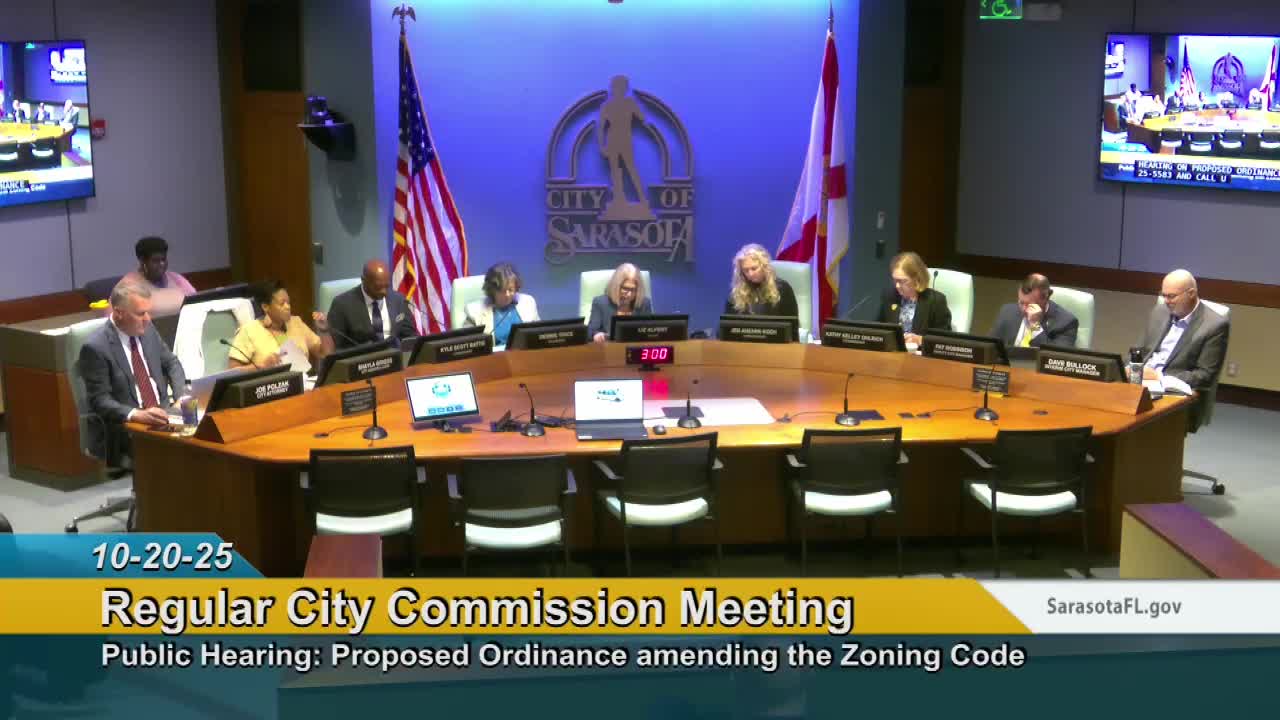
The Sarasota City Commission on Oct. 20 approved a broad set of zoning-text amendments (ordinance 25‑5583) that revise the city’s zoning code definitions, tree and landscape rules, development and downtown design standards and several procedural points — but the commission removed a single, controversial item increasing the maximum building length in urban mixed‑use districts and sent that issue back to staff for further study.
Planning Department General Manager Ryan Chaplain and Chief Planner Brianna Dobbs described the package as the city’s 2025 annual zoning‑text amendment batch. Chaplain said the planning board had recommended approval for nearly all items the board reviewed on Sept. 10, 2025, and Chaplain and Dobbs walked commissioners through about 22 separate changes ranging from clarifying rooftop mechanical screening and bicycle‑parking rules to tree species lists and how waterfront setbacks are measured.
The amendments include: (1) clarifying screening materials for rooftop mechanical equipment; (2) amending the “dwelling unit” definition to allow attached accessory rooms (for example, a pool bath) that lack an internal connection to the primary residence; (3) reconciling two commercial‑parking definitions; (4) standardizing a 5‑foot setback for pools and pool cages; (5) removing certain invasive or misclassified species from the “protected tree” definition and adjusting allowed species lists (for example, replacing queen palm with ribbon palm for a 3‑to‑1 canopy equivalence); (6) relocating and clarifying staging plan requirements; and (7) allowing the Historic Preservation Board to grant density variances to incentivize relocating locally designated historic structures.
The package also contains language to align the city’s plat and replat procedures with two recent state laws (referred to in the presentation as Senate Bills 812 and 784). Chaplain told commissioners one minor zoning item about building‑official appointment was withdrawn from this hearing and will return in a separate code amendment.
Why this matters: The amendments touch many everyday land‑use rules — tree selection and protection, how signs and parking relate to waterfront setbacks, and rules that affect small infill lots and downtown design. Several public speakers and neighborhood groups urged the commission to resist changes that would allow longer, uninterrupted building facades along commercial corridors.
Public comment and debate: Kelly Brown, president of the Sarasota Coalition of City Neighborhood Associations (CCNA), urged the commission to remove from the batch the proposed increase to maximum building length in the urban mixed‑use (MU) districts, arguing the 200‑foot standard had been adopted only a year ago and that increasing it to 250 feet (staff’s compromise after initial developer requests for 300 feet) would undermine the downtown street scale. Brown noted the planning board had unanimously denied the change.
Brooke Fleming, a certified planner with Kimberly Horn representing Orange Pineapple LLC (owner of the McAlpin House), supported ZTA item 17 that would allow the Historic Preservation Board to grant density adjustments when relocating locally designated historic structures, saying it would help preserve a building her client hopes to move.
Chris Gallagher, a member of the public who said he works on local projects, urged the commission to allow longer building lengths or to permit a larger recessed “break” in the façade rather than a 10‑foot separation, arguing infill projects and affordable housing can be made more efficient with fewer mechanical and vertical circulation duplications.
Commission action: The commission voted unanimously to adopt ordinance 25‑5583 with one change: commissioners removed item 15 (the proposed increase of maximum building length in urban mixed‑use districts from 200 feet to 250 feet) from the ordinance on a separate motion. The commission then approved a second motion directing staff to reexamine item 15, work with stakeholders (including Mr. Gallagher and neighborhood groups), and return with revised language and recommendations for further consideration.
Decisions vs. directions: The approved ordinance now becomes city code except for item 15, which was set aside for additional staff study. Commissioners said they preferred staff to propose more detailed design or setback alternatives rather than decide a numeric change from the dais.
Next steps: Staff will return with a revised proposal for item 15 after further outreach and analysis. The planning staff also will prepare the ordinance language and implementation steps for the other approved items and proceed with administrative updates needed to publish the code changes.
Sources: Planning Department presentation by Ryan Chaplain and Brianna Dobbs; public comments by Kelly Brown, Brooke Fleming and Chris Gallagher; commission roll‑call votes.
Planning Department General Manager Ryan Chaplain and Chief Planner Brianna Dobbs described the package as the city’s 2025 annual zoning‑text amendment batch. Chaplain said the planning board had recommended approval for nearly all items the board reviewed on Sept. 10, 2025, and Chaplain and Dobbs walked commissioners through about 22 separate changes ranging from clarifying rooftop mechanical screening and bicycle‑parking rules to tree species lists and how waterfront setbacks are measured.
The amendments include: (1) clarifying screening materials for rooftop mechanical equipment; (2) amending the “dwelling unit” definition to allow attached accessory rooms (for example, a pool bath) that lack an internal connection to the primary residence; (3) reconciling two commercial‑parking definitions; (4) standardizing a 5‑foot setback for pools and pool cages; (5) removing certain invasive or misclassified species from the “protected tree” definition and adjusting allowed species lists (for example, replacing queen palm with ribbon palm for a 3‑to‑1 canopy equivalence); (6) relocating and clarifying staging plan requirements; and (7) allowing the Historic Preservation Board to grant density variances to incentivize relocating locally designated historic structures.
The package also contains language to align the city’s plat and replat procedures with two recent state laws (referred to in the presentation as Senate Bills 812 and 784). Chaplain told commissioners one minor zoning item about building‑official appointment was withdrawn from this hearing and will return in a separate code amendment.
Why this matters: The amendments touch many everyday land‑use rules — tree selection and protection, how signs and parking relate to waterfront setbacks, and rules that affect small infill lots and downtown design. Several public speakers and neighborhood groups urged the commission to resist changes that would allow longer, uninterrupted building facades along commercial corridors.
Public comment and debate: Kelly Brown, president of the Sarasota Coalition of City Neighborhood Associations (CCNA), urged the commission to remove from the batch the proposed increase to maximum building length in the urban mixed‑use (MU) districts, arguing the 200‑foot standard had been adopted only a year ago and that increasing it to 250 feet (staff’s compromise after initial developer requests for 300 feet) would undermine the downtown street scale. Brown noted the planning board had unanimously denied the change.
Brooke Fleming, a certified planner with Kimberly Horn representing Orange Pineapple LLC (owner of the McAlpin House), supported ZTA item 17 that would allow the Historic Preservation Board to grant density adjustments when relocating locally designated historic structures, saying it would help preserve a building her client hopes to move.
Chris Gallagher, a member of the public who said he works on local projects, urged the commission to allow longer building lengths or to permit a larger recessed “break” in the façade rather than a 10‑foot separation, arguing infill projects and affordable housing can be made more efficient with fewer mechanical and vertical circulation duplications.
Commission action: The commission voted unanimously to adopt ordinance 25‑5583 with one change: commissioners removed item 15 (the proposed increase of maximum building length in urban mixed‑use districts from 200 feet to 250 feet) from the ordinance on a separate motion. The commission then approved a second motion directing staff to reexamine item 15, work with stakeholders (including Mr. Gallagher and neighborhood groups), and return with revised language and recommendations for further consideration.
Decisions vs. directions: The approved ordinance now becomes city code except for item 15, which was set aside for additional staff study. Commissioners said they preferred staff to propose more detailed design or setback alternatives rather than decide a numeric change from the dais.
Next steps: Staff will return with a revised proposal for item 15 after further outreach and analysis. The planning staff also will prepare the ordinance language and implementation steps for the other approved items and proceed with administrative updates needed to publish the code changes.
Sources: Planning Department presentation by Ryan Chaplain and Brianna Dobbs; public comments by Kelly Brown, Brooke Fleming and Chris Gallagher; commission roll‑call votes.
View the Full Meeting & All Its Details
This article offers just a summary. Unlock complete video, transcripts, and insights as a Founder Member.
✓
Watch full, unedited meeting videos
✓
Search every word spoken in unlimited transcripts
✓
AI summaries & real-time alerts (all government levels)
✓
Permanent access to expanding government content
30-day money-back guarantee
