Residents cite mold and billing disputes at public housing; mayor outlines HUD rules and Housing Authority procedures
September 12, 2025 | Villa Rica, Carroll County, Georgia
This article was created by AI summarizing key points discussed. AI makes mistakes, so for full details and context, please refer to the video of the full meeting. Please report any errors so we can fix them. Report an error »
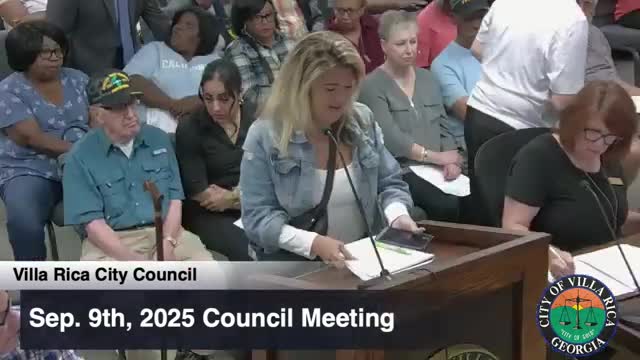
Several residents raised health and billing concerns about public housing in Villarrica during public comment on Sept. 9, telling the mayor and council they had experienced mold, water damage and disputed arrearage balances.
Tanya Ross, who identified herself as a resident of 301 Anderson Road, told council she had paid for a private mold inspection after maintenance repaired and covered a leak and said she was temporarily placed in hotels with her two children while issues persisted. “I have receipts for everything that I say,” Ross said, describing what she called repeated problems and delayed responses from property maintenance.
Monica Taylor, who identified herself as the great-great-granddaughter of a family with deep local ties, told council she found an HVAC lien on a nearby property and said she is disputing an alleged $7,000–$14,000 arrearage the housing authority claims she owes. Taylor said she had paid roughly $3,000 toward the amount but that ledger entries also showed a $20 credit, and she asked the council to investigate the discrepancy.
Mayor Leslie McPherson provided background on how the Villarrica Housing Authority is managed and clarified several points for the public record. McPherson said the Housing Authority is governed by federal rules under the U.S. Department of Housing and Urban Development (HUD) and that the authority’s properties operate under a Project-Based Rental Assistance (PBRA) contract that covers all properties. She said Walton developments’ loans did not come from Anderson, Auburn, or Nunley Homes replacement-reserve funds and that replacement reserve funds are property-specific and not interchangeable.
McPherson explained that Walton is a separate developer that performs tenant vetting for units at Walton, and that displaced tenants from earlier demolition were guaranteed priority to return to Walton phases 1 and 2. On mold responses, McPherson said the housing authority first sends maintenance to perform a moisture test and then contacts mold and water-damage consultants as needed.
Council did not take formal action on individual housing complaints during the meeting. McPherson recommended residents take concerns directly to the Housing Authority for detailed case handling and noted that HUD rules and the structure of PBRA and RAD (Rental Assistance Demonstration) conversions limit some city-level authority over operational details.
The council did not direct staff to open a new investigation during the meeting; a staff member later told a commenter “We’ll get you connected to the city attorney” to facilitate follow-up on legal matters raised during public comment.
Tanya Ross, who identified herself as a resident of 301 Anderson Road, told council she had paid for a private mold inspection after maintenance repaired and covered a leak and said she was temporarily placed in hotels with her two children while issues persisted. “I have receipts for everything that I say,” Ross said, describing what she called repeated problems and delayed responses from property maintenance.
Monica Taylor, who identified herself as the great-great-granddaughter of a family with deep local ties, told council she found an HVAC lien on a nearby property and said she is disputing an alleged $7,000–$14,000 arrearage the housing authority claims she owes. Taylor said she had paid roughly $3,000 toward the amount but that ledger entries also showed a $20 credit, and she asked the council to investigate the discrepancy.
Mayor Leslie McPherson provided background on how the Villarrica Housing Authority is managed and clarified several points for the public record. McPherson said the Housing Authority is governed by federal rules under the U.S. Department of Housing and Urban Development (HUD) and that the authority’s properties operate under a Project-Based Rental Assistance (PBRA) contract that covers all properties. She said Walton developments’ loans did not come from Anderson, Auburn, or Nunley Homes replacement-reserve funds and that replacement reserve funds are property-specific and not interchangeable.
McPherson explained that Walton is a separate developer that performs tenant vetting for units at Walton, and that displaced tenants from earlier demolition were guaranteed priority to return to Walton phases 1 and 2. On mold responses, McPherson said the housing authority first sends maintenance to perform a moisture test and then contacts mold and water-damage consultants as needed.
Council did not take formal action on individual housing complaints during the meeting. McPherson recommended residents take concerns directly to the Housing Authority for detailed case handling and noted that HUD rules and the structure of PBRA and RAD (Rental Assistance Demonstration) conversions limit some city-level authority over operational details.
The council did not direct staff to open a new investigation during the meeting; a staff member later told a commenter “We’ll get you connected to the city attorney” to facilitate follow-up on legal matters raised during public comment.
View the Full Meeting & All Its Details
This article offers just a summary. Unlock complete video, transcripts, and insights as a Founder Member.
✓
Watch full, unedited meeting videos
✓
Search every word spoken in unlimited transcripts
✓
AI summaries & real-time alerts (all government levels)
✓
Permanent access to expanding government content
30-day money-back guarantee
