Columbia County School Board adopts 2025-26 budget, sets millage above rollback rate
September 12, 2025 | Columbia, School Districts, Florida
This article was created by AI summarizing key points discussed. AI makes mistakes, so for full details and context, please refer to the video of the full meeting. Please report any errors so we can fix them. Report an error »
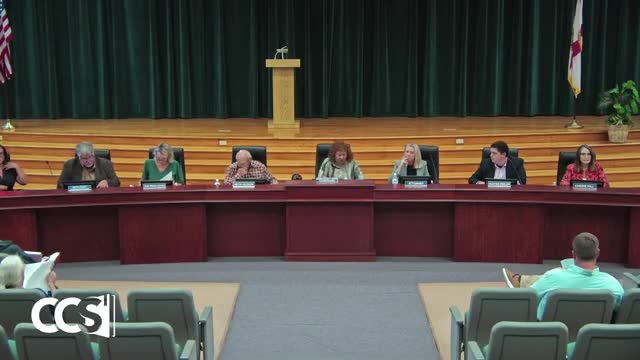
Columbia County School Board members on Sept. 9 adopted the district's fiscal 2025-26 budget and approved local millage rates that exceed the statutory rollback rate, after a presentation from the district's finance director about uncertainties in state funding calculations.
In a public hearing preceding the regular meeting, the board acknowledged that the district's total millage exceeds the rollback rate of 4.97 percent and that the portion required by state law was higher than the rollback by 4.38 percent. The board then voted to adopt the required local effort of 3.101 mills, a basic discretionary rate of 0.748 mills and a local capital outlay rate of 1.5 mills, and afterward adopted the 2025-26 budget.
The vote followed a budget briefing from Bonnie Penner, the district's financial director, who said the district closed fiscal 2024-25 using the third FEFP calculation and is still awaiting a fourth calculation from the state. "The third calculation came out very, very late, and now again the the fourth calculation is also late," Penner said. She told the board that the district had closed the 2024-25 year based on the information available and that the pending calculation could create a variance that would need to be incorporated into the 2025-26 budget.
Penner presented several figures the board discussed: expenditures for 2024-25 were just under $87,500,000, while appropriations shown for 2025-26 total about $95,700,000. She said the apparent increase is driven largely by state-required presentation of revenues earmarked for scholarship (FES) students and that the district must appropriate those revenues to avoid overstating fund balance. Penner said those scholarship-related revenues raised reported 2025-26 revenues by roughly $11.1 million and that once the required entries are corrected in a later budget amendment, the appropriations will more closely align with expected spending.
Penner also reported the district's 2024-25 financial condition ratio was 5.55 percent and said the preliminary 2025-26 budget calculates to just over 4 percent on the face of the documents because of the presentation of the scholarship revenues. She said the district is nevertheless planning to add just under $10,000 to unassigned fund balance. "We are actually putting in just under $10,000 to our unassigned fund balance, so we have increased our fund balance, although barely," Penner said.
The presentation flagged other budget pressures and monitoring items: uncertainty in the final weighted full-time-equivalent (FTE) counts used by the FEFP (Penner said the district's third calculation used just over 8,500 weighted FTE while provisional February numbers suggested funding around 8,800 weighted FTE, a difference of roughly 300), potential increases in utility costs, and a 0.4 percentage-point increase in the Florida Retirement System rate (from 13.63 to 14.03 percent) with an associated rise in the drop percentage from 21.13 to 22.02 percent. Penner said federal funds figures were conservative at budget build and will likely be adjusted in a subsequent amendment; she said capital funds were "looking good" and that sales-tax estimates were expected to rise.
Board members asked a few clarifying questions during the presentation; when asked about transportation cost increases, Penner asked for time to provide the specific amount. No public speakers addressed the hearing before the board closed the public-comment portion.
Actions recorded in the meeting packet and taken during the session included approval of the 2024-25 annual financial report and formal adoption of the 2025-26 budget and the three millage components. Each adoption was moved, seconded and approved by voice vote; the board chair announced that "the ayes have it" for each motion.
The board's adoption takes effect for the 2025-26 fiscal year as reflected in the approved budget documents; Penner and staff said they will return with any necessary budget amendments after the state releases the final FEFP calculation.
In a public hearing preceding the regular meeting, the board acknowledged that the district's total millage exceeds the rollback rate of 4.97 percent and that the portion required by state law was higher than the rollback by 4.38 percent. The board then voted to adopt the required local effort of 3.101 mills, a basic discretionary rate of 0.748 mills and a local capital outlay rate of 1.5 mills, and afterward adopted the 2025-26 budget.
The vote followed a budget briefing from Bonnie Penner, the district's financial director, who said the district closed fiscal 2024-25 using the third FEFP calculation and is still awaiting a fourth calculation from the state. "The third calculation came out very, very late, and now again the the fourth calculation is also late," Penner said. She told the board that the district had closed the 2024-25 year based on the information available and that the pending calculation could create a variance that would need to be incorporated into the 2025-26 budget.
Penner presented several figures the board discussed: expenditures for 2024-25 were just under $87,500,000, while appropriations shown for 2025-26 total about $95,700,000. She said the apparent increase is driven largely by state-required presentation of revenues earmarked for scholarship (FES) students and that the district must appropriate those revenues to avoid overstating fund balance. Penner said those scholarship-related revenues raised reported 2025-26 revenues by roughly $11.1 million and that once the required entries are corrected in a later budget amendment, the appropriations will more closely align with expected spending.
Penner also reported the district's 2024-25 financial condition ratio was 5.55 percent and said the preliminary 2025-26 budget calculates to just over 4 percent on the face of the documents because of the presentation of the scholarship revenues. She said the district is nevertheless planning to add just under $10,000 to unassigned fund balance. "We are actually putting in just under $10,000 to our unassigned fund balance, so we have increased our fund balance, although barely," Penner said.
The presentation flagged other budget pressures and monitoring items: uncertainty in the final weighted full-time-equivalent (FTE) counts used by the FEFP (Penner said the district's third calculation used just over 8,500 weighted FTE while provisional February numbers suggested funding around 8,800 weighted FTE, a difference of roughly 300), potential increases in utility costs, and a 0.4 percentage-point increase in the Florida Retirement System rate (from 13.63 to 14.03 percent) with an associated rise in the drop percentage from 21.13 to 22.02 percent. Penner said federal funds figures were conservative at budget build and will likely be adjusted in a subsequent amendment; she said capital funds were "looking good" and that sales-tax estimates were expected to rise.
Board members asked a few clarifying questions during the presentation; when asked about transportation cost increases, Penner asked for time to provide the specific amount. No public speakers addressed the hearing before the board closed the public-comment portion.
Actions recorded in the meeting packet and taken during the session included approval of the 2024-25 annual financial report and formal adoption of the 2025-26 budget and the three millage components. Each adoption was moved, seconded and approved by voice vote; the board chair announced that "the ayes have it" for each motion.
The board's adoption takes effect for the 2025-26 fiscal year as reflected in the approved budget documents; Penner and staff said they will return with any necessary budget amendments after the state releases the final FEFP calculation.
View the Full Meeting & All Its Details
This article offers just a summary. Unlock complete video, transcripts, and insights as a Founder Member.
✓
Watch full, unedited meeting videos
✓
Search every word spoken in unlimited transcripts
✓
AI summaries & real-time alerts (all government levels)
✓
Permanent access to expanding government content
30-day money-back guarantee
