Seminole commissioners press Tallahassee for fixes after review of Senate Bill 180 and proposed land‑use code changes
September 12, 2025 | Seminole County, Florida
This article was created by AI summarizing key points discussed. AI makes mistakes, so for full details and context, please refer to the video of the full meeting. Please report any errors so we can fix them. Report an error »
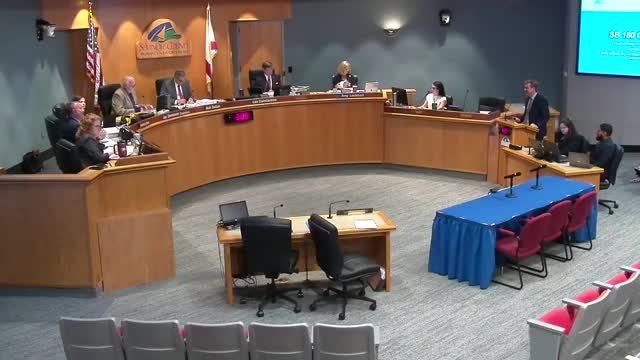
The Seminole County Board of County Commissioners heard a work session update on Senate Bill 180 and a parallel set of proposed amendments to the county's Land Development Code on Sept. 9, 2025, and directed the county manager and county attorney's office to draft a collaborative letter to state legislative leaders expressing the board's concerns.
The update split into two parts: emergency management measures and land‑use restrictions. "The emergency management side can really be distilled down to four subareas — shelters, contracts with service providers during an emergency declaration period, state guidance and continuing training requirements, and information to the public," said Robin McHugh, Assistant County Attorney, summarizing the bill's emergency provisions.
Why this matters: SB 180 creates new statewide requirements that affect how counties run shelters, amend vendor contracts for storm debris and training, and publish preparedness information. It also limits local authority to adopt certain land‑use changes for a specified period after hurricanes — a restriction commissioners said could curtail local responses to flood and safety problems that emerge after storms.
On emergency management, McHugh and staff said the bill explicitly allows caregivers to accompany people in special‑needs shelters and directs the Florida Division of Emergency Management to submit a list of shelters that might need retrofitting; that list is due Oct. 15. The bill requires counties to apply for at least one FDEM‑approved debris management site and establishes a uniform penalty regime for vendor breaches during a governor‑declared natural emergency. McHugh noted Seminole County is accredited under the Emergency Management Accreditation Program and is already largely compliant with many of the bill's standards. The county will nonetheless review franchise and vendor contracts and work with procurement to incorporate bill language as needed.
County Emergency Management Director Alan Harris warned of possible costs: "That is absolutely something that all 67 county emergency managers are concerned about," he said, describing the potential for vendors to seek higher prices or new contract terms if counties amend agreements to require additional storm services.
The bill's land‑use section drew the most attention. Deputy County Attorney Nathan Werkert told commissioners the law adds two restrictions. One is an ongoing rule that, for any county within 100 miles of a storm track that experienced hurricane‑force conditions, the county may not propose or adopt moratoriums, more restrictive or burdensome procedures, or more restrictive comprehensive plan or Land Development Code amendments for one year after landfall. The statute that creates that restriction was cited in the presentation as section 252.422. A second, retroactive restriction applies to counties included in federal disaster declarations for Hurricanes Debbie, Helene or Milton: those counties may not adopt the listed land‑use changes until Oct. 1, 2027, and the prohibition is effective retroactively to Aug. 1, 2024.
Werkert said the statute does not define the phrase "more restrictive or burdensome," a gap that leaves local governments and planners uncertain about what types of ordinary code clarifications or hazard‑mitigation updates might be barred.
Commissioners raised a string of concerns about scope, timing and financial consequences. Commissioner Lee Constantine and others pressed staff on whether the county could seek judicial guidance and whether joining a multi‑jurisdictional lawsuit was warranted; Werkert said the county had been approached by private counsel about joining litigation for a $10,000 flat fee. Several commissioners urged a careful, collaborative approach with the county's legislative delegation and the Florida Association of Counties instead of immediate litigation.
After discussion, the board voted unanimously to ask the county manager and county attorney to draft a pointed but collaborative letter to legislative leadership recounting the board's concerns about home‑rule impacts, ambiguity in the law, and potential unintended consequences. The motion passed without recorded opposition.
What staff will do next: County attorneys and planning staff said they will continue to monitor state rulemaking, review franchise and vendor contracts for necessary language updates, and return with draft Land Development Code amendments where the board's direction was clear. Work on the broader code rewrite will continue; staff said they will withhold code changes where they believe doing so could trigger the statute's prohibitions. Staff also noted the option to request a court determination in advance of adopting questionable changes.
The work session that included the SB 180 briefing continued into the county's scheduled Land Development Code review, where staff presented draft policy and code options on lot sizes, impervious‑surface limits, accessory structures and accessory dwelling units, commercial‑use separations and several process‑streamlining proposals. Those items will return in draft ordinance form after staff incorporates the board's direction and additional legal review.
Ending: Commissioners asked that the draft letter and any proposed code language be circulated to each commissioner's office before returning to the board for final approval. Staff said they would provide comparative examples and legal analysis with the next materials so the board can act on specific code text rather than conceptual direction.
The update split into two parts: emergency management measures and land‑use restrictions. "The emergency management side can really be distilled down to four subareas — shelters, contracts with service providers during an emergency declaration period, state guidance and continuing training requirements, and information to the public," said Robin McHugh, Assistant County Attorney, summarizing the bill's emergency provisions.
Why this matters: SB 180 creates new statewide requirements that affect how counties run shelters, amend vendor contracts for storm debris and training, and publish preparedness information. It also limits local authority to adopt certain land‑use changes for a specified period after hurricanes — a restriction commissioners said could curtail local responses to flood and safety problems that emerge after storms.
On emergency management, McHugh and staff said the bill explicitly allows caregivers to accompany people in special‑needs shelters and directs the Florida Division of Emergency Management to submit a list of shelters that might need retrofitting; that list is due Oct. 15. The bill requires counties to apply for at least one FDEM‑approved debris management site and establishes a uniform penalty regime for vendor breaches during a governor‑declared natural emergency. McHugh noted Seminole County is accredited under the Emergency Management Accreditation Program and is already largely compliant with many of the bill's standards. The county will nonetheless review franchise and vendor contracts and work with procurement to incorporate bill language as needed.
County Emergency Management Director Alan Harris warned of possible costs: "That is absolutely something that all 67 county emergency managers are concerned about," he said, describing the potential for vendors to seek higher prices or new contract terms if counties amend agreements to require additional storm services.
The bill's land‑use section drew the most attention. Deputy County Attorney Nathan Werkert told commissioners the law adds two restrictions. One is an ongoing rule that, for any county within 100 miles of a storm track that experienced hurricane‑force conditions, the county may not propose or adopt moratoriums, more restrictive or burdensome procedures, or more restrictive comprehensive plan or Land Development Code amendments for one year after landfall. The statute that creates that restriction was cited in the presentation as section 252.422. A second, retroactive restriction applies to counties included in federal disaster declarations for Hurricanes Debbie, Helene or Milton: those counties may not adopt the listed land‑use changes until Oct. 1, 2027, and the prohibition is effective retroactively to Aug. 1, 2024.
Werkert said the statute does not define the phrase "more restrictive or burdensome," a gap that leaves local governments and planners uncertain about what types of ordinary code clarifications or hazard‑mitigation updates might be barred.
Commissioners raised a string of concerns about scope, timing and financial consequences. Commissioner Lee Constantine and others pressed staff on whether the county could seek judicial guidance and whether joining a multi‑jurisdictional lawsuit was warranted; Werkert said the county had been approached by private counsel about joining litigation for a $10,000 flat fee. Several commissioners urged a careful, collaborative approach with the county's legislative delegation and the Florida Association of Counties instead of immediate litigation.
After discussion, the board voted unanimously to ask the county manager and county attorney to draft a pointed but collaborative letter to legislative leadership recounting the board's concerns about home‑rule impacts, ambiguity in the law, and potential unintended consequences. The motion passed without recorded opposition.
What staff will do next: County attorneys and planning staff said they will continue to monitor state rulemaking, review franchise and vendor contracts for necessary language updates, and return with draft Land Development Code amendments where the board's direction was clear. Work on the broader code rewrite will continue; staff said they will withhold code changes where they believe doing so could trigger the statute's prohibitions. Staff also noted the option to request a court determination in advance of adopting questionable changes.
The work session that included the SB 180 briefing continued into the county's scheduled Land Development Code review, where staff presented draft policy and code options on lot sizes, impervious‑surface limits, accessory structures and accessory dwelling units, commercial‑use separations and several process‑streamlining proposals. Those items will return in draft ordinance form after staff incorporates the board's direction and additional legal review.
Ending: Commissioners asked that the draft letter and any proposed code language be circulated to each commissioner's office before returning to the board for final approval. Staff said they would provide comparative examples and legal analysis with the next materials so the board can act on specific code text rather than conceptual direction.
Don't Miss a Word: See the Full Meeting!
Go beyond summaries. Unlock every video, transcript, and key insight with a Founder Membership.
✓
Get instant access to full meeting videos
✓
Search and clip any phrase from complete transcripts
✓
Receive AI-powered summaries & custom alerts
✓
Enjoy lifetime, unrestricted access to government data
30-day money-back guarantee
