County transfer-station tarp rule forces council to weigh ending city bulk-pickup or buy costly tarps
September 12, 2025 | Moraine City Council, Moraine, Montgomery County, Ohio
This article was created by AI summarizing key points discussed. AI makes mistakes, so for full details and context, please refer to the video of the full meeting. Please report any errors so we can fix them. Report an error »
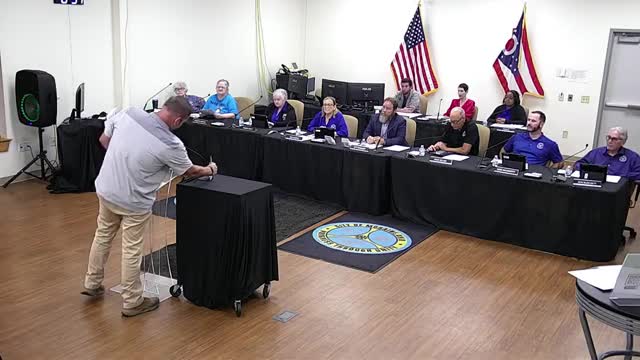
The Committee of the Whole heard an extended staff update on county transfer-station requirements that take effect in 2026 and will require municipal and commercial vehicles to have tarped loads when entering the facility. City staff warned the rule will make the city’s current curbside bulk-trash program expensive and logistically difficult.
The discussion centered on enforcement the Solid Waste District plans at the transfer station, the technical limits of tarp systems on the city’s bulk-trash vehicles, and alternatives such as encouraging residents to schedule the City of Dayton bulk pickup the city now pays for.
City staff member Chris said the transfer station will begin enforcing a rule next year that vehicles must have loads 95% covered and that repeated violations will trigger rising fines. “They will have somebody there that’s enforcing this,” Chris said. He estimated tarp systems cost about $5,500 per truck and said the city uses roughly eight trucks for bulk pickup. He warned that those tarps do not withstand some uses — “If you buy a tarp for trash, you can't use that tarp if you're going to haul blacktop. If you haul blacktop with that tarp, it will melt the tarp.”
Staff described operational problems specific to bulk trash: the tarp systems are designed to work with tailgates up, but the city’s crews haul bulk items with tailgates down. That means either changing the trucks or adopting workarounds such as manually bungeeing tarps to tailgates when dumping, a process that would slow dumps and create traffic congestion at the transfer station. “You’ve got a mile of traffic behind you laying on the horns because you're out trying to undo your tarp,” Chris said.
Council members and staff discussed costs and alternatives. Staff estimated a ballpark $50,000–$60,000 to equip and maintain tarps across the fleet; a grant applied for would not cover a full tarp. Chris and another staffer noted the city already pays the City of Dayton for a pickup option that lets residents schedule bulk collections up to 26 times per year; that service could be promoted more heavily to residents as an alternative to the city’s own curbside program. “I do think that using the City of Dayton would probably be the best financially and, logistically for us,” Chris said.
Staff also gave usage and cost figures to the committee: May dump fees were about $3,500; historical high single-month dump fees were about $6,000 in 2019 and have fallen since the City started promoting Dayton’s service. Staff reported 23 QR-code scheduling (resident-scheduled) pickups so far this year and provided 2022 totals (East side: 48 loads; West side: 50 loads) and assorted material counts (tires, paint, oil) as background for cost comparisons.
Council asked staff to investigate options and return with specifics: cost projections for tarp purchases and maintenance, whether the City of Dayton could perform scheduled neighborhood or annual pickups on the city’s behalf, and how to better educate residents about resident-scheduled Dayton pickups. No formal motion or vote was taken; the item was discussion-only and staff said they will bring back answers for council consideration.
Ending: Council members signaled an appetite to shift away from running the full curbside bulk-trash operation if doing so avoids an expensive tarp program, but they asked staff for concrete cost comparisons and implementation scenarios before any policy change.
The discussion centered on enforcement the Solid Waste District plans at the transfer station, the technical limits of tarp systems on the city’s bulk-trash vehicles, and alternatives such as encouraging residents to schedule the City of Dayton bulk pickup the city now pays for.
City staff member Chris said the transfer station will begin enforcing a rule next year that vehicles must have loads 95% covered and that repeated violations will trigger rising fines. “They will have somebody there that’s enforcing this,” Chris said. He estimated tarp systems cost about $5,500 per truck and said the city uses roughly eight trucks for bulk pickup. He warned that those tarps do not withstand some uses — “If you buy a tarp for trash, you can't use that tarp if you're going to haul blacktop. If you haul blacktop with that tarp, it will melt the tarp.”
Staff described operational problems specific to bulk trash: the tarp systems are designed to work with tailgates up, but the city’s crews haul bulk items with tailgates down. That means either changing the trucks or adopting workarounds such as manually bungeeing tarps to tailgates when dumping, a process that would slow dumps and create traffic congestion at the transfer station. “You’ve got a mile of traffic behind you laying on the horns because you're out trying to undo your tarp,” Chris said.
Council members and staff discussed costs and alternatives. Staff estimated a ballpark $50,000–$60,000 to equip and maintain tarps across the fleet; a grant applied for would not cover a full tarp. Chris and another staffer noted the city already pays the City of Dayton for a pickup option that lets residents schedule bulk collections up to 26 times per year; that service could be promoted more heavily to residents as an alternative to the city’s own curbside program. “I do think that using the City of Dayton would probably be the best financially and, logistically for us,” Chris said.
Staff also gave usage and cost figures to the committee: May dump fees were about $3,500; historical high single-month dump fees were about $6,000 in 2019 and have fallen since the City started promoting Dayton’s service. Staff reported 23 QR-code scheduling (resident-scheduled) pickups so far this year and provided 2022 totals (East side: 48 loads; West side: 50 loads) and assorted material counts (tires, paint, oil) as background for cost comparisons.
Council asked staff to investigate options and return with specifics: cost projections for tarp purchases and maintenance, whether the City of Dayton could perform scheduled neighborhood or annual pickups on the city’s behalf, and how to better educate residents about resident-scheduled Dayton pickups. No formal motion or vote was taken; the item was discussion-only and staff said they will bring back answers for council consideration.
Ending: Council members signaled an appetite to shift away from running the full curbside bulk-trash operation if doing so avoids an expensive tarp program, but they asked staff for concrete cost comparisons and implementation scenarios before any policy change.
View the Full Meeting & All Its Details
This article offers just a summary. Unlock complete video, transcripts, and insights as a Founder Member.
✓
Watch full, unedited meeting videos
✓
Search every word spoken in unlimited transcripts
✓
AI summaries & real-time alerts (all government levels)
✓
Permanent access to expanding government content
30-day money-back guarantee
