Historic Preservation Commission approves removal of three hazardous trees in Pioneer Park
September 15, 2025 | Independence, Polk County, Oregon
This article was created by AI summarizing key points discussed. AI makes mistakes, so for full details and context, please refer to the video of the full meeting. Please report any errors so we can fix them. Report an error »
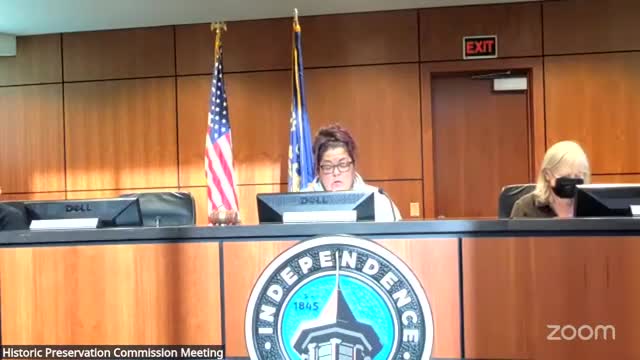
The Historic Preservation Commission voted to approve an application to remove three trees in Pioneer Park at a public hearing on Sept. 15, 2025, after staff presented a certified-arborist report concluding the trees posed a hazard to people and nearby property. The commission’s action conditions removal on stump grinding and replacement plantings to be installed between November and March and protected from wildlife damage.
The vote followed a staff presentation from Yvette, who said the application included a hazard assessment from an arborist and a tree-service report and that "these trees are in danger." The staff report identified two oak trees with large wounds or holes near infrastructure and a multi-stem bigleaf maple that the report described as about 50% dead from the top down. The staff recommendation was approval with one condition: remove the trees, grind the stumps and replace each tree.
The commission’s decision matters because Pioneer Park lies in a local historic district and contains trees listed on the city’s historic-tree list; removals there require the commission to apply the city’s land-use criteria. The hearing record notes the procedure was conducted as a Type 3 quasi-judicial hearing under the city and State of Oregon land-use procedures and that findings must tie to the applicable code criteria cited in the staff report.
During public comment, Jordan Perez, identified in the record as executive director of the Waterfed Council at 165 D Street, urged that replacement plantings be native species, specifically recommending Oregon white oak for longevity and habitat benefits. "Our recommendation would be that you consider... replaced with a native species," Perez said, and recommended planting larger stock, protecting young trees from deer, and planting in the fall–winter rainy season to improve survival odds.
Commissioners asked about specifics that were not in the application packet: the size of replacement trees, post-planting care and watering schedules, timelines for removal relative to bird-nesting season, and which budget line would cover removal and replacement costs. Staff stated the application is being considered on land-use criteria and that budgetary responsibility and line-item funding were not specified in the record; one commissioner referenced a combined operating budget figure of about $86,000 for library, museum and parks, but staff said budget questions were outside the quasi-judicial hearing’s scope.
The approved condition requires the applicant to remove the trees, grind the stumps, and replace each tree with a new tree of the same species to be planted between November and March and to be protected (for example, caged) to reduce deer or other damage. The motion was made and seconded, the commission called for the vote, members responded "Aye," and the chair announced the motion carried.
The application was submitted by Jason Brainske, identified in the record as the city’s public works supervisor; staff noted Brainske was not present at the hearing. The record includes staff photos and the arborist report that describe wound locations and decay risk for the oaks and the top‑dead condition for the maple adjacent to Ash Creek.
Next steps: the removal and replacement must comply with the motion’s condition (stump grinding, same-species replacement, planting window and protective measures). The commission closed the hearing at 5:59 p.m. on Sept. 15, 2025, and took the formal approval action on the record.
The vote followed a staff presentation from Yvette, who said the application included a hazard assessment from an arborist and a tree-service report and that "these trees are in danger." The staff report identified two oak trees with large wounds or holes near infrastructure and a multi-stem bigleaf maple that the report described as about 50% dead from the top down. The staff recommendation was approval with one condition: remove the trees, grind the stumps and replace each tree.
The commission’s decision matters because Pioneer Park lies in a local historic district and contains trees listed on the city’s historic-tree list; removals there require the commission to apply the city’s land-use criteria. The hearing record notes the procedure was conducted as a Type 3 quasi-judicial hearing under the city and State of Oregon land-use procedures and that findings must tie to the applicable code criteria cited in the staff report.
During public comment, Jordan Perez, identified in the record as executive director of the Waterfed Council at 165 D Street, urged that replacement plantings be native species, specifically recommending Oregon white oak for longevity and habitat benefits. "Our recommendation would be that you consider... replaced with a native species," Perez said, and recommended planting larger stock, protecting young trees from deer, and planting in the fall–winter rainy season to improve survival odds.
Commissioners asked about specifics that were not in the application packet: the size of replacement trees, post-planting care and watering schedules, timelines for removal relative to bird-nesting season, and which budget line would cover removal and replacement costs. Staff stated the application is being considered on land-use criteria and that budgetary responsibility and line-item funding were not specified in the record; one commissioner referenced a combined operating budget figure of about $86,000 for library, museum and parks, but staff said budget questions were outside the quasi-judicial hearing’s scope.
The approved condition requires the applicant to remove the trees, grind the stumps, and replace each tree with a new tree of the same species to be planted between November and March and to be protected (for example, caged) to reduce deer or other damage. The motion was made and seconded, the commission called for the vote, members responded "Aye," and the chair announced the motion carried.
The application was submitted by Jason Brainske, identified in the record as the city’s public works supervisor; staff noted Brainske was not present at the hearing. The record includes staff photos and the arborist report that describe wound locations and decay risk for the oaks and the top‑dead condition for the maple adjacent to Ash Creek.
Next steps: the removal and replacement must comply with the motion’s condition (stump grinding, same-species replacement, planting window and protective measures). The commission closed the hearing at 5:59 p.m. on Sept. 15, 2025, and took the formal approval action on the record.
Don't Miss a Word: See the Full Meeting!
Go beyond summaries. Unlock every video, transcript, and key insight with a Founder Membership.
✓
Get instant access to full meeting videos
✓
Search and clip any phrase from complete transcripts
✓
Receive AI-powered summaries & custom alerts
✓
Enjoy lifetime, unrestricted access to government data
30-day money-back guarantee
