Commission approves rezoning on West Vine Avenue to allow ground‑floor housing, with hillside protection retained
September 15, 2025 | Planning Meetings, Knoxville City, Knox County, Tennessee
This article was created by AI summarizing key points discussed. AI makes mistakes, so for full details and context, please refer to the video of the full meeting. Please report any errors so we can fix them. Report an error »
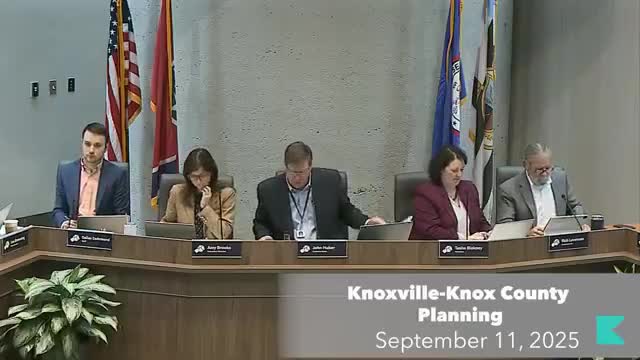
The Knoxville‑Knox County Planning Commission on Sept. 11 voted to rezone a West Vine Avenue parcel from the downtown grid subdistrict (DKG) to the boulevard subdistrict (DKB), a change that permits residential uses on the ground floor.
Taylor Forrester, representing property owner Lee Burch, told the commission the site’s topography, irregular lot shape and proximity to a steep 40‑foot elevation change make ground‑floor commercial uses impractical. Forrester said the DKG designation — drafted for traditional 300‑by‑300 downtown blocks — is not a good fit at this location and asked commissioners to recommend DKB. “This property is located about 300 feet from [South Gay Street] with a great elevation change of about 40 feet,” Forrester said, arguing commercial tenants are unlikely to succeed at that address.
Opposition included parishioners and neighborhood residents who worried rezoning would erode downtown’s pedestrian‑oriented fabric and diminish the potential for future street‑level businesses. Father Charlie Donahue of Immaculate Conception and residents pointed to the site’s historic character and narrow, steep street network. Melissa Mancini said the change could “eviscerate the facade of a historic building” and urged preservation of the area’s character. By contrast, Jack Coker of YES Knoxville supported the rezoning as a way to boost downtown housing density and said residential units could help support future commercial activity.
Commission discussion focused on competing goals: preserving areas intended for pedestrian‑oriented, street‑level commercial activity (DKG) versus granting flexibility for residential uses where topography and parcel buildings make commercial retail unlikely. Staff briefed the commission on specific dimensional differences: DKG requires more frequent building entries and stricter limits on blank walls, while DKB allows larger build‑to setbacks (up to 25 feet) and permits up to 35 linear feet of blank wall.
The commission approved the rezoning motion, with an amendment that the hillside protection overlay remain in place. Commissioners Midas and Gill voted against the motion; the chair announced the motion passed. Commissioners urged the applicant to meet with nearby institutions and neighbors to coordinate future plans.
Outcome and next steps: Rezoning to DKB allows the owner greater flexibility to place residential uses at street level; it does not require ground‑floor commercial uses. The commission added the requirement that the hillside protection overlay remain in effect. Staff recommended the applicant meet with Immaculate Conception Church and other nearby stakeholders before pursuing permitting and design work.
Taylor Forrester, representing property owner Lee Burch, told the commission the site’s topography, irregular lot shape and proximity to a steep 40‑foot elevation change make ground‑floor commercial uses impractical. Forrester said the DKG designation — drafted for traditional 300‑by‑300 downtown blocks — is not a good fit at this location and asked commissioners to recommend DKB. “This property is located about 300 feet from [South Gay Street] with a great elevation change of about 40 feet,” Forrester said, arguing commercial tenants are unlikely to succeed at that address.
Opposition included parishioners and neighborhood residents who worried rezoning would erode downtown’s pedestrian‑oriented fabric and diminish the potential for future street‑level businesses. Father Charlie Donahue of Immaculate Conception and residents pointed to the site’s historic character and narrow, steep street network. Melissa Mancini said the change could “eviscerate the facade of a historic building” and urged preservation of the area’s character. By contrast, Jack Coker of YES Knoxville supported the rezoning as a way to boost downtown housing density and said residential units could help support future commercial activity.
Commission discussion focused on competing goals: preserving areas intended for pedestrian‑oriented, street‑level commercial activity (DKG) versus granting flexibility for residential uses where topography and parcel buildings make commercial retail unlikely. Staff briefed the commission on specific dimensional differences: DKG requires more frequent building entries and stricter limits on blank walls, while DKB allows larger build‑to setbacks (up to 25 feet) and permits up to 35 linear feet of blank wall.
The commission approved the rezoning motion, with an amendment that the hillside protection overlay remain in place. Commissioners Midas and Gill voted against the motion; the chair announced the motion passed. Commissioners urged the applicant to meet with nearby institutions and neighbors to coordinate future plans.
Outcome and next steps: Rezoning to DKB allows the owner greater flexibility to place residential uses at street level; it does not require ground‑floor commercial uses. The commission added the requirement that the hillside protection overlay remain in effect. Staff recommended the applicant meet with Immaculate Conception Church and other nearby stakeholders before pursuing permitting and design work.
View the Full Meeting & All Its Details
This article offers just a summary. Unlock complete video, transcripts, and insights as a Founder Member.
✓
Watch full, unedited meeting videos
✓
Search every word spoken in unlimited transcripts
✓
AI summaries & real-time alerts (all government levels)
✓
Permanent access to expanding government content
30-day money-back guarantee
