Design review committee questions massing and signage for Harpeth Village mixed‑use plan
September 16, 2025 | Franklin City, Williamson County, Tennessee
This article was created by AI summarizing key points discussed. AI makes mistakes, so for full details and context, please refer to the video of the full meeting. Please report any errors so we can fix them. Report an error »
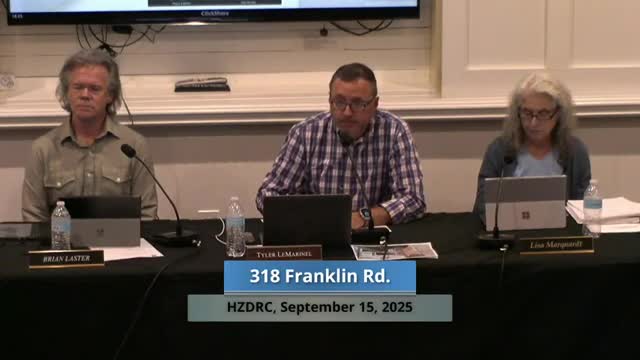
Developers seeking approval for the Harpeth Village mixed‑use redevelopment presented revised plans to the Design Review Committee, showing lower building heights and a reconfigured entrance road, but committee members said the project still reads too massive in places and asked for more variation in building height and simpler, more historic‑informed storefront details.
The project team told the committee they had “reduced height from our last meeting” and moved the entrance road to address engineering concerns, creating an entry plaza and more screening along the adjacent residences on Morningside Drive (Drake, Gamble Design Collaborative). “The biggest changes are we really looked at how do we pull back the scale, how do we pull everything down and in a little bit so it just didn’t feel quite so massive,” architect Meredith of 906 Studio said, explaining that parapets and roof lines had been lowered and some parapets simplified.
Committee members and staff said the plans show meaningful changes but still need work on massing, ground‑floor proportions and signage. Elizabeth (city staff) told the committee that as submitted “the scale of the first floors of the three connected buildings appears to be out of proportion to the adjacent historic buildings in the district,” and that the proposed storefront colonnade and stacked balconies were “accentuat[ing] the building’s height” and making the block read heavier than nearby historic commercial buildings.
Why it matters
The Harpeth Village site sits behind the hill near the Factory District and adjacent to residential lots on Morningside Drive. Committee members said the development’s design will strongly affect nearby historic character and public views; the DRC must recommend whether the preliminary massing and scale are likely to receive a Certificate of Appropriateness (COA) before the planning commission and Board of Mayor and Aldermen consider zoning modifications.
Details of the discussion
- Massing and height: The applicants reduced peak parapet heights and moved building footprints away from Morningside Drive. Still, several DRC members said the three‑building block at the rear reads as a single long mass with insufficient vertical variety. “There’s not one that drops several feet and looks substantial enough,” one member said, urging clearer step‑downs in parapet and roof height.
- Ground floor scale and storefronts: Multiple members questioned the high colonnade/portico at the First Floor, which the applicants said was intended to set retail apart from upper‑level residences. DRC members recommended lowering that loggia and narrowing or simplifying columns so the First Floor does not overscale the building façades or feel like an outdoor mall rather than historic urban storefronts.
- Materials and fenestration: Staff and members asked for further study of storefront rhythm and window proportions so that solids and voids align with district precedents. Elizabeth noted that “large glass planes and metal curtainwalls…are not seen in Franklin’s historic districts” and should be balanced with punched openings and traditional storefront rhythm.
- Parking screening and site grading: The applicants added a short wall and landscape buffer to screen headlights from adjacent residences. Staff asked for more details about the required retaining walls and grading for the access drive from Franklin Road; the DRC cautioned against extensive topographic alteration that would change the hill’s historic view.
- Signage and modification of standards (MOS): The applicants asked the Board of Mayor and Aldermen to allow a signage MOS so they could later propose signs not currently in the HZC guidelines. Staff cautioned that any MOS would not guarantee COA approval and recommended limiting MOS scope. Several members said the only sign form that felt compatible so far was a traditional hanging/projecting sign; internal illumination and large blade signs would need careful review at COA stage.
What the committee asked applicants to do next
- Provide revised elevations and 3‑D views that show the proposed buildings in context with Magnolia Hall/Factory District and adjacent Morningside houses, including sightlines from Franklin Road and 96 Glass Lane.
- Add clearer vertical variation among the three connected buildings (not minor parapet changes but visible step‑downs) and simplify the tall loggia/colonnade on the First Floor by lowering it and reducing column heft.
- Supply detailed plans for retaining walls, grading and the access drive, with civil and stormwater information so staff can assess impacts to the hill and sightlines.
- If pursuing a signage MOS, submit a focused sign packet at the development stage and be prepared to show how each proposed sign type would comply with historic guidelines at the COA phase.
Ending note
Applicants said they would return with revised elevations and additional information. Staff reminded the committee that a preliminary HZC recommendation is procedural: final COA review of architectural details and signs would follow once the planning approvals and MOS (if any) are addressed.
The project team told the committee they had “reduced height from our last meeting” and moved the entrance road to address engineering concerns, creating an entry plaza and more screening along the adjacent residences on Morningside Drive (Drake, Gamble Design Collaborative). “The biggest changes are we really looked at how do we pull back the scale, how do we pull everything down and in a little bit so it just didn’t feel quite so massive,” architect Meredith of 906 Studio said, explaining that parapets and roof lines had been lowered and some parapets simplified.
Committee members and staff said the plans show meaningful changes but still need work on massing, ground‑floor proportions and signage. Elizabeth (city staff) told the committee that as submitted “the scale of the first floors of the three connected buildings appears to be out of proportion to the adjacent historic buildings in the district,” and that the proposed storefront colonnade and stacked balconies were “accentuat[ing] the building’s height” and making the block read heavier than nearby historic commercial buildings.
Why it matters
The Harpeth Village site sits behind the hill near the Factory District and adjacent to residential lots on Morningside Drive. Committee members said the development’s design will strongly affect nearby historic character and public views; the DRC must recommend whether the preliminary massing and scale are likely to receive a Certificate of Appropriateness (COA) before the planning commission and Board of Mayor and Aldermen consider zoning modifications.
Details of the discussion
- Massing and height: The applicants reduced peak parapet heights and moved building footprints away from Morningside Drive. Still, several DRC members said the three‑building block at the rear reads as a single long mass with insufficient vertical variety. “There’s not one that drops several feet and looks substantial enough,” one member said, urging clearer step‑downs in parapet and roof height.
- Ground floor scale and storefronts: Multiple members questioned the high colonnade/portico at the First Floor, which the applicants said was intended to set retail apart from upper‑level residences. DRC members recommended lowering that loggia and narrowing or simplifying columns so the First Floor does not overscale the building façades or feel like an outdoor mall rather than historic urban storefronts.
- Materials and fenestration: Staff and members asked for further study of storefront rhythm and window proportions so that solids and voids align with district precedents. Elizabeth noted that “large glass planes and metal curtainwalls…are not seen in Franklin’s historic districts” and should be balanced with punched openings and traditional storefront rhythm.
- Parking screening and site grading: The applicants added a short wall and landscape buffer to screen headlights from adjacent residences. Staff asked for more details about the required retaining walls and grading for the access drive from Franklin Road; the DRC cautioned against extensive topographic alteration that would change the hill’s historic view.
- Signage and modification of standards (MOS): The applicants asked the Board of Mayor and Aldermen to allow a signage MOS so they could later propose signs not currently in the HZC guidelines. Staff cautioned that any MOS would not guarantee COA approval and recommended limiting MOS scope. Several members said the only sign form that felt compatible so far was a traditional hanging/projecting sign; internal illumination and large blade signs would need careful review at COA stage.
What the committee asked applicants to do next
- Provide revised elevations and 3‑D views that show the proposed buildings in context with Magnolia Hall/Factory District and adjacent Morningside houses, including sightlines from Franklin Road and 96 Glass Lane.
- Add clearer vertical variation among the three connected buildings (not minor parapet changes but visible step‑downs) and simplify the tall loggia/colonnade on the First Floor by lowering it and reducing column heft.
- Supply detailed plans for retaining walls, grading and the access drive, with civil and stormwater information so staff can assess impacts to the hill and sightlines.
- If pursuing a signage MOS, submit a focused sign packet at the development stage and be prepared to show how each proposed sign type would comply with historic guidelines at the COA phase.
Ending note
Applicants said they would return with revised elevations and additional information. Staff reminded the committee that a preliminary HZC recommendation is procedural: final COA review of architectural details and signs would follow once the planning approvals and MOS (if any) are addressed.
Don't Miss a Word: See the Full Meeting!
Go beyond summaries. Unlock every video, transcript, and key insight with a Founder Membership.
✓
Get instant access to full meeting videos
✓
Search and clip any phrase from complete transcripts
✓
Receive AI-powered summaries & custom alerts
✓
Enjoy lifetime, unrestricted access to government data
30-day money-back guarantee
