Planning commission reviews roles, stresses findings‑of‑fact and public testimony
September 16, 2025 | DeKalb City, DeKalb County, Illinois
This article was created by AI summarizing key points discussed. AI makes mistakes, so for full details and context, please refer to the video of the full meeting. Please report any errors so we can fix them. Report an error »
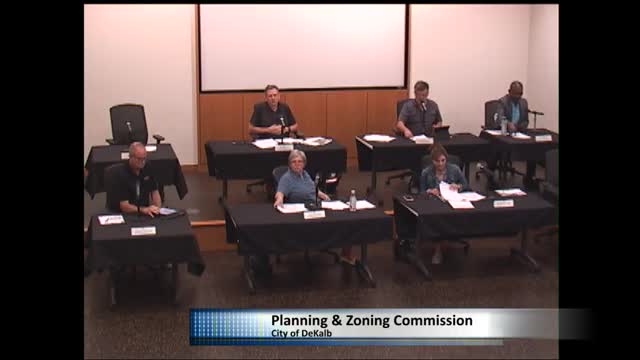
The DeKalb Planning and Zoning Commission on Monday held a staff‑led discussion of the commission’s roles and responsibilities, with Mr. Nicholas and other city staff explaining how the body should weigh evidence, frame findings of fact and interact with applicants and the public. The session followed a recent contentious zoning matter and aimed to clarify process and expectations for future petitions.
"What I thought was maybe useful was for us all…to have some conversation about how that works," Mr. Nicholas said, opening the discussion about the commission's role in reviewing petitions and making findings. Staff framed the commission as the body responsible for applying statutory and ordinance standards — not for broader policy tradeoffs that fall to elected officials — and emphasized that public testimony should be heard but must be considered against the specific findings required by law.
City Manager Bill described recent staff efforts to expand tree‑maintenance and planting programs and noted the city had secured Morton Arboretum grant funding to help with public‑tree pruning; he said the city is reviewing options to assist private owners with costly tree work. "We're going through the city budget, and we're talking about what might be done, to augment our initiative in that area," Bill said.
Staff reviewed the evolution of local review bodies in DeKalb, explaining that when the zoning board of appeals performed variance reviews it acted as a quasi‑judicial body requiring formal findings; those responsibilities now rest with the planning commission under the city's Unified Development Ordinance and state statute. Staff reminded commissioners that findings of fact typically address whether a property can yield a reasonable return under existing regulations, whether the hardship is unique, whether granting the variance would harm adjacent properties' long‑range development, and whether public facilities are adequate.
Mr. Nicholas used a recent rezoning and development conversation — including debate earlier in the month about a proposed development that staff had described in various terms — to illustrate how testimony that falls outside the ordinance's specific findings (for example, broader speculation or unrelated concerns) can complicate deliberations. "We need to, from time to time, look at our roles and look at our responsibilities," he said.
Commissioners asked practical questions: how to relate to neighbors, how the public hearing functions, how to reopen a vote if new information appears, and whether applicants can bring early, nonbinding concept plans for feedback. Staff confirmed that concept plans can be used for early feedback without a filing fee and that further presentations can be scheduled when applicants wish to refine proposals.
The session closed with staff reiterating that the commission's determinations should be rooted in the evidence before it and in the findings prescribed by statute and the Unified Development Ordinance, while also encouraging commissioners to listen to public testimony and to direct staff to seek additional factual information where relevant. No formal action was taken; the session was informational and intended to improve future hearings and decisions.
"What I thought was maybe useful was for us all…to have some conversation about how that works," Mr. Nicholas said, opening the discussion about the commission's role in reviewing petitions and making findings. Staff framed the commission as the body responsible for applying statutory and ordinance standards — not for broader policy tradeoffs that fall to elected officials — and emphasized that public testimony should be heard but must be considered against the specific findings required by law.
City Manager Bill described recent staff efforts to expand tree‑maintenance and planting programs and noted the city had secured Morton Arboretum grant funding to help with public‑tree pruning; he said the city is reviewing options to assist private owners with costly tree work. "We're going through the city budget, and we're talking about what might be done, to augment our initiative in that area," Bill said.
Staff reviewed the evolution of local review bodies in DeKalb, explaining that when the zoning board of appeals performed variance reviews it acted as a quasi‑judicial body requiring formal findings; those responsibilities now rest with the planning commission under the city's Unified Development Ordinance and state statute. Staff reminded commissioners that findings of fact typically address whether a property can yield a reasonable return under existing regulations, whether the hardship is unique, whether granting the variance would harm adjacent properties' long‑range development, and whether public facilities are adequate.
Mr. Nicholas used a recent rezoning and development conversation — including debate earlier in the month about a proposed development that staff had described in various terms — to illustrate how testimony that falls outside the ordinance's specific findings (for example, broader speculation or unrelated concerns) can complicate deliberations. "We need to, from time to time, look at our roles and look at our responsibilities," he said.
Commissioners asked practical questions: how to relate to neighbors, how the public hearing functions, how to reopen a vote if new information appears, and whether applicants can bring early, nonbinding concept plans for feedback. Staff confirmed that concept plans can be used for early feedback without a filing fee and that further presentations can be scheduled when applicants wish to refine proposals.
The session closed with staff reiterating that the commission's determinations should be rooted in the evidence before it and in the findings prescribed by statute and the Unified Development Ordinance, while also encouraging commissioners to listen to public testimony and to direct staff to seek additional factual information where relevant. No formal action was taken; the session was informational and intended to improve future hearings and decisions.
View the Full Meeting & All Its Details
This article offers just a summary. Unlock complete video, transcripts, and insights as a Founder Member.
✓
Watch full, unedited meeting videos
✓
Search every word spoken in unlimited transcripts
✓
AI summaries & real-time alerts (all government levels)
✓
Permanent access to expanding government content
30-day money-back guarantee
