Parents protest $150 marching-band fee as district outlines $9.5 million shortfall and policy review
September 16, 2025 | Garfield Heights City Schools, School Districts, Ohio
This article was created by AI summarizing key points discussed. AI makes mistakes, so for full details and context, please refer to the video of the full meeting. Please report any errors so we can fix them. Report an error »
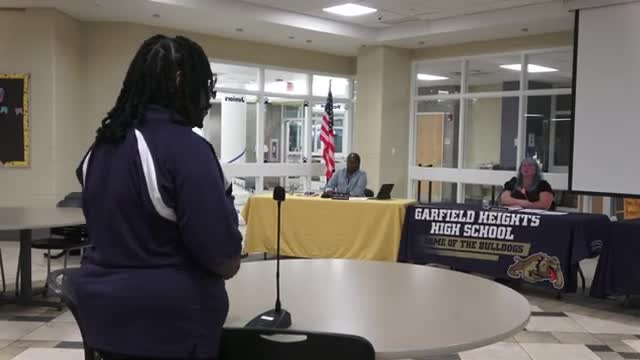
Parents, students and boosters confronted the Garfield Heights City Schools board Sept. 15 over a newly announced fee for marching-band participation, while district leaders described severe budget pressures and a plan to develop a formal pay-to-participate policy.
Several parents and the band-boosters president urged the board to rescind or delay a $150 marching-band participation fee they said would prevent students from attending graded events. "This board has chosen to block kids from contests, parades, and performances," parent Renee Bolton told the board. "Many events which are part of their grade, unless their families can pay." Booster president Valerie Toney said the community is low-income and asked the district to avoid excluding students: "Which child sitting here tonight would you tell that they can't participate because they can't pay?" she asked.
Superintendent Dr. Reynolds and other administrators said the district is working under acute fiscal pressures and that the pay-to-participate matter must follow district policy procedures. "We will present something to the board for next month's board meeting, and then we'll go ahead and take it to probably November in order to make a decision on how we're gonna be moving forward with policy," Dr. Reynolds said. He described the action as an administrative proposal to be vetted by the policy committee, not an immediate board-enforced suspension of students.
Deja Bailey, a district staff member who spoke to parents at the meeting, said, "When it comes to band class, your grade will not be affected by marching band." A student speaker, Brianna Matthew, disputed that characterization, saying graded out-of-school activities are recorded in the district system and that inability to pay could affect GPA.
The board heard the district's broader financial forecast during the meeting: administration and the treasurer said the district faces a projected $9.5 million shortfall for fiscal year 2027 and proposed reductions including 20 teaching positions and 10 operations positions to address that gap. Treasurer Phil O'Kove said the district already reduced about $4.5 million earlier in the year but that without additional revenue the state could put the district under oversight or pursue a territory transfer to another district. He also said the state had cut district funding by 2 percent for the next biennium (4 percent cumulative) and warned of possible federal cuts to IDEA-B funding.
Board members asked for clear public communications and more time for families if administratively feasible. Dr. Reynolds said the district would follow the policy-committee process and that the administration could provide additional time if necessary. Community members offered to help raise funds; one speaker said his nonprofit could collect donations so families could be covered.
No new district policy was approved at the meeting and administration did not set a final deadline in public; Dr. Reynolds said he would bring a formal proposal to the board in the coming weeks and route it to the policy committee for review before any implementation decision.
Several parents and the band-boosters president urged the board to rescind or delay a $150 marching-band participation fee they said would prevent students from attending graded events. "This board has chosen to block kids from contests, parades, and performances," parent Renee Bolton told the board. "Many events which are part of their grade, unless their families can pay." Booster president Valerie Toney said the community is low-income and asked the district to avoid excluding students: "Which child sitting here tonight would you tell that they can't participate because they can't pay?" she asked.
Superintendent Dr. Reynolds and other administrators said the district is working under acute fiscal pressures and that the pay-to-participate matter must follow district policy procedures. "We will present something to the board for next month's board meeting, and then we'll go ahead and take it to probably November in order to make a decision on how we're gonna be moving forward with policy," Dr. Reynolds said. He described the action as an administrative proposal to be vetted by the policy committee, not an immediate board-enforced suspension of students.
Deja Bailey, a district staff member who spoke to parents at the meeting, said, "When it comes to band class, your grade will not be affected by marching band." A student speaker, Brianna Matthew, disputed that characterization, saying graded out-of-school activities are recorded in the district system and that inability to pay could affect GPA.
The board heard the district's broader financial forecast during the meeting: administration and the treasurer said the district faces a projected $9.5 million shortfall for fiscal year 2027 and proposed reductions including 20 teaching positions and 10 operations positions to address that gap. Treasurer Phil O'Kove said the district already reduced about $4.5 million earlier in the year but that without additional revenue the state could put the district under oversight or pursue a territory transfer to another district. He also said the state had cut district funding by 2 percent for the next biennium (4 percent cumulative) and warned of possible federal cuts to IDEA-B funding.
Board members asked for clear public communications and more time for families if administratively feasible. Dr. Reynolds said the district would follow the policy-committee process and that the administration could provide additional time if necessary. Community members offered to help raise funds; one speaker said his nonprofit could collect donations so families could be covered.
No new district policy was approved at the meeting and administration did not set a final deadline in public; Dr. Reynolds said he would bring a formal proposal to the board in the coming weeks and route it to the policy committee for review before any implementation decision.
View the Full Meeting & All Its Details
This article offers just a summary. Unlock complete video, transcripts, and insights as a Founder Member.
✓
Watch full, unedited meeting videos
✓
Search every word spoken in unlimited transcripts
✓
AI summaries & real-time alerts (all government levels)
✓
Permanent access to expanding government content
30-day money-back guarantee
