Wake County presents draft 50-year One Water Plan; public comment open through Oct. 10
September 17, 2025 | Fuquay Varina, Wake County, North Carolina
This article was created by AI summarizing key points discussed. AI makes mistakes, so for full details and context, please refer to the video of the full meeting. Please report any errors so we can fix them. Report an error »
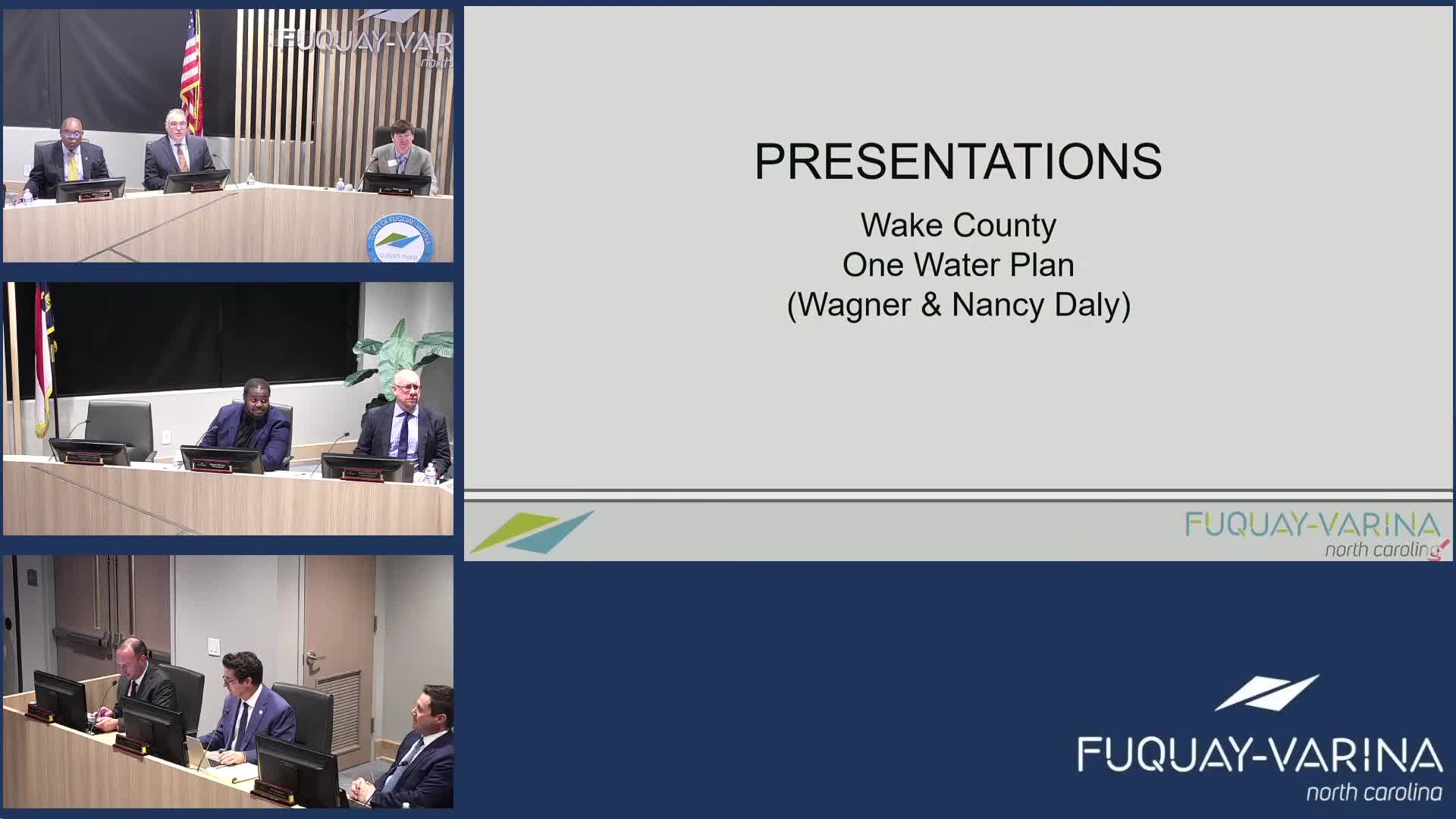
Wake County water staff updated the Fuquay Varina Board of Commissioners on the draft Wake One Water Plan Tuesday, describing a county-led, multi-jurisdictional effort to plan for long-term water supply, stormwater, wastewater and flood resilience. Nancy Daley, Wake County water resources program manager, said the draft is open for public comment through Oct. 10 and staff expects to finalize the plan in early 2026.
Daley told the board the plan takes a 50-year view and “integrates all forms of water,” including surface water, groundwater, stormwater and wastewater, and is built on the county’s Plan Wake comprehensive land-use work. She described four focus areas: optimized water supply (including reuse and stormwater capture), water-quality and hydrology improvements (including green stormwater infrastructure), land conservation (open space and agricultural protection) and flood resilience (including modeling and public outreach).
The draft, Daley said, results from two public surveys, multiple community input sessions and technical workshops with municipalities and private providers. “The Wake County Water Partnership has been integral to the development of this plan,” she said, identifying the partnership as a board-appointed committee that includes municipal representatives and private and agricultural stakeholders. Daley also noted consultants Hazen and Sawyer, Tetra Tech and RTI contributed technical work.
Local officials pressed for clarity on the plan’s authority, funding and expected outcomes. Commissioner Adcock asked whether the plan would control municipal water utilities; Daley replied it would not — the plan provides information and recommends coordination, but does not reassign municipal authorities. Daley said Wake County oversees private wells and certain stormwater and septic rules in county jurisdictions but that municipalities provide most municipal drinking water.
Commissioner Adcock and other board members urged clearer county support for municipal infrastructure and for partnerships to extend municipal service to areas currently served by wells and septics. Daley said the draft identifies strategies that will require differing implementation pathways; some are organizational and coordination-focused while others will need discrete project funding. “Right now, we don’t have a designated funding source,” she said, and added that the water partnership and work groups will be asked to help prioritize and identify funding options.
Commissioner Harris asked whether the planning effort connects to broader regional water work. Daley said the county is coordinating with existing regional efforts — including the Triangle Water Supply Partnership — and intends to build on, not duplicate, those studies while addressing elements such as stormwater and wastewater that regional supply groups may not cover.
Daley and Michael Wagner, Fuquay Varina public utilities director (the town’s representative to the Wake County Water Partnership), asked municipal staff to continue participating in the partnership’s workgroups to move planning toward implementation. Daley said the draft plan is available on the Wake County website, that a public webinar is scheduled for Oct. 1, and that public comment closes Oct. 10.
The board did not take formal action on the plan during the meeting; Daley sought municipal collaboration and continued staff participation in partnership work groups as the next practical steps.
Daley told the board the plan takes a 50-year view and “integrates all forms of water,” including surface water, groundwater, stormwater and wastewater, and is built on the county’s Plan Wake comprehensive land-use work. She described four focus areas: optimized water supply (including reuse and stormwater capture), water-quality and hydrology improvements (including green stormwater infrastructure), land conservation (open space and agricultural protection) and flood resilience (including modeling and public outreach).
The draft, Daley said, results from two public surveys, multiple community input sessions and technical workshops with municipalities and private providers. “The Wake County Water Partnership has been integral to the development of this plan,” she said, identifying the partnership as a board-appointed committee that includes municipal representatives and private and agricultural stakeholders. Daley also noted consultants Hazen and Sawyer, Tetra Tech and RTI contributed technical work.
Local officials pressed for clarity on the plan’s authority, funding and expected outcomes. Commissioner Adcock asked whether the plan would control municipal water utilities; Daley replied it would not — the plan provides information and recommends coordination, but does not reassign municipal authorities. Daley said Wake County oversees private wells and certain stormwater and septic rules in county jurisdictions but that municipalities provide most municipal drinking water.
Commissioner Adcock and other board members urged clearer county support for municipal infrastructure and for partnerships to extend municipal service to areas currently served by wells and septics. Daley said the draft identifies strategies that will require differing implementation pathways; some are organizational and coordination-focused while others will need discrete project funding. “Right now, we don’t have a designated funding source,” she said, and added that the water partnership and work groups will be asked to help prioritize and identify funding options.
Commissioner Harris asked whether the planning effort connects to broader regional water work. Daley said the county is coordinating with existing regional efforts — including the Triangle Water Supply Partnership — and intends to build on, not duplicate, those studies while addressing elements such as stormwater and wastewater that regional supply groups may not cover.
Daley and Michael Wagner, Fuquay Varina public utilities director (the town’s representative to the Wake County Water Partnership), asked municipal staff to continue participating in the partnership’s workgroups to move planning toward implementation. Daley said the draft plan is available on the Wake County website, that a public webinar is scheduled for Oct. 1, and that public comment closes Oct. 10.
The board did not take formal action on the plan during the meeting; Daley sought municipal collaboration and continued staff participation in partnership work groups as the next practical steps.
Don't Miss a Word: See the Full Meeting!
Go beyond summaries. Unlock every video, transcript, and key insight with a Founder Membership.
✓
Get instant access to full meeting videos
✓
Search and clip any phrase from complete transcripts
✓
Receive AI-powered summaries & custom alerts
✓
Enjoy lifetime, unrestricted access to government data
30-day money-back guarantee
