County explains facilities cost-allocation method: square-foot occupancy drives charges
September 18, 2025 | Cowlitz County, Washington
This article was created by AI summarizing key points discussed. AI makes mistakes, so for full details and context, please refer to the video of the full meeting. Please report any errors so we can fix them. Report an error »
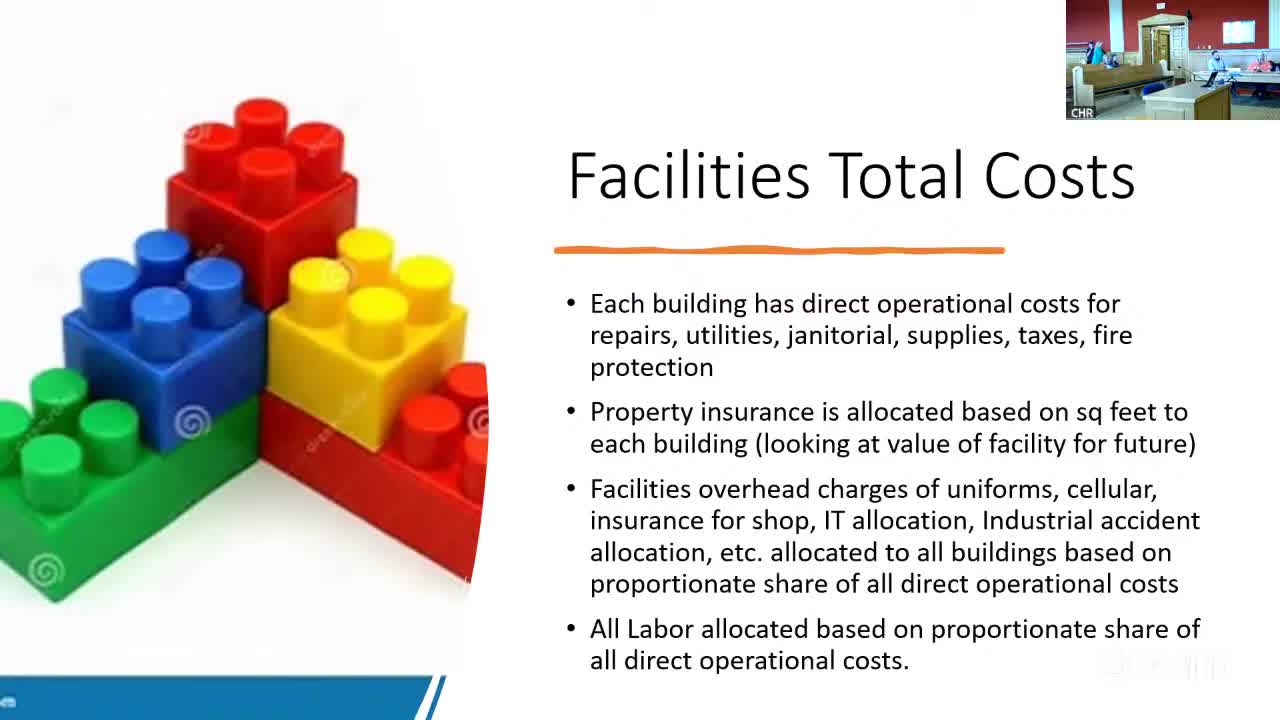
County staff explained to commissioners how facilities operating costs are allocated to departments and how shared-space charges are calculated.
Public Works staff described the method: each building's direct operational costs (repairs, utilities, janitorial, supplies, taxes, fire protection and property insurance) are totaled; for shared buildings the county calculates a price per square foot (excluding non-occupiable areas) and multiplies that by each department's occupied square footage to determine each department's allocation. District court space is charged to the county and to participating cities in proportion to court caseloads; the county currently carries about 73% of that allocation.
Staff emphasized that the allocation covers operational costs only and does not include depreciation or capital-reserve funding for roofs and other large renovations, which the county funds from separate capital reserves. Labor and overhead costs for facilities maintenance are allocated proportionally to buildings based on direct operational cost; staff said future improvements could allocate labor based on a work-order tracking system when sufficient historical data exists.
Why it matters: departments budget for facilities costs as operating expenses; understanding the allocation method helps departments plan and avoid surprises. Staff said the county calculates estimated allocations for departments as part of the budget process and performs retroactive adjustments after each fiscal year closes.
Discussion vs. direction vs. decision: Staff provided an explanatory presentation (discussion). The methodology was described as current practice; no policy change or board vote occurred at the workshop.
Ending: Facilities and finance staff said they will continue to refine allocations, explore alternative bases (e.g., building value) and aim to improve labor-allocation accuracy through work-order data.
Public Works staff described the method: each building's direct operational costs (repairs, utilities, janitorial, supplies, taxes, fire protection and property insurance) are totaled; for shared buildings the county calculates a price per square foot (excluding non-occupiable areas) and multiplies that by each department's occupied square footage to determine each department's allocation. District court space is charged to the county and to participating cities in proportion to court caseloads; the county currently carries about 73% of that allocation.
Staff emphasized that the allocation covers operational costs only and does not include depreciation or capital-reserve funding for roofs and other large renovations, which the county funds from separate capital reserves. Labor and overhead costs for facilities maintenance are allocated proportionally to buildings based on direct operational cost; staff said future improvements could allocate labor based on a work-order tracking system when sufficient historical data exists.
Why it matters: departments budget for facilities costs as operating expenses; understanding the allocation method helps departments plan and avoid surprises. Staff said the county calculates estimated allocations for departments as part of the budget process and performs retroactive adjustments after each fiscal year closes.
Discussion vs. direction vs. decision: Staff provided an explanatory presentation (discussion). The methodology was described as current practice; no policy change or board vote occurred at the workshop.
Ending: Facilities and finance staff said they will continue to refine allocations, explore alternative bases (e.g., building value) and aim to improve labor-allocation accuracy through work-order data.
Don't Miss a Word: See the Full Meeting!
Go beyond summaries. Unlock every video, transcript, and key insight with a Founder Membership.
✓
Get instant access to full meeting videos
✓
Search and clip any phrase from complete transcripts
✓
Receive AI-powered summaries & custom alerts
✓
Enjoy lifetime, unrestricted access to government data
30-day money-back guarantee
