Tempe council pauses decision on 2‑story ADU appeal, asks zoning administrator for formal opinion
September 19, 2025 | Tempe, Maricopa County, Arizona
This article was created by AI summarizing key points discussed. AI makes mistakes, so for full details and context, please refer to the video of the full meeting. Please report any errors so we can fix them. Report an error »
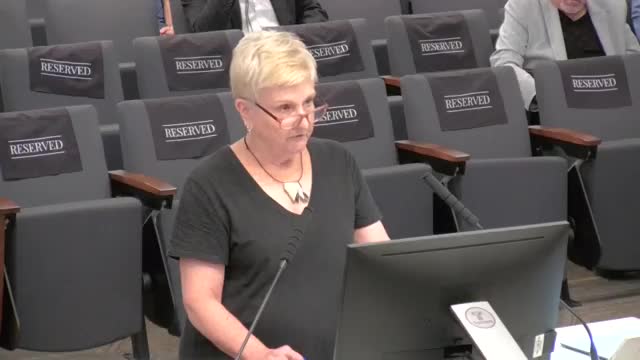
Dawn Sinclair, the appellant in an appeal of a development review commission approval, asked the Tempe City Council to overturn a use permit that would allow a two‑story accessory dwelling unit (ADU) behind a single‑story home at 36 East Cairo Drive. Sinclair argued the second story conflicted with the neighborhood's character and city policy and said the Board of Adjustment has already decided she has standing to appeal. "A two‑story structure just isn't compatible with the character of Greater Broadmoor," Sinclair told the council.
The council heard more than a dozen public speakers from nearby neighborhoods who said the proposed ADU would erode single‑story neighborhood character, reduce privacy and lower property values. Barto Besic, president of the New Vista Neighborhood Association, said the ADU would "set a precedent that damages the character and charm of our single story neighborhood." Resident testimony also raised deed restrictions, parking and traffic, and the growing number of investor‑owned rentals nearby.
Tim Linklater, the applicant's representative from 3 C Contracting LLC, called the proposed ADU compatible with existing development and said the structure’s lofts are intended for storage. "If we were to remove these lofts out of this the design, the exterior structure wouldn't change in any way, shape or form," Linklater said.
City Attorney Eric Anderson and other staff answered legal questions about state ADU law during the hearing. Anderson referenced Arizona Revised Statutes 9‑461.18, explaining that state law "does entitle a single family residence to 1 attached as well as 1 detached ADU" and noted that the statute limits municipalities' ability to require use permits in some circumstances.
Council members debated two competing concerns: neighborhood consistency and the limits of local authority under recent state ADU legislation. Councilmember Amber Amberg moved to deny the appeal (to uphold the DRC approval); that motion failed on a 5‑2 vote. After further legal questions and a request for clarity about how Tempe will align city practice with state law, the council voted unanimously to continue the matter and to direct the zoning administrator to issue a formal opinion on the council's legal authority and the interaction of state ADU law with local rules.
The council did not take a final vote on the use permit. Vice Mayor Lauren Garland moved the continuation, and the council approved continuing the item until the zoning administrator's formal opinion is resolved. Sinclair and multiple neighbors said they plan to continue pressing the council to deny the two‑story element and urged the city to treat deed restrictions and the Cultural Resources Area designation as relevant context when evaluating compatibility.
The council instructed staff to notify interested parties when the zoning administrator's opinion and any follow‑up scheduling are complete.
The record includes arguments about collateral estoppel (whether standing was already litigated before the Board of Adjustment), the definition of "neighborhood" in city policy, and an alternative the appellant advanced that would preserve a single‑story profile while providing storage space: Sinclair presented a redesign that she said would lower the roofline to about 15 feet while retaining storage capacity and one additional unit of housing.
The council's action was procedural: continuing the appeal to await a formal zoning administrator determination rather than resolving the substantive question about the ADU's height and compatibility. A return date will be scheduled after staff obtains and processes the requested legal interpretation.
The council heard more than a dozen public speakers from nearby neighborhoods who said the proposed ADU would erode single‑story neighborhood character, reduce privacy and lower property values. Barto Besic, president of the New Vista Neighborhood Association, said the ADU would "set a precedent that damages the character and charm of our single story neighborhood." Resident testimony also raised deed restrictions, parking and traffic, and the growing number of investor‑owned rentals nearby.
Tim Linklater, the applicant's representative from 3 C Contracting LLC, called the proposed ADU compatible with existing development and said the structure’s lofts are intended for storage. "If we were to remove these lofts out of this the design, the exterior structure wouldn't change in any way, shape or form," Linklater said.
City Attorney Eric Anderson and other staff answered legal questions about state ADU law during the hearing. Anderson referenced Arizona Revised Statutes 9‑461.18, explaining that state law "does entitle a single family residence to 1 attached as well as 1 detached ADU" and noted that the statute limits municipalities' ability to require use permits in some circumstances.
Council members debated two competing concerns: neighborhood consistency and the limits of local authority under recent state ADU legislation. Councilmember Amber Amberg moved to deny the appeal (to uphold the DRC approval); that motion failed on a 5‑2 vote. After further legal questions and a request for clarity about how Tempe will align city practice with state law, the council voted unanimously to continue the matter and to direct the zoning administrator to issue a formal opinion on the council's legal authority and the interaction of state ADU law with local rules.
The council did not take a final vote on the use permit. Vice Mayor Lauren Garland moved the continuation, and the council approved continuing the item until the zoning administrator's formal opinion is resolved. Sinclair and multiple neighbors said they plan to continue pressing the council to deny the two‑story element and urged the city to treat deed restrictions and the Cultural Resources Area designation as relevant context when evaluating compatibility.
The council instructed staff to notify interested parties when the zoning administrator's opinion and any follow‑up scheduling are complete.
The record includes arguments about collateral estoppel (whether standing was already litigated before the Board of Adjustment), the definition of "neighborhood" in city policy, and an alternative the appellant advanced that would preserve a single‑story profile while providing storage space: Sinclair presented a redesign that she said would lower the roofline to about 15 feet while retaining storage capacity and one additional unit of housing.
The council's action was procedural: continuing the appeal to await a formal zoning administrator determination rather than resolving the substantive question about the ADU's height and compatibility. A return date will be scheduled after staff obtains and processes the requested legal interpretation.
Don't Miss a Word: See the Full Meeting!
Go beyond summaries. Unlock every video, transcript, and key insight with a Founder Membership.
✓
Get instant access to full meeting videos
✓
Search and clip any phrase from complete transcripts
✓
Receive AI-powered summaries & custom alerts
✓
Enjoy lifetime, unrestricted access to government data
30-day money-back guarantee
