Baltimore auditors, finance officials say long-running control weaknesses caused late FY24 financial reports; corrective steps underway
September 19, 2025 | Baltimore City, Baltimore County, Maryland
This article was created by AI summarizing key points discussed. AI makes mistakes, so for full details and context, please refer to the video of the full meeting. Please report any errors so we can fix them. Report an error »
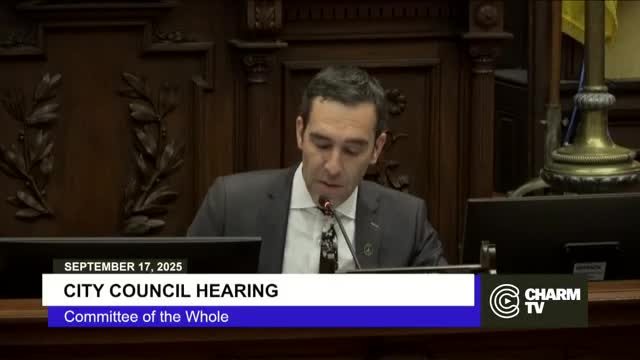
Baltimore City Council President Z Cohen convened a Committee of the Whole hearing Sept. 17 to review the city's Annual Comprehensive Financial Report for the fiscal year ended June 30, 2024, and an associated federal single audit that the city's auditor and external auditors said were completed with an opinion date of May 9, 2025. "We are holding this hearing because the 70 fourth city council is committed to transparency, accountability, and good fiscal stewardship," Council President Z Cohen said at the start of the hearing.
The city auditor, Josh Pash, and SB and Company engagement partner Bill Seymour told the council the ACFR and single audit were completed on May 9, 2025, after paperwork and schedules were finally provided in April 2025. Pash said the state-required ACFR due date is Dec. 31, 2024, and the single audit deadline was March 31, 2025. "The audits were completed for the opinion dated 05/09/2025," Josh Pash said.
The external auditors identified recurring material weaknesses in internal controls over financial reporting and federal compliance. Seymour said material weaknesses have recurred across multiple years in areas that include water and wastewater billing, grants accounting, fixed assets and information technology. "When we have a finding, management provides us a corrective action plan," he said, explaining that removing a material weakness typically requires implementing and testing corrective steps over time.
Finance Director Michael Moxton and his deputies described multiple process and staffing changes underway. "I am happy to report that we are on track to making this December 31 target as of right now for the FY '25 ACFR," Moxton said, describing hiring, internal deadlines and new tracking tools aimed at timelier publication. Deputy director Yolanda Mosites and BAPS acting chief Danielle Tillman outlined training, software mapping fixes and a reconciliation metric intended to prevent repeat payroll-accounting and cash-reconciliation errors.
Council members repeatedly pressed why long-standing weaknesses persisted. Seymour and city officials attributed the durability of findings to pandemic-era staffing losses, an enterprise software transition and the lag between fiscal-year activity and audit cycles. Seymour noted that, because the single audit is due nine months after year end, "it normally takes at least 2 years to be able to clear" material weaknesses once identified.
The administration said corrective measures already adopted include new staffing, updated procedures, corrective-action trackers and Board of Estimates approvals of grant-related policies (see separate articles). Officials emphasized that some fixes are technical and can be corrected quickly, while others require multiyear implementation and testing before auditors will remove a finding.
Council members said timeliness and accuracy of the ACFR are essential to budget decisions and to sustaining investor confidence; the city's finance team noted credit-rating agencies watch fund balance and other fiscal metrics closely. The committee asked for continued written updates on corrective actions and for the administration to meet the stated December 31 target for the FY25 ACFR.
The city auditor, Josh Pash, and SB and Company engagement partner Bill Seymour told the council the ACFR and single audit were completed on May 9, 2025, after paperwork and schedules were finally provided in April 2025. Pash said the state-required ACFR due date is Dec. 31, 2024, and the single audit deadline was March 31, 2025. "The audits were completed for the opinion dated 05/09/2025," Josh Pash said.
The external auditors identified recurring material weaknesses in internal controls over financial reporting and federal compliance. Seymour said material weaknesses have recurred across multiple years in areas that include water and wastewater billing, grants accounting, fixed assets and information technology. "When we have a finding, management provides us a corrective action plan," he said, explaining that removing a material weakness typically requires implementing and testing corrective steps over time.
Finance Director Michael Moxton and his deputies described multiple process and staffing changes underway. "I am happy to report that we are on track to making this December 31 target as of right now for the FY '25 ACFR," Moxton said, describing hiring, internal deadlines and new tracking tools aimed at timelier publication. Deputy director Yolanda Mosites and BAPS acting chief Danielle Tillman outlined training, software mapping fixes and a reconciliation metric intended to prevent repeat payroll-accounting and cash-reconciliation errors.
Council members repeatedly pressed why long-standing weaknesses persisted. Seymour and city officials attributed the durability of findings to pandemic-era staffing losses, an enterprise software transition and the lag between fiscal-year activity and audit cycles. Seymour noted that, because the single audit is due nine months after year end, "it normally takes at least 2 years to be able to clear" material weaknesses once identified.
The administration said corrective measures already adopted include new staffing, updated procedures, corrective-action trackers and Board of Estimates approvals of grant-related policies (see separate articles). Officials emphasized that some fixes are technical and can be corrected quickly, while others require multiyear implementation and testing before auditors will remove a finding.
Council members said timeliness and accuracy of the ACFR are essential to budget decisions and to sustaining investor confidence; the city's finance team noted credit-rating agencies watch fund balance and other fiscal metrics closely. The committee asked for continued written updates on corrective actions and for the administration to meet the stated December 31 target for the FY25 ACFR.
View the Full Meeting & All Its Details
This article offers just a summary. Unlock complete video, transcripts, and insights as a Founder Member.
✓
Watch full, unedited meeting videos
✓
Search every word spoken in unlimited transcripts
✓
AI summaries & real-time alerts (all government levels)
✓
Permanent access to expanding government content
30-day money-back guarantee
