Commission approves reconstruction plan for 5401 Alabama Avenue and ties demolition to building permit
September 19, 2025 | Chattanooga City, Hamilton County, Tennessee
This article was created by AI summarizing key points discussed. AI makes mistakes, so for full details and context, please refer to the video of the full meeting. Please report any errors so we can fix them. Report an error »
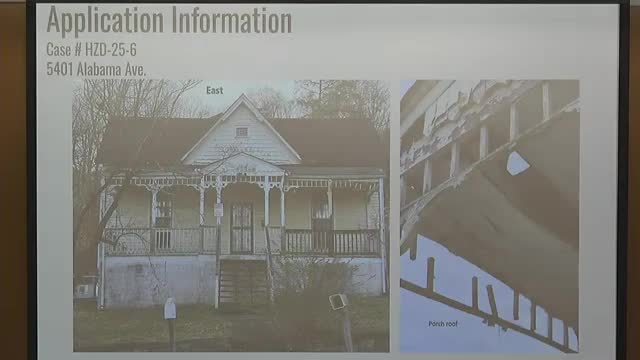
The Chattanooga Historic Zoning Commission approved plans to reconstruct the front of 5401 Alabama Avenue in Saint Elmo and authorized demolition tied explicitly to the reconstruction application, following hours of discussion about salvage and precedent for demolition of deteriorated historic buildings.
What the commission decided: The commission approved case HZ‑25‑107, a reconstruction and addition for the contributing circa‑1889 property, and added conditions that front‑facing siding and trim on the reconstructed portion match the historic size and profile; windows may be aluminum‑clad or composite; and reinstallation of original trim is encouraged where possible but not required. Separately, the commission voted to take up the related demolition application (HZD‑25‑6) and approved demolition with a condition that a demolition permit may not be issued until the building permit for the reconstruction (HZ‑25‑107) is in hand.
Why it matters: The parcel is listed as contributing in the National Register nomination. Commissioners wrestled with the Secretary of the Interior’s standards for reconstruction, the extent of structural failure documented in an engineer’s report, and the risk of approving a demolition that a future owner could use to remove the building without rebuilding in kind.
Applicant presentation: Architect Denise Shaw explained the house has severe structural problems—foundation and framing failures, and collapsed floors—and that the team intends to salvage decorative elements where feasible and otherwise reconstruct the historic front elevation to match original proportions and detailing. Shaw provided measured figures: the original front footprint she cited was about 1,619 square feet; the proposed new first floor is 2,247 square feet (an increase of 628 sq ft on the first floor), with an upper level of about 953 sq ft. Shaw said the new design holds roof lines back to preserve the street scale and that the reconstructed front will reintroduce original trim and porch details where possible.
Commission discussion and caution: Commissioners emphasized demolition is permanent and voiced concern that approving a demolition without an enforceable reconstruction could leave a vacant lot or allow a future owner to build differently. Several commissioners recommended coupling approval of reconstruction with demolition or denying standalone demolition. Staff confirmed code process requires a separate demolition permit and a separate building permit; the building department may allow both but a demolition permit alone could be pulled without a building permit unless the commission conditions its approval.
Actions and outcomes: The commission approved HZ‑25‑107 (reconstruction) with the conditions noted above. For HZD‑25‑6 (demolition), the commission approved the demolition application but conditioned the demolition permit so it cannot be issued prior to issuance of the building permit for HZ‑25‑107. The motion for reconstruction passed with one recorded opposed vote; the demolition approval was carried with one opposed vote.
Implementation notes: Staff and the applicant said they will salvage trim, brackets and other decorative elements where possible, but the front will be reconstructed if those elements are beyond repair. The applicant and staff also discussed coordination with code enforcement to ensure demolition orders and historic‑district processes align more effectively in future cases.
What the commission decided: The commission approved case HZ‑25‑107, a reconstruction and addition for the contributing circa‑1889 property, and added conditions that front‑facing siding and trim on the reconstructed portion match the historic size and profile; windows may be aluminum‑clad or composite; and reinstallation of original trim is encouraged where possible but not required. Separately, the commission voted to take up the related demolition application (HZD‑25‑6) and approved demolition with a condition that a demolition permit may not be issued until the building permit for the reconstruction (HZ‑25‑107) is in hand.
Why it matters: The parcel is listed as contributing in the National Register nomination. Commissioners wrestled with the Secretary of the Interior’s standards for reconstruction, the extent of structural failure documented in an engineer’s report, and the risk of approving a demolition that a future owner could use to remove the building without rebuilding in kind.
Applicant presentation: Architect Denise Shaw explained the house has severe structural problems—foundation and framing failures, and collapsed floors—and that the team intends to salvage decorative elements where feasible and otherwise reconstruct the historic front elevation to match original proportions and detailing. Shaw provided measured figures: the original front footprint she cited was about 1,619 square feet; the proposed new first floor is 2,247 square feet (an increase of 628 sq ft on the first floor), with an upper level of about 953 sq ft. Shaw said the new design holds roof lines back to preserve the street scale and that the reconstructed front will reintroduce original trim and porch details where possible.
Commission discussion and caution: Commissioners emphasized demolition is permanent and voiced concern that approving a demolition without an enforceable reconstruction could leave a vacant lot or allow a future owner to build differently. Several commissioners recommended coupling approval of reconstruction with demolition or denying standalone demolition. Staff confirmed code process requires a separate demolition permit and a separate building permit; the building department may allow both but a demolition permit alone could be pulled without a building permit unless the commission conditions its approval.
Actions and outcomes: The commission approved HZ‑25‑107 (reconstruction) with the conditions noted above. For HZD‑25‑6 (demolition), the commission approved the demolition application but conditioned the demolition permit so it cannot be issued prior to issuance of the building permit for HZ‑25‑107. The motion for reconstruction passed with one recorded opposed vote; the demolition approval was carried with one opposed vote.
Implementation notes: Staff and the applicant said they will salvage trim, brackets and other decorative elements where possible, but the front will be reconstructed if those elements are beyond repair. The applicant and staff also discussed coordination with code enforcement to ensure demolition orders and historic‑district processes align more effectively in future cases.
View the Full Meeting & All Its Details
This article offers just a summary. Unlock complete video, transcripts, and insights as a Founder Member.
✓
Watch full, unedited meeting videos
✓
Search every word spoken in unlimited transcripts
✓
AI summaries & real-time alerts (all government levels)
✓
Permanent access to expanding government content
30-day money-back guarantee
