Design Review Board approves 3-foot height waiver for San Marino Drive residence
September 19, 2025 | Miami Beach, Miami-Dade County, Florida
This article was created by AI summarizing key points discussed. AI makes mistakes, so for full details and context, please refer to the video of the full meeting. Please report any errors so we can fix them. Report an error »
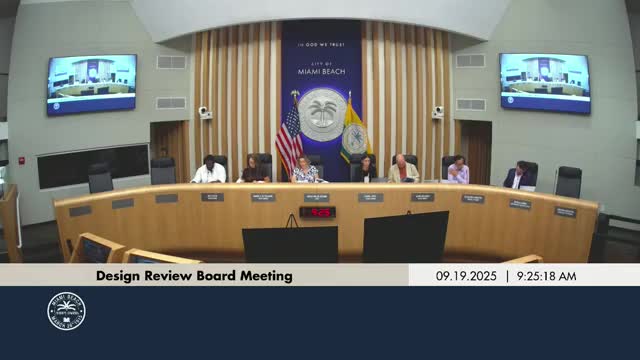
Miami Beach’s Design Review Board on Sept. 19 approved design review and a three-foot height waiver that will allow a proposed two-story single-family home at 409 East San Marino Drive to be built to a flat-roof height of 27 feet.
The board voted 4-1 to grant the request after hearing staff and applicant presentations and discussion about neighborhood context, resiliency and screening for mechanical equipment. The waiver raised the property’s maximum allowed height in the RS3 zoning district from the code’s 24-foot as‑of‑right limit to 27 feet for this project.
Staff summarized the proposal and recommended approval. Rogelio (staff member) said the project complies with setbacks, is on a large RS3 lot of 12,855 square feet and that “staff is supportive of the granting of the waiver.” The application materials show a contemporary two-story house clad primarily in travertine, with courtyards and extensive landscaping along side property lines.
Applicant attorney Matthew Amster of Burkhard, Bridal Fernandez, Larkin & Tappanis and architect Cody Thayman of Thayman Architecture and Design presented the design. Thayman said the plan “takes advantage of that North Bay view” by angling the primary bedroom at 45 degrees and carving courtyards into the massing. Landscape architect Matt Lewis described a planting strategy that replaces nearly no landscaping on the lot today with a dense native buffer and said the proposal will “add quite a bit of landscaping to our lot” to screen neighbors.
The project also incorporates resiliency measures. The owners proposed three feet of freeboard so finished floor elevation will meet required floodproofing; the team emphasized there will be no rooftop deck and no rooftop access. The architects said mechanical equipment and a backup generator are intended to be concealed on the low garage roof within a recessed area so those units are not visible from the street.
Board members praised the design and the landscape strategy but raised questions about precedent. Board member Myra expressed concern about routinely granting height waivers to accommodate recessed mechanical equipment, saying, “It’s the precedence we set of granting waivers for an additional 3 feet, to hide equipment, mechanical equipment, that could have been taken care of in the floor plan of the house.” Other members urged caution but said the large lot, the lowered eaves and the screening make this instance acceptable.
Members discussed interior ceiling heights: the proposal shows about 12-foot ceilings on the first floor and 11-foot ceilings on the second. Several board members noted similar character could be achieved at the 24-foot maximum roof height by modestly reducing ceiling heights, but the applicant said losing the three feet would expose screened mechanical equipment and materially reduce interior ceiling heights.
The motion to approve carried on a 4-1 roll call. The motion, made by board member Mister Lester and seconded by Miss Lewin, approved the design and a three-foot waiver to a flat-roof height of 27 feet (above DFE). Vote record on the motion: Miss Boutagavoli — No; Miss Killer Nelson — Yes; Mister Lester — Yes; Miss Lewin — Yes; Mister Meshberg — Yes. Conditions of approval include working with staff on final material and finish selections (including metal mullion color), and following the conditions listed in the draft order provided to the board.
The applicant may now proceed to building-permit review with the requirement that final materials match the approved palette and that staff confirm the agreed refinements during permit review.
The board voted 4-1 to grant the request after hearing staff and applicant presentations and discussion about neighborhood context, resiliency and screening for mechanical equipment. The waiver raised the property’s maximum allowed height in the RS3 zoning district from the code’s 24-foot as‑of‑right limit to 27 feet for this project.
Staff summarized the proposal and recommended approval. Rogelio (staff member) said the project complies with setbacks, is on a large RS3 lot of 12,855 square feet and that “staff is supportive of the granting of the waiver.” The application materials show a contemporary two-story house clad primarily in travertine, with courtyards and extensive landscaping along side property lines.
Applicant attorney Matthew Amster of Burkhard, Bridal Fernandez, Larkin & Tappanis and architect Cody Thayman of Thayman Architecture and Design presented the design. Thayman said the plan “takes advantage of that North Bay view” by angling the primary bedroom at 45 degrees and carving courtyards into the massing. Landscape architect Matt Lewis described a planting strategy that replaces nearly no landscaping on the lot today with a dense native buffer and said the proposal will “add quite a bit of landscaping to our lot” to screen neighbors.
The project also incorporates resiliency measures. The owners proposed three feet of freeboard so finished floor elevation will meet required floodproofing; the team emphasized there will be no rooftop deck and no rooftop access. The architects said mechanical equipment and a backup generator are intended to be concealed on the low garage roof within a recessed area so those units are not visible from the street.
Board members praised the design and the landscape strategy but raised questions about precedent. Board member Myra expressed concern about routinely granting height waivers to accommodate recessed mechanical equipment, saying, “It’s the precedence we set of granting waivers for an additional 3 feet, to hide equipment, mechanical equipment, that could have been taken care of in the floor plan of the house.” Other members urged caution but said the large lot, the lowered eaves and the screening make this instance acceptable.
Members discussed interior ceiling heights: the proposal shows about 12-foot ceilings on the first floor and 11-foot ceilings on the second. Several board members noted similar character could be achieved at the 24-foot maximum roof height by modestly reducing ceiling heights, but the applicant said losing the three feet would expose screened mechanical equipment and materially reduce interior ceiling heights.
The motion to approve carried on a 4-1 roll call. The motion, made by board member Mister Lester and seconded by Miss Lewin, approved the design and a three-foot waiver to a flat-roof height of 27 feet (above DFE). Vote record on the motion: Miss Boutagavoli — No; Miss Killer Nelson — Yes; Mister Lester — Yes; Miss Lewin — Yes; Mister Meshberg — Yes. Conditions of approval include working with staff on final material and finish selections (including metal mullion color), and following the conditions listed in the draft order provided to the board.
The applicant may now proceed to building-permit review with the requirement that final materials match the approved palette and that staff confirm the agreed refinements during permit review.
View the Full Meeting & All Its Details
This article offers just a summary. Unlock complete video, transcripts, and insights as a Founder Member.
✓
Watch full, unedited meeting videos
✓
Search every word spoken in unlimited transcripts
✓
AI summaries & real-time alerts (all government levels)
✓
Permanent access to expanding government content
30-day money-back guarantee
