Lakeville planning commission recommends 2026–2030 capital improvement plan to council
September 19, 2025 | Lakeville City, Dakota County, Minnesota
This article was created by AI summarizing key points discussed. AI makes mistakes, so for full details and context, please refer to the video of the full meeting. Please report any errors so we can fix them. Report an error »
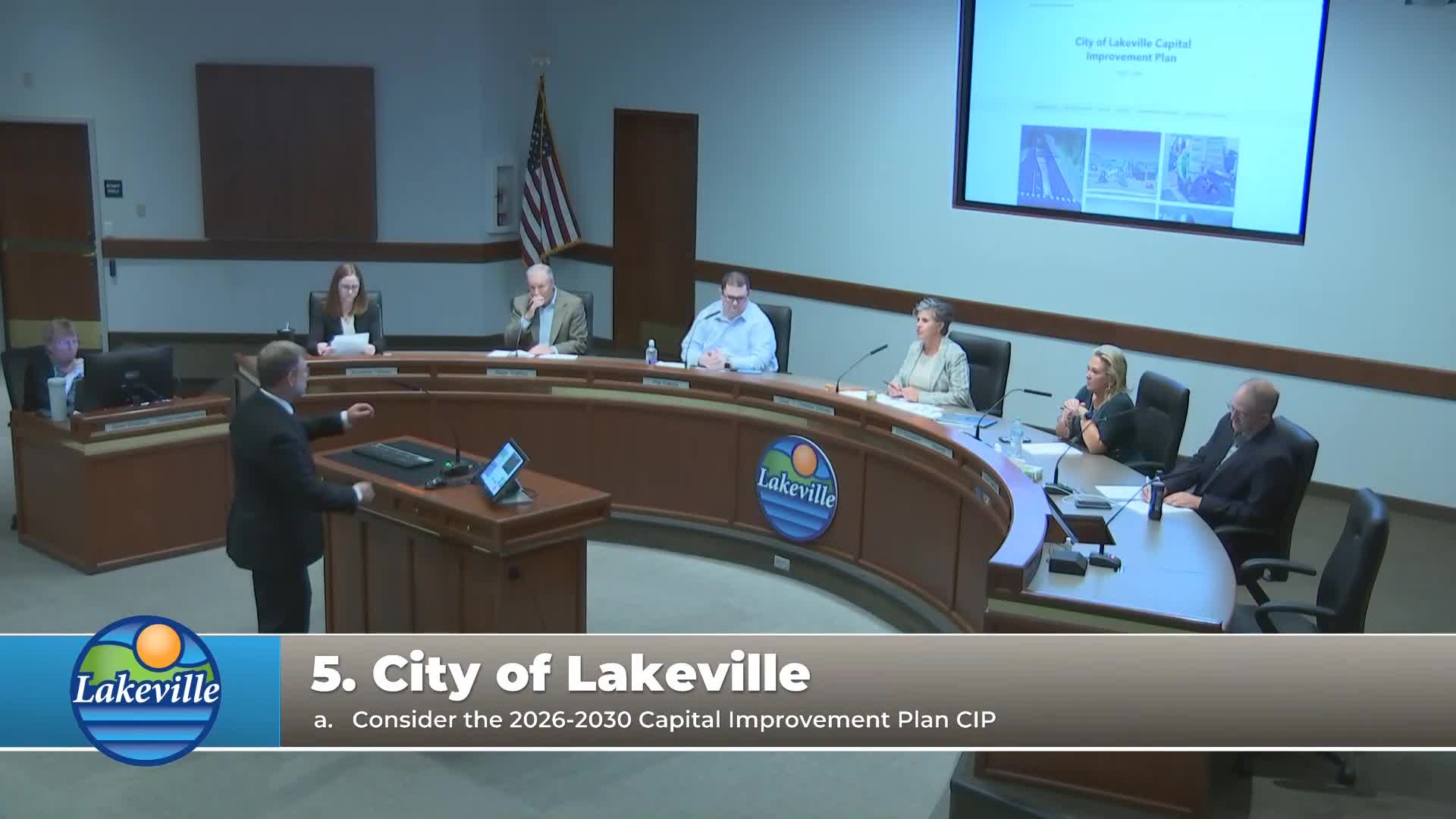
The Lakeville Planning Commission on Sept. 18 voted to recommend that the City Council adopt the 2026–2030 Capital Improvement Plan, finding it consistent with the city’s 2040 comprehensive plan. The motion was moved by Commissioner Calusa and carried by roll call (Traffes, Palooza, Zimmer, Duckworth, Swanson, Hensley and others voting aye). Zach Johnson, the city engineer, presented the draft plan and described it as “a guide … used by city staff and officials to keep us running well today and also help us prepare to tomorrow’s future.”
The plan identifies nine infrastructure categories: transportation, utilities, parks and recreation, environmental resources, technology, equipment and facilities. Johnson highlighted next year’s pavement preservation program with Judicial Road on the west side of the city and a freight rail car storage project that would construct a 225‑car track to shift rail car storage out of County Road 50 and into the industrial park. He called the document a “living document” that can change as priorities and conditions evolve.
Key transportation items in the plan include expansion and modernization of Dodd Boulevard into a two‑lane divided roadway with turn lanes and trails, an interchange improvement at County Road 50 and Interstate 35 designed as a divergent‑diamond interchange (scheduled to begin construction in 2028 and estimated as a two‑year project), intersection improvements including proposed roundabouts, and a set of traffic‑signal replacements and new signals in 2026–27 intended to mitigate impacts from larger projects.
On utilities, Johnson said the plan programs maintenance work and capacity additions: repainting the Dakota Heights water tower in 2026, replacement wells and forecasting for two new wells programmed for 2028 (subject to growth and state permitting), and a water‑treatment facility expansion proposed for 2027. Facilities projects listed include a new community center opening in 2026, expansion of the central maintenance facility in 2027 and construction of Fire Station 5 starting in 2026.
Commissioners asked questions about cost sharing and water supply. Commissioner Swanson asked whether the Judicial Road pavement preservation project includes a cost share with the neighboring city; Johnson said the city shares that project 50/50 with the adjacent community and that the work is a mill‑and‑overlay pavement preservation project, not an expansion. Commissioner Travis asked how groundwater supply is assessed for new wells; Johnson said the city uses a demand model, coordinates with state permitting and plans wells only when projected volumes show additional supply is needed.
Commissioners also noted trade‑offs. One commissioner observed that the city’s debt level will increase as the plan is implemented. The commission approved the recommendation after discussion and thanked staff for the work on the draft plan.
The recommendation will go to the City Council on Oct. 6 for final consideration.
The plan identifies nine infrastructure categories: transportation, utilities, parks and recreation, environmental resources, technology, equipment and facilities. Johnson highlighted next year’s pavement preservation program with Judicial Road on the west side of the city and a freight rail car storage project that would construct a 225‑car track to shift rail car storage out of County Road 50 and into the industrial park. He called the document a “living document” that can change as priorities and conditions evolve.
Key transportation items in the plan include expansion and modernization of Dodd Boulevard into a two‑lane divided roadway with turn lanes and trails, an interchange improvement at County Road 50 and Interstate 35 designed as a divergent‑diamond interchange (scheduled to begin construction in 2028 and estimated as a two‑year project), intersection improvements including proposed roundabouts, and a set of traffic‑signal replacements and new signals in 2026–27 intended to mitigate impacts from larger projects.
On utilities, Johnson said the plan programs maintenance work and capacity additions: repainting the Dakota Heights water tower in 2026, replacement wells and forecasting for two new wells programmed for 2028 (subject to growth and state permitting), and a water‑treatment facility expansion proposed for 2027. Facilities projects listed include a new community center opening in 2026, expansion of the central maintenance facility in 2027 and construction of Fire Station 5 starting in 2026.
Commissioners asked questions about cost sharing and water supply. Commissioner Swanson asked whether the Judicial Road pavement preservation project includes a cost share with the neighboring city; Johnson said the city shares that project 50/50 with the adjacent community and that the work is a mill‑and‑overlay pavement preservation project, not an expansion. Commissioner Travis asked how groundwater supply is assessed for new wells; Johnson said the city uses a demand model, coordinates with state permitting and plans wells only when projected volumes show additional supply is needed.
Commissioners also noted trade‑offs. One commissioner observed that the city’s debt level will increase as the plan is implemented. The commission approved the recommendation after discussion and thanked staff for the work on the draft plan.
The recommendation will go to the City Council on Oct. 6 for final consideration.
Don't Miss a Word: See the Full Meeting!
Go beyond summaries. Unlock every video, transcript, and key insight with a Founder Membership.
✓
Get instant access to full meeting videos
✓
Search and clip any phrase from complete transcripts
✓
Receive AI-powered summaries & custom alerts
✓
Enjoy lifetime, unrestricted access to government data
30-day money-back guarantee
