Northglenn requests deeper analysis after third‑party comparison of police retirement options
September 22, 2025 | Northglenn, Adams County, Colorado
This article was created by AI summarizing key points discussed. AI makes mistakes, so for full details and context, please refer to the video of the full meeting. Please report any errors so we can fix them. Report an error »
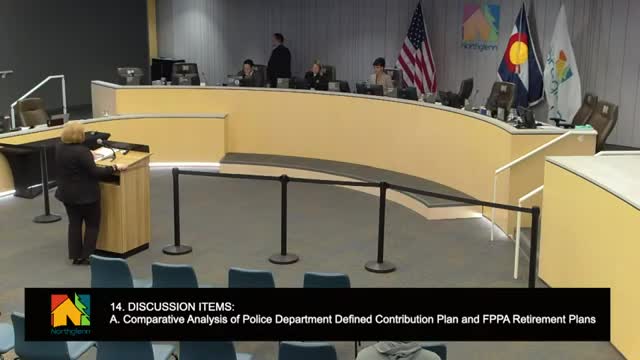
City staff and a third‑party adviser briefed Northglenn City Council on Sept. 23 on retirement plan options for police officers after a request from the Fraternal Order of Police to evaluate moving from a local defined‑contribution plan to the statewide FPPA defined‑benefit system.
Inovest Portfolio Solutions principal Jared Martin described conceptual differences between defined‑contribution (money‑purchase) accounts — the city’s current police retirement structure administered via Mission Square Retirement — and the FPPA defined‑benefit model, which defines retirement payouts and is administered at the state level. Martin emphasized he was providing impartial, educational analysis: “I’m not here to give ... to opine which path to take,” he said; city staff later said they would commission a deeper financial study if council desired.
Key points: The current money‑purchase plan holds individual accounts, allows flexible distributions and leaves assets to beneficiaries; FPPA pools assets, uses actuarial funding and can provide a predictable lifetime benefit. Martin noted trade‑offs: defined benefit plans can lower retirement risk for employees near retirement but concentrate funding and longevity risk on the employer; defined contribution plans shift investment and longevity risk to employees. Presentation details included vesting differences (current local plan 6‑year vesting, FPPA 5 years in the example discussed) and recent FPPA contribution increases cited as a historical trend.
Council direction: Several council members spoke in favor of studying the question further. City Manager Heather Geyer summarized next steps and staff sought council consensus. Council members gave consensus to proceed with a more detailed financial analysis to quantify employer funding impacts and options for reentry, note potential effects on recruitment and retention, and return with timeline and cost estimates.
What happens next: Staff will pursue a deeper fiscal analysis of the funding implications, possible contribution rates, and transition costs, and return to council with findings for a policy decision.
Inovest Portfolio Solutions principal Jared Martin described conceptual differences between defined‑contribution (money‑purchase) accounts — the city’s current police retirement structure administered via Mission Square Retirement — and the FPPA defined‑benefit model, which defines retirement payouts and is administered at the state level. Martin emphasized he was providing impartial, educational analysis: “I’m not here to give ... to opine which path to take,” he said; city staff later said they would commission a deeper financial study if council desired.
Key points: The current money‑purchase plan holds individual accounts, allows flexible distributions and leaves assets to beneficiaries; FPPA pools assets, uses actuarial funding and can provide a predictable lifetime benefit. Martin noted trade‑offs: defined benefit plans can lower retirement risk for employees near retirement but concentrate funding and longevity risk on the employer; defined contribution plans shift investment and longevity risk to employees. Presentation details included vesting differences (current local plan 6‑year vesting, FPPA 5 years in the example discussed) and recent FPPA contribution increases cited as a historical trend.
Council direction: Several council members spoke in favor of studying the question further. City Manager Heather Geyer summarized next steps and staff sought council consensus. Council members gave consensus to proceed with a more detailed financial analysis to quantify employer funding impacts and options for reentry, note potential effects on recruitment and retention, and return with timeline and cost estimates.
What happens next: Staff will pursue a deeper fiscal analysis of the funding implications, possible contribution rates, and transition costs, and return to council with findings for a policy decision.
View the Full Meeting & All Its Details
This article offers just a summary. Unlock complete video, transcripts, and insights as a Founder Member.
✓
Watch full, unedited meeting videos
✓
Search every word spoken in unlimited transcripts
✓
AI summaries & real-time alerts (all government levels)
✓
Permanent access to expanding government content
30-day money-back guarantee
