The Dalles adopts new mobile-food vendor code; council urges site help for downtown meal provider
September 22, 2025 | The Dalles, Wasco County, Oregon
This article was created by AI summarizing key points discussed. AI makes mistakes, so for full details and context, please refer to the video of the full meeting. Please report any errors so we can fix them. Report an error »
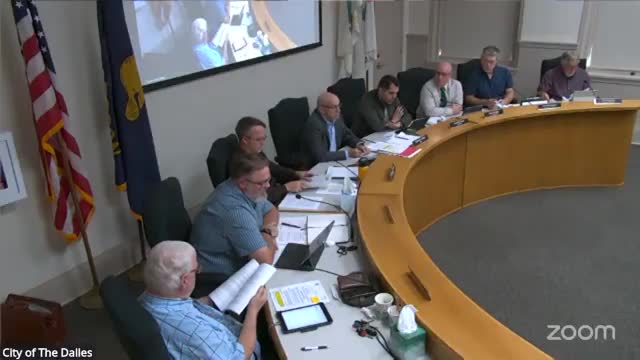
The Dalles City Council on Sept. 22 adopted a new ordinance rewriting local rules for mobile food vendors and transient merchants, keeping short-term permits in place while requiring vendors that operate at the same location long-term to secure a future land-use approval once the city adopts implementing standards. Councilors voted to adopt General Ordinance No. 25‑1419 by title only; Councilor Randall moved to adopt and Councilor Richardson seconded the motion, which carried.
Why it matters: The ordinance aims to clarify when mobile vendors may operate on private property, to carve out limited allowances for traditional right-of-way uses such as ice cream trucks, and to set a transition path so the city can create a clear land-use process for vendors who remain at a single site more than 12 months.
Under the ordinance, a type 2 license (a typical short-term mobile‑vendor permit) will be valid for 12 months and may be renewed; if the city has not adopted a land‑use procedure applicable to long‑term vendors by the time a vendor’s renewal would otherwise expire, the vendor may continue to obtain type 2 licenses until 12 months after the city adopts that land‑use standard. Staff told council that the ordinance takes effect 30 days after adoption (around Oct. 21) and that no new fees are created by this code change; the City cited ORS 294.160 in explaining fee-notice requirements and said fee-setting remains a separate, annual process.
Council and staff said the change is intended to be more business friendly than the older code while preserving the city’s authority over rights-of-way. Planning staff and the city attorney clarified that vendors remain prohibited from vending in public rights-of-way except for a limited ice-cream-truck carve-out; vendors that want permanent utility connections or additional seating will need to use the city’s land‑use process when that is adopted. Director Chandler said land‑use reviews are typically completed within 120 days after an application is deemed complete but noted the front‑end completeness review is often the longest part of the process.
Public comment and social service impacts: The ordinance hearing drew extended public comment about Bread and Blessings, a volunteer meal program that has operated downtown for years. Tracy Urege Zeman, who identified herself as affiliated with Bread and Blessings, told the council, “We don’t wanna work against the poor,” and asked the city to consider routes that do not further burden people who are unhoused. Teresa (no last name provided), a volunteer with the program, said she will continue feeding people and asked for support to find a usable site; she also described clients’ needs including meals, showers and laundry services.
Council response and next steps: Several councilors said they value Bread and Blessings’ work and urged the city and community partners to help find a safer, less disruptive site that is not downtown or in a residential neighborhood. Councilor Randall said he “will make a commitment … to assist in finding an appropriate spot” and later asked staff to engage with Bread and Blessings and relevant community partners; the city manager said staff has already been contacting potential partners and would continue outreach. No formal, binding relocation order was issued, and at least one councilor explicitly declined to direct staff by vote, saying outreach and advocacy are within the city manager’s discretion.
Details that matter: Staff said the city had just four active mobile‑vendor licenses when the topic was noticed to vendors earlier, and the proposed code makes several procedural changes intended to reduce administrative burden while protecting public safety and utility infrastructure. The ordinance also clarifies that vendors tied into city water or sewer could trigger land‑use review because of their permanent utility impacts.
What to watch: The council and staff said they intend to develop clearer, objective land‑use standards for long‑term vendor operations; that process will be separate from tonight’s ordinance and could take months. In the meantime, type 2 license holders who remain eligible will be allowed to renew under the transitional language in the ordinance until a land‑use standard is adopted.
Ending note: The council read the ordinance by title only and adopted it; staff and multiple councilors said they will pursue discussions with Bread and Blessings, Mid Columbia Community Action and other partners to explore suitable alternative locations and mitigation measures.
Why it matters: The ordinance aims to clarify when mobile vendors may operate on private property, to carve out limited allowances for traditional right-of-way uses such as ice cream trucks, and to set a transition path so the city can create a clear land-use process for vendors who remain at a single site more than 12 months.
Under the ordinance, a type 2 license (a typical short-term mobile‑vendor permit) will be valid for 12 months and may be renewed; if the city has not adopted a land‑use procedure applicable to long‑term vendors by the time a vendor’s renewal would otherwise expire, the vendor may continue to obtain type 2 licenses until 12 months after the city adopts that land‑use standard. Staff told council that the ordinance takes effect 30 days after adoption (around Oct. 21) and that no new fees are created by this code change; the City cited ORS 294.160 in explaining fee-notice requirements and said fee-setting remains a separate, annual process.
Council and staff said the change is intended to be more business friendly than the older code while preserving the city’s authority over rights-of-way. Planning staff and the city attorney clarified that vendors remain prohibited from vending in public rights-of-way except for a limited ice-cream-truck carve-out; vendors that want permanent utility connections or additional seating will need to use the city’s land‑use process when that is adopted. Director Chandler said land‑use reviews are typically completed within 120 days after an application is deemed complete but noted the front‑end completeness review is often the longest part of the process.
Public comment and social service impacts: The ordinance hearing drew extended public comment about Bread and Blessings, a volunteer meal program that has operated downtown for years. Tracy Urege Zeman, who identified herself as affiliated with Bread and Blessings, told the council, “We don’t wanna work against the poor,” and asked the city to consider routes that do not further burden people who are unhoused. Teresa (no last name provided), a volunteer with the program, said she will continue feeding people and asked for support to find a usable site; she also described clients’ needs including meals, showers and laundry services.
Council response and next steps: Several councilors said they value Bread and Blessings’ work and urged the city and community partners to help find a safer, less disruptive site that is not downtown or in a residential neighborhood. Councilor Randall said he “will make a commitment … to assist in finding an appropriate spot” and later asked staff to engage with Bread and Blessings and relevant community partners; the city manager said staff has already been contacting potential partners and would continue outreach. No formal, binding relocation order was issued, and at least one councilor explicitly declined to direct staff by vote, saying outreach and advocacy are within the city manager’s discretion.
Details that matter: Staff said the city had just four active mobile‑vendor licenses when the topic was noticed to vendors earlier, and the proposed code makes several procedural changes intended to reduce administrative burden while protecting public safety and utility infrastructure. The ordinance also clarifies that vendors tied into city water or sewer could trigger land‑use review because of their permanent utility impacts.
What to watch: The council and staff said they intend to develop clearer, objective land‑use standards for long‑term vendor operations; that process will be separate from tonight’s ordinance and could take months. In the meantime, type 2 license holders who remain eligible will be allowed to renew under the transitional language in the ordinance until a land‑use standard is adopted.
Ending note: The council read the ordinance by title only and adopted it; staff and multiple councilors said they will pursue discussions with Bread and Blessings, Mid Columbia Community Action and other partners to explore suitable alternative locations and mitigation measures.
Don't Miss a Word: See the Full Meeting!
Go beyond summaries. Unlock every video, transcript, and key insight with a Founder Membership.
✓
Get instant access to full meeting videos
✓
Search and clip any phrase from complete transcripts
✓
Receive AI-powered summaries & custom alerts
✓
Enjoy lifetime, unrestricted access to government data
30-day money-back guarantee
