Utah redistricting committee opens court-ordered mid-decade redraw, sets compressed schedule
September 22, 2025 | 2025 Utah Legislature, Utah Legislature, Utah Legislative Branch, Utah
This article was created by AI summarizing key points discussed. AI makes mistakes, so for full details and context, please refer to the video of the full meeting. Please report any errors so we can fix them. Report an error »
SALT LAKE CITY — The Legislative Redistricting Committee opened a court-ordered, mid-decade congressional redistricting process on Sept. 22, saying it will follow Proposition 4 standards after a court found the 2021 congressional map and the 2020 redistricting statute invalid. "We are doing this in compliance with the court's orders and under protest," Senator Bridal, co-chair of the committee, told members and the public at the start of the meeting.
The committee heard staff legal and technical briefings and agreed to a compressed calendar set by the district court and the lieutenant governor's office. Alan Houston, associate general counsel with the Office of Legislative Research and General Counsel, summarized the litigation history and the court deadlines that structure the process: the committee must post proposed map(s) for public comment by Oct. 6; the public comment period will be open through Oct. 5; parties will file maps with the court on Oct. 6; expert materials and briefs are due Oct. 17; parties may present evidence at a court hearing if necessary; proposed findings are due Oct. 28; and the court is expected to issue a final decision by Nov. 10 so the lieutenant governor can prepare for the 2026 election cycle.
The committee's legal staff described the immediate reason for the special schedule. Houston said the Utah Supreme Court revived a challenge to SB 200 (2020 redistricting amendments), and the district court subsequently enjoined the statute and the enacted 2021 congressional map, stating that Proposition 4 governs the current process. John Cannon, director of legislative research and general counsel and staff to the committee, clarified technical constraints: the committee will use Census 2020 population and the geographic snapshot from Jan. 1, 2020, agreed to by the litigation parties, and will aim for minimal population deviation — ideally zero — among the four congressional districts.
Committee chairs signaled they would take staff presentations and then reconvene for further public input and map consideration. Senator Bridal said the committee will hold a second meeting on Wednesday and expects to return in special session by Oct. 6 to vote on a map. The committee approved routine minutes from prior meetings at the outset; Representative Candace Perucci moved approval and the motion carried by voice vote. The committee recessed for a short break at the end of the session.
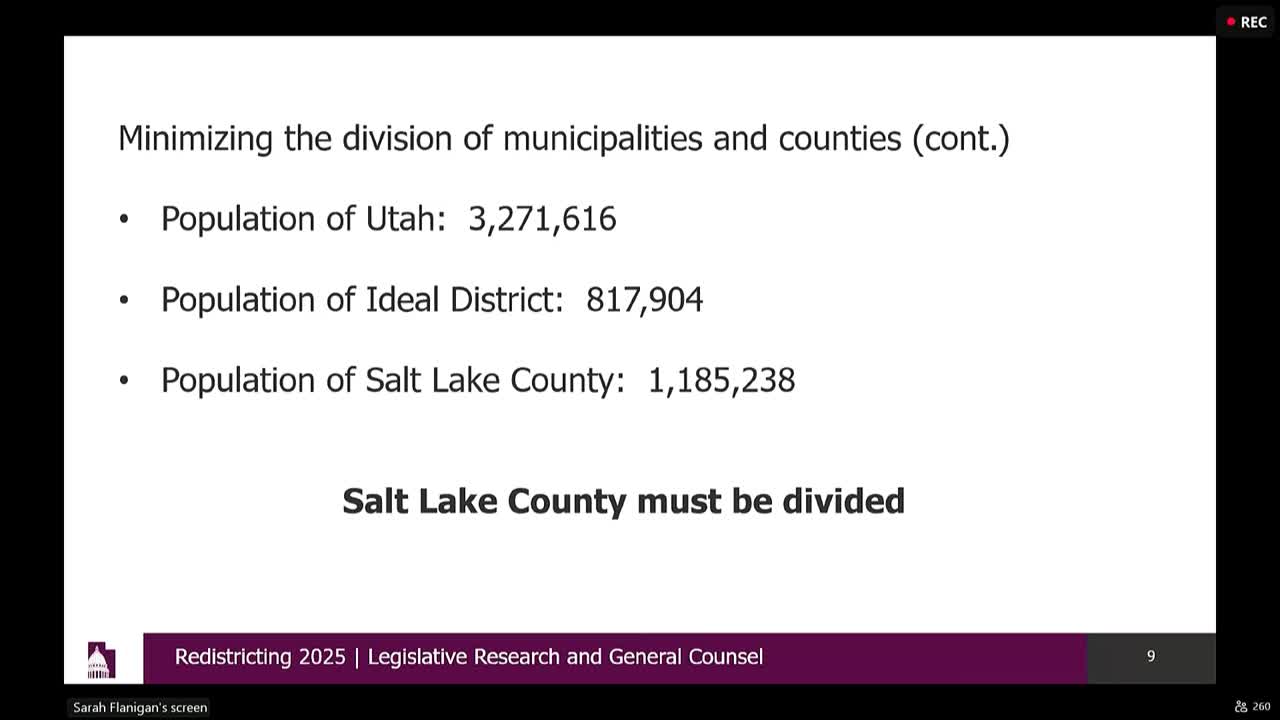
Why this matters: The court rulings removed the statute and map enacted after the 2020 census and required the Legislature to redraw congressional lines under Proposition 4, which prioritizes equal population and other locality-based standards and includes a prohibition on maps that “purposefully or unduly” favor a political party or incumbent. Because Utah has four congressional seats, staff emphasized the state’s constrained options: Salt Lake County’s population exceeds the ideal district size and so must be split under any lawful plan. The timing set by the court compresses public outreach and planning into a two-week window before the Oct. 6 filing deadline.
What happens next: Staff and external experts will produce map options that the committee will review; the committee will publicly post proposed map(s) and accept public comment during the court-ordered time frame. The committee’s work is structured by the court timetable and the requirement to apply Proposition 4’s ordered standards, including federal constitutional limits, municipal and county division minimization, compactness, contiguity, and consideration of communities of interest. "We will meet again on Wednesday," Senator Bridal said; "by Oct. 6 we will come back in special session and vote on a map."
The committee heard staff legal and technical briefings and agreed to a compressed calendar set by the district court and the lieutenant governor's office. Alan Houston, associate general counsel with the Office of Legislative Research and General Counsel, summarized the litigation history and the court deadlines that structure the process: the committee must post proposed map(s) for public comment by Oct. 6; the public comment period will be open through Oct. 5; parties will file maps with the court on Oct. 6; expert materials and briefs are due Oct. 17; parties may present evidence at a court hearing if necessary; proposed findings are due Oct. 28; and the court is expected to issue a final decision by Nov. 10 so the lieutenant governor can prepare for the 2026 election cycle.
The committee's legal staff described the immediate reason for the special schedule. Houston said the Utah Supreme Court revived a challenge to SB 200 (2020 redistricting amendments), and the district court subsequently enjoined the statute and the enacted 2021 congressional map, stating that Proposition 4 governs the current process. John Cannon, director of legislative research and general counsel and staff to the committee, clarified technical constraints: the committee will use Census 2020 population and the geographic snapshot from Jan. 1, 2020, agreed to by the litigation parties, and will aim for minimal population deviation — ideally zero — among the four congressional districts.
Committee chairs signaled they would take staff presentations and then reconvene for further public input and map consideration. Senator Bridal said the committee will hold a second meeting on Wednesday and expects to return in special session by Oct. 6 to vote on a map. The committee approved routine minutes from prior meetings at the outset; Representative Candace Perucci moved approval and the motion carried by voice vote. The committee recessed for a short break at the end of the session.
Why this matters: The court rulings removed the statute and map enacted after the 2020 census and required the Legislature to redraw congressional lines under Proposition 4, which prioritizes equal population and other locality-based standards and includes a prohibition on maps that “purposefully or unduly” favor a political party or incumbent. Because Utah has four congressional seats, staff emphasized the state’s constrained options: Salt Lake County’s population exceeds the ideal district size and so must be split under any lawful plan. The timing set by the court compresses public outreach and planning into a two-week window before the Oct. 6 filing deadline.
What happens next: Staff and external experts will produce map options that the committee will review; the committee will publicly post proposed map(s) and accept public comment during the court-ordered time frame. The committee’s work is structured by the court timetable and the requirement to apply Proposition 4’s ordered standards, including federal constitutional limits, municipal and county division minimization, compactness, contiguity, and consideration of communities of interest. "We will meet again on Wednesday," Senator Bridal said; "by Oct. 6 we will come back in special session and vote on a map."
Don't Miss a Word: See the Full Meeting!
Go beyond summaries. Unlock every video, transcript, and key insight with a Founder Membership.
✓
Get instant access to full meeting videos
✓
Search and clip any phrase from complete transcripts
✓
Receive AI-powered summaries & custom alerts
✓
Enjoy lifetime, unrestricted access to government data
30-day money-back guarantee
