Committee debate centers on defining 'partisan symmetry' test as sponsor seeks statutory standard
September 22, 2025 | 2025 Utah Legislature, Utah Legislature, Utah Legislative Branch, Utah
This article was created by AI summarizing key points discussed. AI makes mistakes, so for full details and context, please refer to the video of the full meeting. Please report any errors so we can fix them. Report an error »
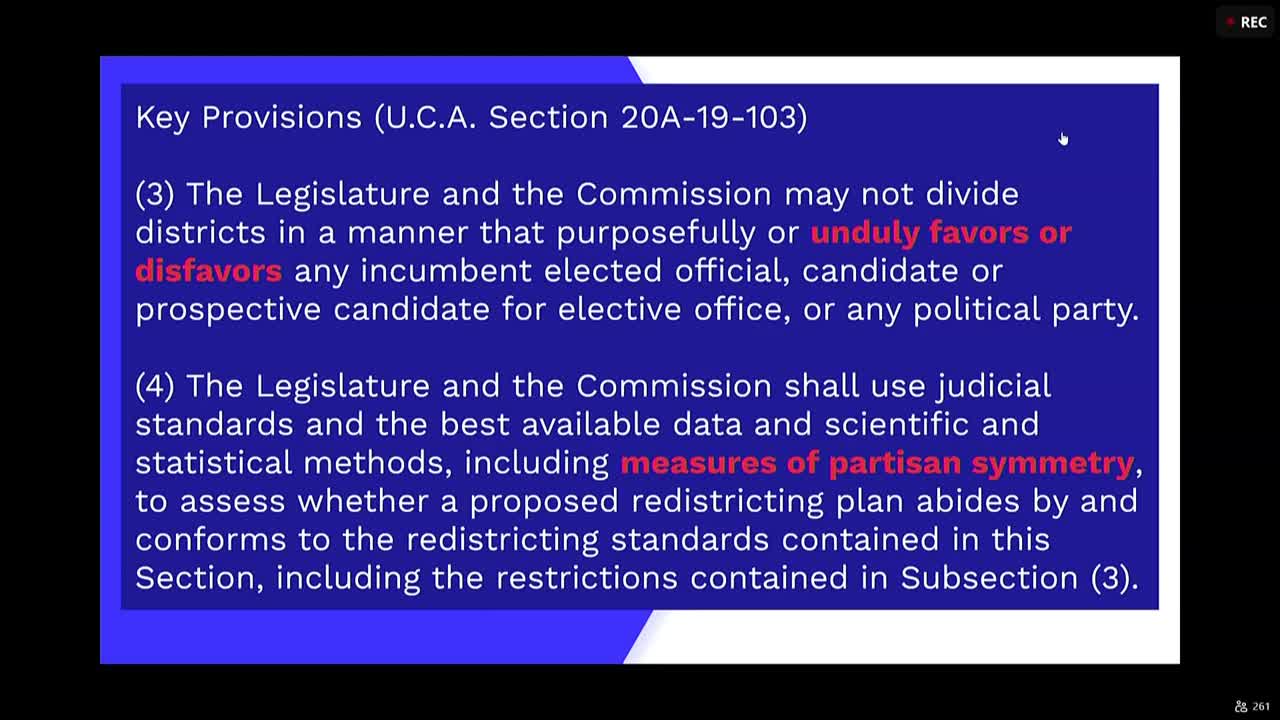
SALT LAKE CITY — The Legislative Redistricting Committee devoted significant discussion on Sept. 22 to how the Legislature should satisfy Proposition 4's prohibition on maps that "purposefully or unduly" favor a political party or incumbent. Senator Brammer introduced a bill file intended to define which statistical and judicial standards the Legislature will use to assess partisan symmetry; the committee did not take action on the file.
"We're trying to provide some clarity for the courts," Senator Brammer said as he described the statutory language he is proposing to guide the partisan-symmetry analysis. Michael Curtis, one of the committee attorneys, summarized the statutory requirement: partisan political data may not be considered in map creation except to run a post hoc analysis using "measures of partisan symmetry" and other scientific methods. "Partisan information in any form can't be considered in compiling a plan," Curtis said, "but after the map is complete, an analysis has to be run to ensure that we haven't purposefully or unduly favored or disfavored."
Several members urged the committee to consider multiple measures rather than codifying a single test. Senator Escamilla and Representative Doug Owens pressed the point that Proposition 4 mentions "scientific and statistical methods, including measures of partisan symmetry," and that the statute's language was deliberately broad. "Prop 4 was very clear that there is more than just partisan symmetry," Escamilla said. Representative Owens warned that starting with a single defined test could be perceived as narrowing the voters' initiative and might raise optics or legal questions.
Supporters of a focused statutory test argued that courts need a workable, administrable standard to evaluate compliance and to reduce litigation over methodology. Senator Brammer said a clear standard would prevent continual litigation where courts must resolve dueling expert analyses: "If you don't have a standard, you're guaranteeing every single instance has to go to court," he said.
Committee counsel discussed several candidate statistical approaches and their strengths and limits in a four-district state. Counsel and outside experts noted that some widely discussed metrics — for example, the efficiency gap — perform poorly in states with only a few congressional seats. Staff said the partisan-bias (symmetry) measure is the direct formulation of partisan symmetry and that other tests (mean-median, declination) have distinct properties and trade-offs. Committee chairs said no vote would be taken in the Sept. 22 meeting and that members would return for further review.
Why this matters: Proposition 4 requires both an intent and an effect analysis for partisan fairness and instructs the Legislature to use the best available data and scientific methods. How the Legislature defines those methods — and whether it adopts one primary test or several — will influence which proposed maps pass the statutory standard and how much evidence a court will consider in any challenge.
What happened next: The committee held the discussion for information only and did not vote on the bill file. Staff and counsel said technical analyses of proposed maps will be run outside the committee's view to avoid exposing legislators to partisan data during map creation; the tests will be applied after a proposed map is drawn. "You can't do that purposely," counsel said of partisan advantage, "you also can't do that unduly — intent and results matter."
"We're trying to provide some clarity for the courts," Senator Brammer said as he described the statutory language he is proposing to guide the partisan-symmetry analysis. Michael Curtis, one of the committee attorneys, summarized the statutory requirement: partisan political data may not be considered in map creation except to run a post hoc analysis using "measures of partisan symmetry" and other scientific methods. "Partisan information in any form can't be considered in compiling a plan," Curtis said, "but after the map is complete, an analysis has to be run to ensure that we haven't purposefully or unduly favored or disfavored."
Several members urged the committee to consider multiple measures rather than codifying a single test. Senator Escamilla and Representative Doug Owens pressed the point that Proposition 4 mentions "scientific and statistical methods, including measures of partisan symmetry," and that the statute's language was deliberately broad. "Prop 4 was very clear that there is more than just partisan symmetry," Escamilla said. Representative Owens warned that starting with a single defined test could be perceived as narrowing the voters' initiative and might raise optics or legal questions.
Supporters of a focused statutory test argued that courts need a workable, administrable standard to evaluate compliance and to reduce litigation over methodology. Senator Brammer said a clear standard would prevent continual litigation where courts must resolve dueling expert analyses: "If you don't have a standard, you're guaranteeing every single instance has to go to court," he said.
Committee counsel discussed several candidate statistical approaches and their strengths and limits in a four-district state. Counsel and outside experts noted that some widely discussed metrics — for example, the efficiency gap — perform poorly in states with only a few congressional seats. Staff said the partisan-bias (symmetry) measure is the direct formulation of partisan symmetry and that other tests (mean-median, declination) have distinct properties and trade-offs. Committee chairs said no vote would be taken in the Sept. 22 meeting and that members would return for further review.
Why this matters: Proposition 4 requires both an intent and an effect analysis for partisan fairness and instructs the Legislature to use the best available data and scientific methods. How the Legislature defines those methods — and whether it adopts one primary test or several — will influence which proposed maps pass the statutory standard and how much evidence a court will consider in any challenge.
What happened next: The committee held the discussion for information only and did not vote on the bill file. Staff and counsel said technical analyses of proposed maps will be run outside the committee's view to avoid exposing legislators to partisan data during map creation; the tests will be applied after a proposed map is drawn. "You can't do that purposely," counsel said of partisan advantage, "you also can't do that unduly — intent and results matter."
View the Full Meeting & All Its Details
This article offers just a summary. Unlock complete video, transcripts, and insights as a Founder Member.
✓
Watch full, unedited meeting videos
✓
Search every word spoken in unlimited transcripts
✓
AI summaries & real-time alerts (all government levels)
✓
Permanent access to expanding government content
30-day money-back guarantee
